Department of Oncology, Military Institute of Medicine in Warsaw, Warsaw, Poland.
Cancer Biol Ther. 2012 Nov;13(13):1235-43. doi: 10.4161/cbt.21813. Epub 2012 Aug 22.
CRC caused more than 600,000 estimated deaths in 2008. Dysregulated signaling through the RAS/RAF/mitogen-activated protein kinase (MEK)/extracellular signal-regulated kinase (ERK) signaling pathway due to mutations in K-Ras and B-Raf are common events in CRC.
Incidence of mutations in codons 12 and 13 of K-Ras and exons 11 and 15 of B-Raf were analyzed in amplified PCR products from primary tumors of 273 patients with CRC, and their prognostic and predictive significance was assessed. The prognostic role of clinical and pathological factors was also examined.
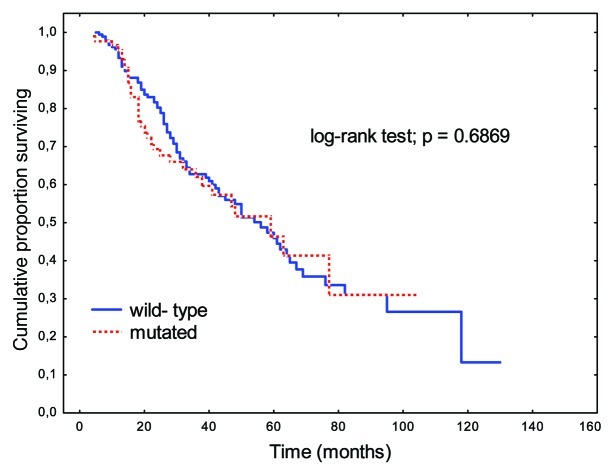
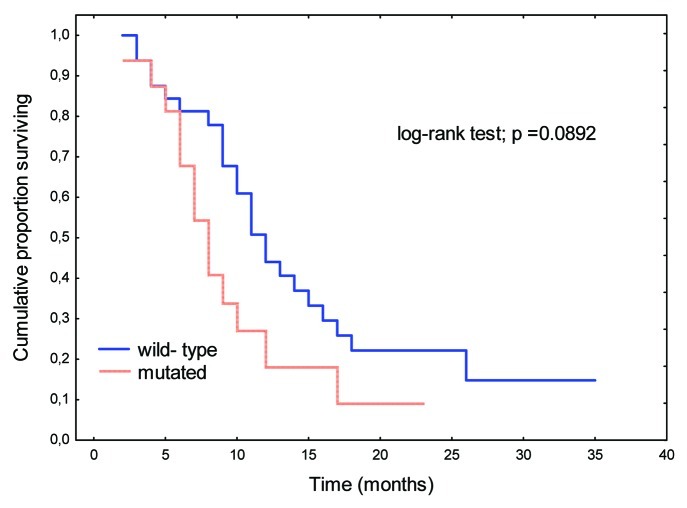
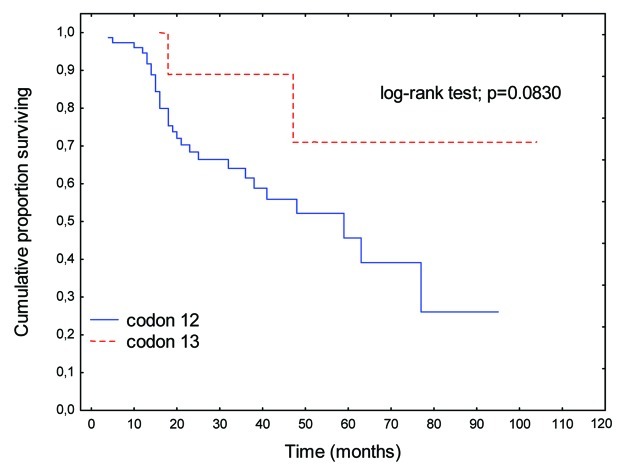
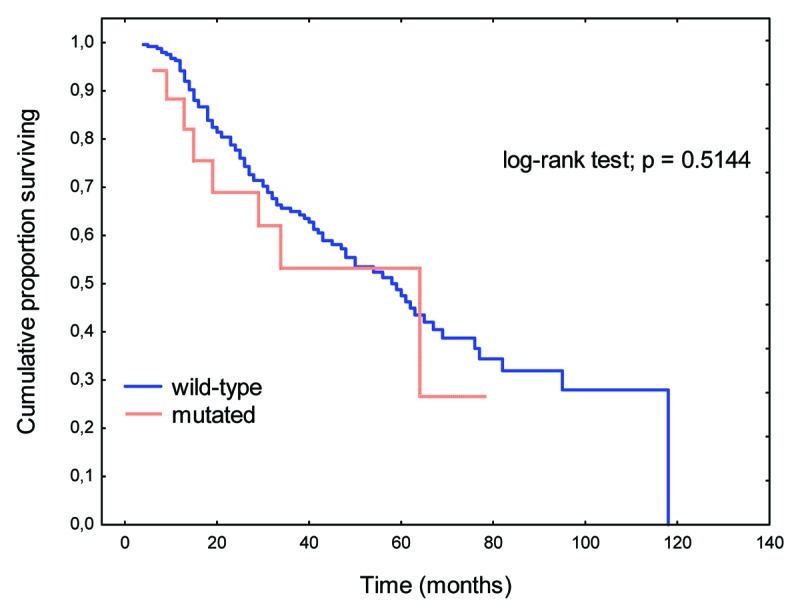
K-Ras mutations were present in 89 patients (32.6%), of whom 76 (85.4%) had mutations in codon 12 and 10 (11.2%) had mutations in codon 13. B-Raf gene mutations were present in 17 patients (6.9%), of whom 6 (35.3%) had mutations in exon 15. Multivariate analysis revealed a predictive significance for K-Ras mutations with respect to time to progression in patients treated with irinotecan and oxaliplatin as first-line chemotherapy. There was no predictive significance for B-Raf gene mutation status in these patients. The following risk factors were found to affect overall survival (OS) rates: primary tumor location, lymph node involvement grade, carcinoembryonic antigen (CEA) level before treatment, and performance status according to WHO criteria.
Based on the results of this study, K-Ras mutation status may be a suitable indicator of patient eligibility and a prognostic indicator for responsiveness to anti-EGFR therapy alone, or in combination with chemotherapy. Also, K-Ras mutation status may predict time to progression in patients treated with irinotecan and oxaliplatin.
CRC 在 2008 年导致了超过 600,000 人死亡的估计人数。由于 K-Ras 和 B-Raf 中的突变,RAS/RAF/丝裂原活化蛋白激酶(MEK)/细胞外信号调节激酶(ERK)信号通路的信号失调是 CRC 中的常见事件。
分析了 273 例 CRC 患者的原发肿瘤中 K-Ras 密码子 12 和 13 以及 B-Raf 外显子 11 和 15 的扩增 PCR 产物中的突变发生率,并评估了其预后和预测意义。还检查了临床和病理因素的预后作用。
89 例患者(32.6%)存在 K-Ras 突变,其中 76 例(85.4%)存在密码子 12 突变,10 例(11.2%)存在密码子 13 突变。17 例患者(6.9%)存在 B-Raf 基因突变,其中 6 例(35.3%)存在外显子 15 突变。多变量分析显示,对于接受伊立替康和奥沙利铂作为一线化疗的患者,K-Ras 突变与进展时间具有预测意义。在这些患者中,B-Raf 基因突变状态没有预测意义。发现以下危险因素会影响总生存率(OS):原发肿瘤位置、淋巴结受累程度、治疗前癌胚抗原(CEA)水平以及根据 WHO 标准的表现状态。
基于这项研究的结果,K-Ras 突变状态可能是患者适合性的合适指标,也是单独使用抗 EGFR 治疗或联合化疗的反应性的预后指标。此外,K-Ras 突变状态可能预测接受伊立替康和奥沙利铂治疗的患者的进展时间。