Lineberger Comprehensive Cancer Center and Department of Pharmacology, University of North Carolina at Chapel Hill, Chapel Hill, North Carolina, United States of America.
PLoS One. 2012;7(7):e41876. doi: 10.1371/journal.pone.0041876. Epub 2012 Jul 24.
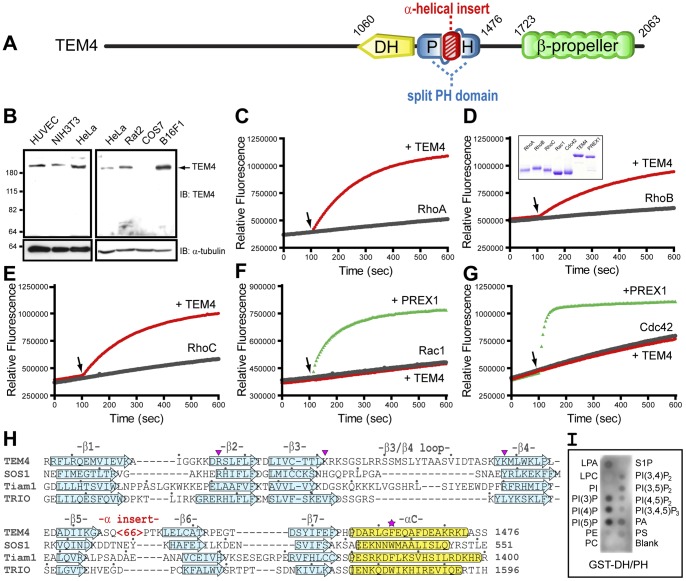
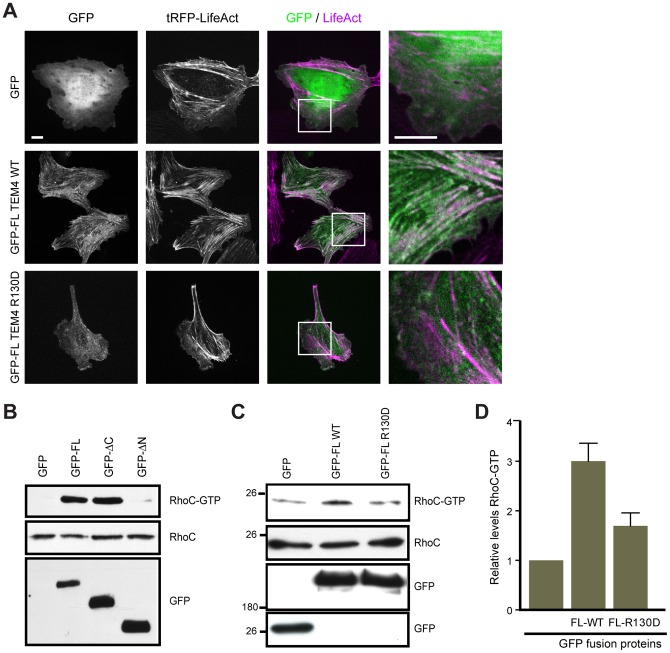
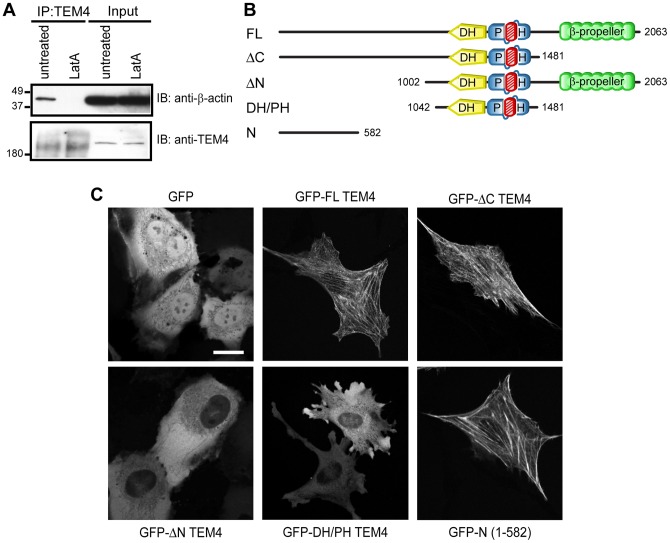
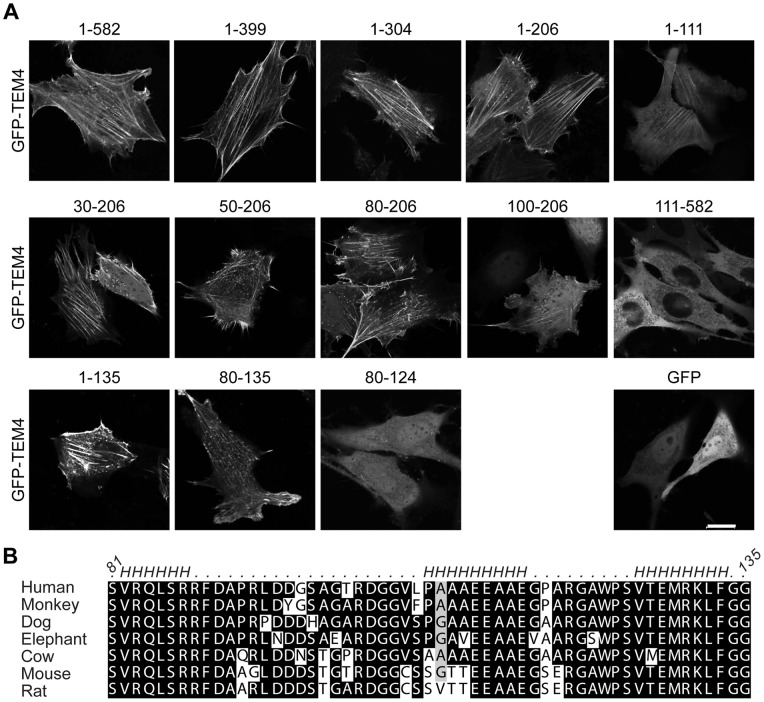
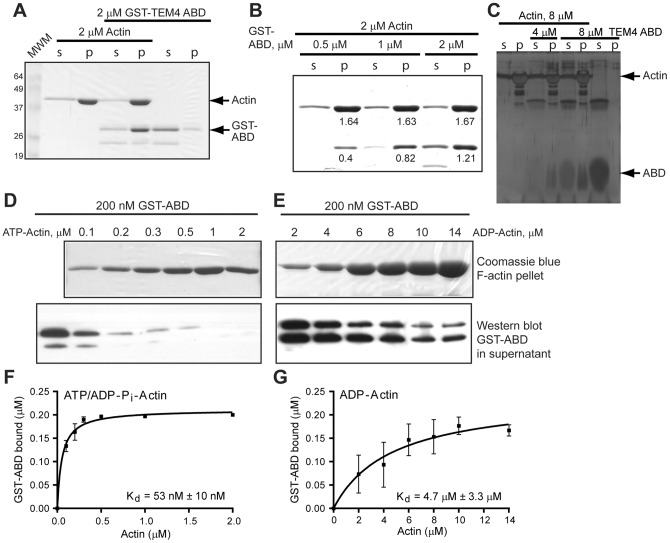
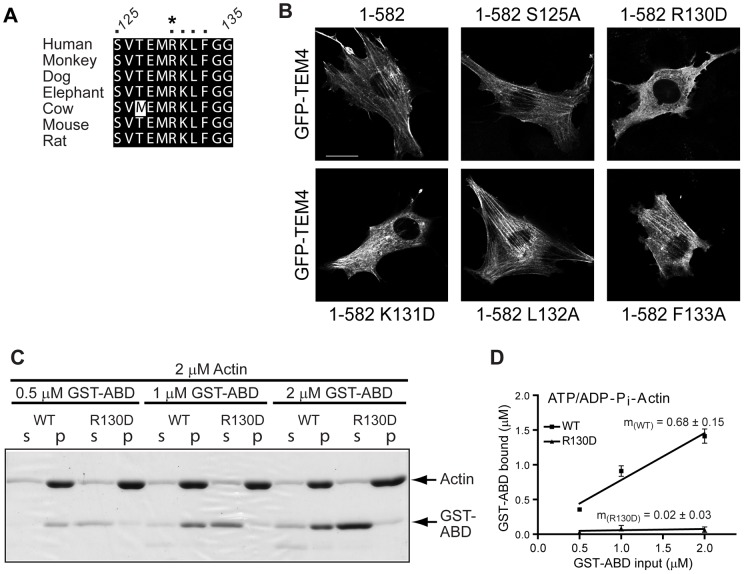
Spatio-temporal activation of Rho GTPases is essential for their function in a variety of biological processes and is achieved in part by regulating the localization of their activators, the Rho guanine nucleotide exchange factors (RhoGEFs). In this study, we provide the first characterization of the full-length protein encoded by RhoGEF TEM4 and delineate its domain structure, catalytic activity, and subcellular localization. First, we determined that TEM4 can stimulate guanine nucleotide exchange on RhoA and the related RhoB and RhoC isoforms. Second, we determined that TEM4, like other Dbl RhoGEFs, contains a functional pleckstrin homology (PH) domain immediately C-terminal to the catalytic Dbl homology (DH) domain. Third, using immunofluorescence analysis, we showed that TEM4 localizes to the actin cytoskeleton through sequences in the N-terminus of TEM4 independently of the DH/PH domains. Using site-directed mutagenesis and deletion analysis, we identified a minimal region between residues 81 and 135 that binds directly to F-actin and has an ∼90-fold higher affinity for ATP-loaded F-actin. Finally, we demonstrated that a single point mutation (R130D) within full-length TEM4 abolishes actin binding and localization of TEM4 to the actin cytoskeleton, as well as dampens the in vivo activity of TEM4 towards RhoC. Taken together, our data demonstrate that TEM4 contains a novel actin binding domain and binding to actin is essential for TEM4 subcellular localization and activity. The unique subcellular localization of TEM4 suggests a spatially-restricted activity and expands the diversity of mechanisms by which RhoGEF function can be regulated.
Rho GTPases 的时空激活对于它们在各种生物过程中的功能至关重要,部分是通过调节其激活剂(Rho 鸟苷酸交换因子(RhoGEFs))的定位来实现的。在这项研究中,我们首次对 RhoGEF TEM4 编码的全长蛋白进行了表征,并描绘了其结构域结构、催化活性和亚细胞定位。首先,我们确定 TEM4 可以刺激 RhoA 以及相关的 RhoB 和 RhoC 同工型的鸟苷酸交换。其次,我们确定 TEM4,像其他 Dbl RhoGEFs 一样,在催化 Dbl 同源(DH)结构域的 C 端含有一个功能结构域的pleckstrin 同源(PH)结构域。第三,通过免疫荧光分析,我们表明 TEM4 通过 TEM4 N 端的序列独立于 DH/PH 结构域定位到肌动蛋白细胞骨架。通过定点突变和缺失分析,我们确定了一个位于残基 81 到 135 之间的最小区域,该区域可以直接与 F-肌动蛋白结合,并且对 ATP 加载的 F-肌动蛋白的亲和力约高 90 倍。最后,我们证明了全长 TEM4 内的单个点突变(R130D)会破坏 TEM4 与肌动蛋白的结合以及 TEM4 向肌动蛋白细胞骨架的定位,并削弱 TEM4 对 RhoC 的体内活性。总之,我们的数据表明 TEM4 含有一个新的肌动蛋白结合结构域,并且与肌动蛋白的结合对于 TEM4 的亚细胞定位和活性至关重要。TEM4 的独特亚细胞定位表明其具有空间限制的活性,并扩展了 RhoGEF 功能可以被调节的机制的多样性。