Programa de Pós-Graduação em Imunologia Básica e Aplicada, Instituto de Ciências Biológicas, Universidade Federal do Amazonas, Manaus, Brasil.
PLoS One. 2012;7(8):e41588. doi: 10.1371/journal.pone.0041588. Epub 2012 Aug 13.
Rheumatoid Arthritis (RA) is an autoimmune disease characterized by chronic inflammation of the joints that affects approximately 1% of the population worldwide. The HLA-DRB1 gene locus plays a major role in genetic susceptibility to RA, a condition that has been associated with a high cardiovascular morbidity and mortality in many studies.
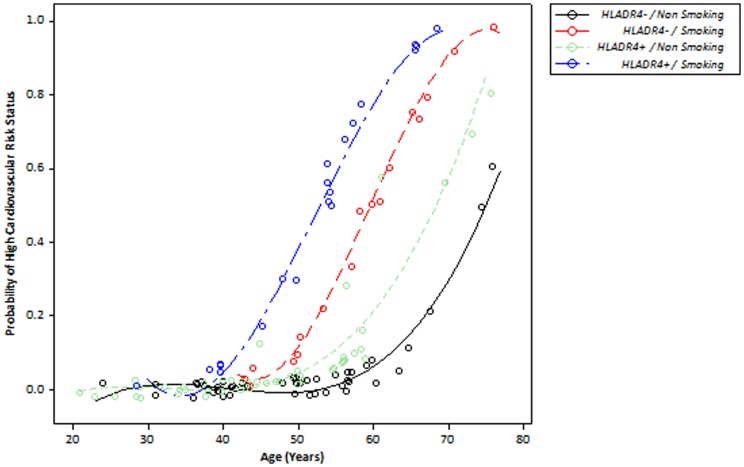
METHODOLOGY/PRINCIPAL FINDINGS: The aim of this work was to investigate which types of HLA class II genes are associated with RA in patients from the Brazilian Amazon and their influence on high cardiovascular risk status in this population. For this purpose, a case-control study was carried out with a total of 350 non-Indian individuals made up of a cohort of 132 consecutive RA sufferers and 218 healthy controls. A χ(2) test showed that HLADRB104 (p<0.0016; OR = 1.89; 95% CI = 1.29-2.79) and HLADRB110 (p = 0.0377; OR = 3.81; 95% CI = 1.16-12.50) are the major HLA genes associated with susceptibility to RA. A logistic regression model also showed that the interaction between HLADRB1*04 (p = 0.027; OR = 6.02; 95% CI = 1.21-29.7), age (p = 0.0001; OR = 1.26; 95% CI = 1.13-1.39) and smoking (p = 0.0001; OR = 23.6; 95% CI = 4.25-32.1) is associated with a probability of a high cardiovascular risk status at an early age.
CONCLUSIONS/SIGNIFICANCE: The results of this study show for the first time that HLA class II type is associated with RA in Brazilian Amazon populations and that a specific interaction between the HLA-DRB1*04 gene and smoking is associated with a high cardiovascular risk status, as initially reported in the European population. This study therefore contributes to an understanding of gene-environment interactions in RA patients.
类风湿关节炎(RA)是一种以关节慢性炎症为特征的自身免疫性疾病,影响全球约 1%的人口。HLA-DRB1 基因座在 RA 的遗传易感性中起主要作用,许多研究表明,RA 与心血管疾病发病率和死亡率高有关。
方法/主要发现:本研究的目的是调查在来自巴西亚马逊地区的患者中,哪些类型的 HLA Ⅱ类基因与 RA 相关,以及这些基因在该人群中是否与高心血管风险状态有关。为此,进行了一项病例对照研究,共纳入 350 名非印第安人,其中包括 132 名连续的 RA 患者队列和 218 名健康对照。卡方检验显示,HLADRB104(p<0.0016;OR=1.89;95%CI=1.29-2.79)和 HLADRB110(p=0.0377;OR=3.81;95%CI=1.16-12.50)是与 RA 易感性相关的主要 HLA 基因。逻辑回归模型也显示,HLADRB1*04 之间的相互作用(p=0.027;OR=6.02;95%CI=1.21-29.7)、年龄(p=0.0001;OR=1.26;95%CI=1.13-1.39)和吸烟(p=0.0001;OR=23.6;95%CI=4.25-32.1)与年轻时发生高心血管风险状态的概率相关。
结论/意义:本研究结果首次表明,HLA Ⅱ类在巴西亚马逊地区人群中与 RA 相关,并且 HLA-DRB1*04 基因与吸烟之间的特定相互作用与高心血管风险状态相关,这与最初在欧洲人群中报道的结果一致。因此,本研究有助于理解 RA 患者的基因-环境相互作用。