Karolinska Institutet, Stockholm, Sweden.
Uppsala University, Uppsala, Sweden.
Arthritis Rheumatol. 2019 Sep;71(9):1504-1511. doi: 10.1002/art.40852. Epub 2019 Jul 24.
Smoking is associated with an increased risk of rheumatoid arthritis (RA) in subsets of patients defined according to the presence or absence of anti-citrullinated protein antibodies (ACPAs) and rheumatoid factors (RFs). Moreover, an interaction between smoking and the HLA-DRB1 shared epitope (SE) has been demonstrated to be a risk factor for seropositive RA. The aim of this study was to investigate the interplay between smoking and the HLA-DRB1 SE with regard to risk of RA in different patient subsets based on ACPA and RF status.
Incident cases of RA (3,645 cases, 5,883 matched controls) were divided into 4 subgroups based on the presence or absence of RF and anti-cyclic citrullinated peptide 2 (anti-CCP2) antibodies. The influence of smoking on the risk of disease was determined in each RA subgroup, using logistic regression models with calculation of odds ratios and 95% confidence intervals (95% CIs). The potential interaction between smoking and HLA-DRB1 SE genes was evaluated by calculating the attributable proportion due to interaction (AP).
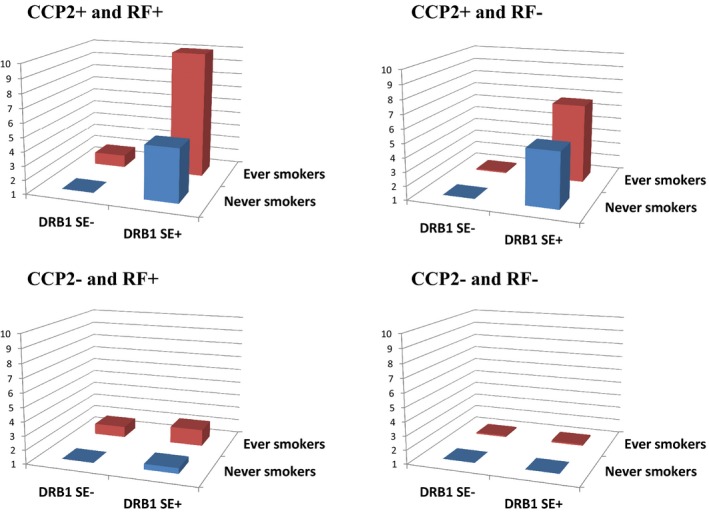
In the RF+/anti-CCP2+ subset of RA patients, both smoking and the presence of the HLA-DRB1 SE conferred independent disease risks, and there was a strong interaction between the 2 risk factors (AP 0.4, 95% CI 0.3, 0.5). In the RF-/anti-CCP2+ patient subset, the HLA-DRB1 SE conferred an increased risk of RA, whereas the independent influence of smoking was limited. However, there was a significant interaction between the HLA-DRB1 SE and smoking (AP 0.2, 95% CI 0.02, 0.5). In the RF+/anti-CCP2- patient subset, there was an increased risk of disease among smokers, which was only marginally affected by the presence of the HLA-DRB1 SE, and no interaction between the 2 factors was observed (AP 0.002, 95% CI -0.3, 0.3). In the RF-/anti-CCP2- patient subset, neither smoking nor the presence of the HLA-DRB1 SE conferred an increased risk of RA.
These findings demonstrate different effects of smoking and HLA-DRB1 in the 4 serologically defined RA subsets.
吸烟与类风湿关节炎(RA)风险增加有关,这种相关性在根据是否存在抗瓜氨酸蛋白抗体(ACPAs)和类风湿因子(RFs)来定义的患者亚组中更为明显。此外,吸烟与人类白细胞抗原-DRB1 共享表位(SE)之间的相互作用已被证明是血清阳性 RA 的危险因素。本研究旨在根据 ACPA 和 RF 状态,探讨吸烟与 HLA-DRB1 SE 之间在不同患者亚组中对 RA 风险的相互作用。
将 RA(3645 例病例,5883 例匹配对照)的新发病例分为 4 个亚组,根据是否存在 RF 和抗环瓜氨酸肽 2(抗-CCP2)抗体。在每个 RA 亚组中,使用 logistic 回归模型计算比值比和 95%置信区间(95%CI)来确定吸烟对疾病风险的影响。通过计算归因比例(AP)来评估吸烟和 HLA-DRB1 SE 基因之间的潜在相互作用。
在 RF+/抗-CCP2+的 RA 患者亚组中,吸烟和 HLA-DRB1 SE 的存在均独立地增加了疾病风险,并且这两个危险因素之间存在强烈的相互作用(AP 0.4,95%CI 0.3,0.5)。在 RF-/抗-CCP2+患者亚组中,HLA-DRB1 SE 增加了 RA 的发病风险,而吸烟的独立影响有限。然而,HLA-DRB1 SE 和吸烟之间存在显著的相互作用(AP 0.2,95%CI 0.02,0.5)。在 RF+/抗-CCP2-的患者亚组中,吸烟者的疾病风险增加,但 HLA-DRB1 SE 的存在对其影响有限,且两个因素之间没有观察到相互作用(AP 0.002,95%CI -0.3,0.3)。在 RF-/抗-CCP2-的患者亚组中,吸烟或 HLA-DRB1 SE 的存在均未增加 RA 的发病风险。
这些发现表明吸烟和 HLA-DRB1 在四个血清学定义的 RA 亚组中具有不同的作用。