Tuberculosis Control Department, Pham Ngoc Thach Hospital, Ho Chi Minh City, Vietnam.
PLoS One. 2012;7(8):e42323. doi: 10.1371/journal.pone.0042323. Epub 2012 Aug 13.
Studies have shown that the Mycobacterium tuberculosis Beijing genotype is an emerging pathogen that is frequently associated with drug resistance. This suggests that drug resistant Beijing strains have a relatively high transmission fitness compared to other drug-resistant strains.
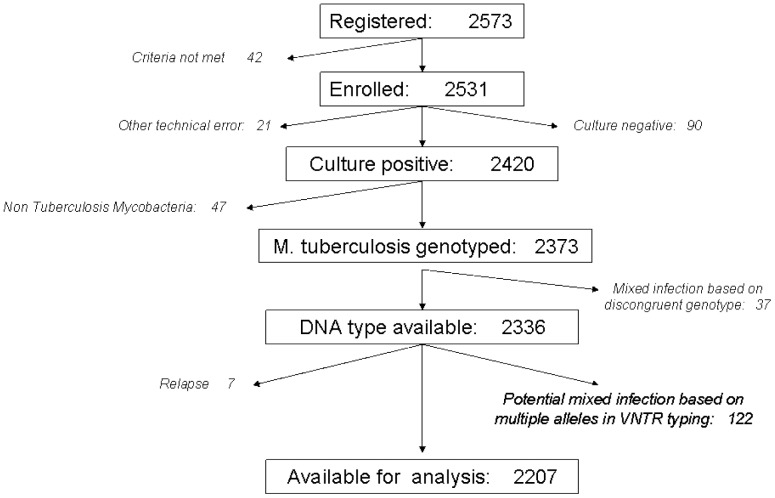
We studied the relative transmission fitness of the Beijing genotype in relation to anti-tuberculosis drug resistance in a population-based study of smear-positive tuberculosis patients prospectively recruited and studied over a 4-year period in rural Vietnam. Transmission fitness was analyzed by clustering of cases on basis of three DNA typing methods. Of 2531 included patients, 2207 (87%) were eligible for analysis of whom 936 (42%) were in a DNA fingerprint cluster. The clustering rate varied by genotype with 292/786 (37%) for the Beijing genotype, 527/802 (67%) for the East-African Indian (EAI) genotype, and 117/619 (19%) for other genotypes. Clustering was associated with the EAI compared to the Beijing genotype (adjusted odds ratio (OR(adj)) 3.4: 95% CI 2.8-4.4). Patients infected with streptomycin-resistant strains were less frequently clustered than patients infected with streptomycin-susceptible strains when these were of the EAI genotype (OR(adj) 0.6, 95% CI 0.4-0.9), while this pattern was reversed for strains of the Beijing genotype (OR(adj) 1.3, 95% CI 1.0-1.8, p for difference 0.002). The strong association between Beijing and MDR-TB (OR(adj) 7.2; 95% CI 4.2-12.3) existed only if streptomycin resistance was present.
Beijing genotype strains showed less overall transmissibility than EAI strains, but when comparisons were made within genotypes, Beijing strains showed increased transmission fitness when streptomycin-resistant, while the reverse was observed for EAI strains. The association between MDR-TB and Beijing genotype in this population was strongly dependent on resistance to streptomycin. Streptomycin resistance may provide Beijing strains with a fitness advantage over other genotypes and predispose to multidrug resistance in patients infected with Beijing strains.
研究表明,结核分枝杆菌北京基因型是一种新兴的病原体,常与耐药性相关。这表明,耐药性北京株相对于其他耐药株具有相对较高的传播适应性。
我们在越南农村进行了一项基于人群的前瞻性研究,对 2531 例涂阳肺结核患者进行了研究,根据三种 DNA 分型方法对病例进行聚类,以研究北京基因型与抗结核药物耐药性之间的相对传播适应性。2531 例患者中,2207 例(87%)符合分析条件,其中 936 例(42%)存在 DNA 指纹聚类。聚类率因基因型而异,北京基因型为 292/786(37%),东非-印度型(EAI)基因型为 527/802(67%),其他基因型为 117/619(19%)。与北京基因型相比,EAI 基因型的聚类率更高(调整比值比(OR(adj))为 3.4:95%CI 2.8-4.4)。当这些菌株为 EAI 基因型时,感染链霉素耐药株的患者比感染链霉素敏感株的患者聚类频率更低(调整比值比(OR(adj))为 0.6,95%CI 0.4-0.9),而北京基因型菌株的模式则相反(调整比值比(OR(adj))为 1.3,95%CI 1.0-1.8,p 差值为 0.002)。只有当存在链霉素耐药性时,北京基因型菌株与 MDR-TB(调整比值比(OR(adj))为 7.2;95%CI 4.2-12.3)之间才存在强烈关联。
北京基因型菌株的总体传播能力低于 EAI 菌株,但在比较基因型内时,链霉素耐药的北京菌株的传播适应性增加,而 EAI 菌株则相反。该人群中 MDR-TB 与北京基因型之间的关联强烈依赖于链霉素耐药性。链霉素耐药性可能使北京菌株相对于其他基因型具有适应性优势,并使感染北京菌株的患者易发生耐多药。