Devaux Isabelle, Kremer Kristin, Heersma Herre, Van Soolingen Dick
European Centre for Disease Prevention and Control, Stockholm, Sweden.
Emerg Infect Dis. 2009 Jul;15(7):1052-60. doi: 10.3201/eid1507.080994.
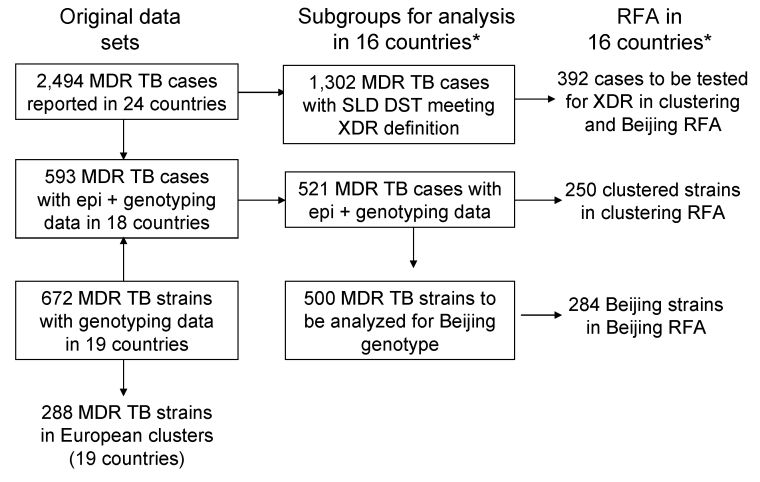
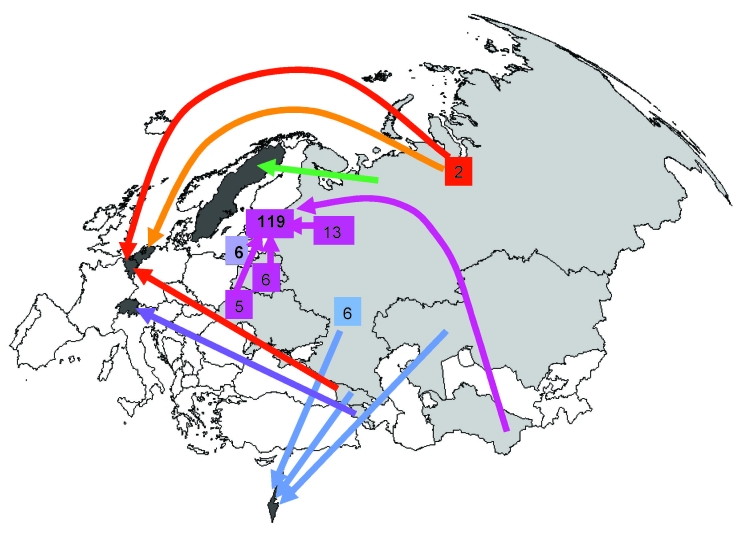
Molecular surveillance of multidrug-resistant tuberculosis (MDR TB) was implemented in Europe as case reporting in 2005. For all new MDR TB cases detected from January 2003 through June 2007, countries reported case-based epidemiologic data and DNA fingerprint patterns of MDR TB strains when available. International clusters were detected and analyzed. From 2003 through mid-2007 in Europe, 2,494 cases of MDR TB were reported from 24 European countries. Epidemiologic and molecular data were linked for 593 (39%) cases, and 672 insertion sequence 6110 DNA fingerprint patterns were reported from 19 countries. Of these patterns, 288 (43%) belonged to 18 European clusters; 7 clusters (242/288 cases, 84%) were characterized by strains of the Beijing genotype family, including the largest cluster (175/288 cases, 61%). Both clustering and the Beijing genotype were associated with strains originating in eastern European countries. Molecular cluster detection contributes to identification of transmission profile, risk factors, and control measures.
2005年,欧洲开始实施耐多药结核病(MDR-TB)的分子监测,以病例报告的形式开展。对于2003年1月至2007年6月期间发现的所有新发耐多药结核病病例,各国在有相关数据时上报基于病例的流行病学数据以及耐多药结核菌株的DNA指纹图谱。对国际聚集性病例进行了检测和分析。2003年至2007年年中,欧洲24个国家报告了2494例耐多药结核病病例。593例(39%)病例的流行病学和分子数据相关联,19个国家报告了672种插入序列6110 DNA指纹图谱。在这些图谱中,288种(43%)属于18个欧洲聚集性病例;7个聚集性病例(242/288例,84%)的特征是北京基因型家族的菌株,其中包括最大的聚集性病例(175/288例,61%)。聚集性病例和北京基因型均与源自东欧国家的菌株有关。分子聚集性病例检测有助于确定传播情况、危险因素和控制措施。