Department of Pediatrics, University of California San Diego, La Jolla, California, United States of America.
PLoS One. 2012;7(8):e42984. doi: 10.1371/journal.pone.0042984. Epub 2012 Aug 13.
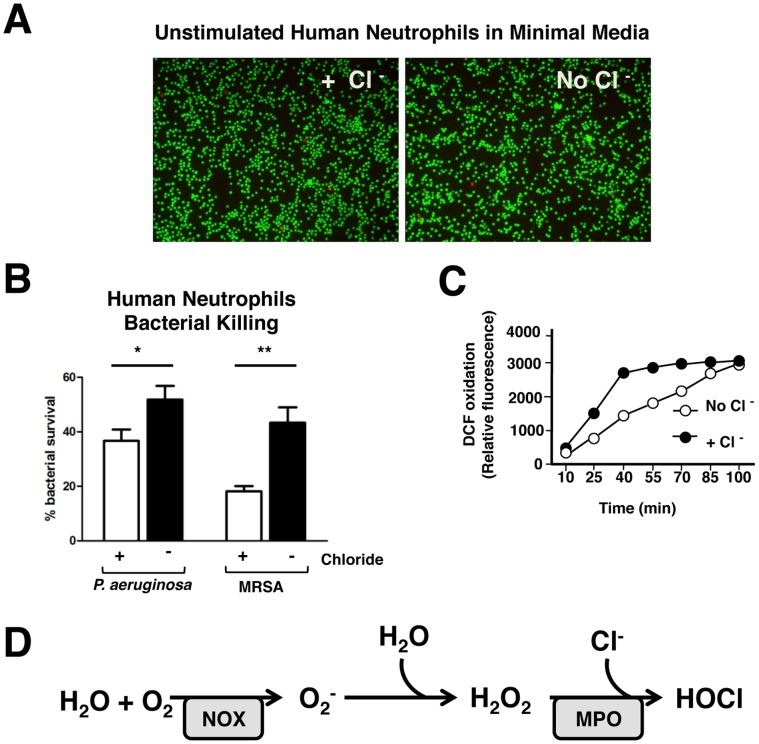
The release by neutrophils of DNA-based extracellular traps (NETs) is a recently recognized innate immune phenomenon that contributes significantly to control of bacterial pathogens at tissue foci of infection. NETs have also been implicated in the pathogenesis of non-infectious diseases such as small vessel vasculitis, lupus and cystic fibrosis lung disease. Reactive oxygen species (ROS) are important mediators of NET generation (NETosis). Neutrophils with reduced ROS production, such as those from patients with chronic granulomatous disease or myeloperoxidase (MPO) deficiency, produce fewer NETs in response to inflammatory stimuli. To better understand the roles of various ROS in NETosis, we explore the role of MPO, its substrates chloride ion (Cl(-)) and hydrogen peroxide (H(2)O(2)), and its product hypochlorite (HOCl) in NETosis.
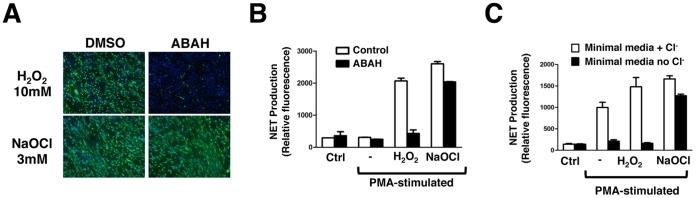
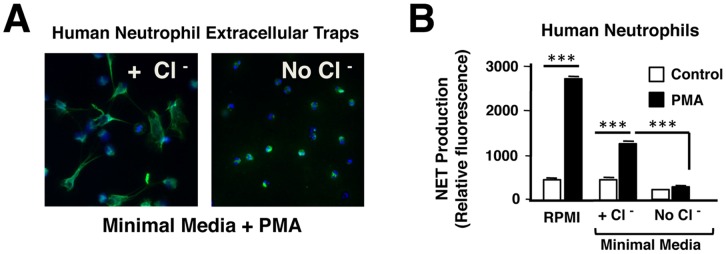
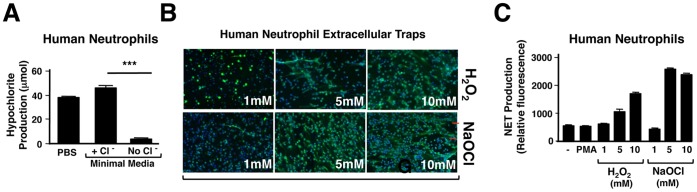
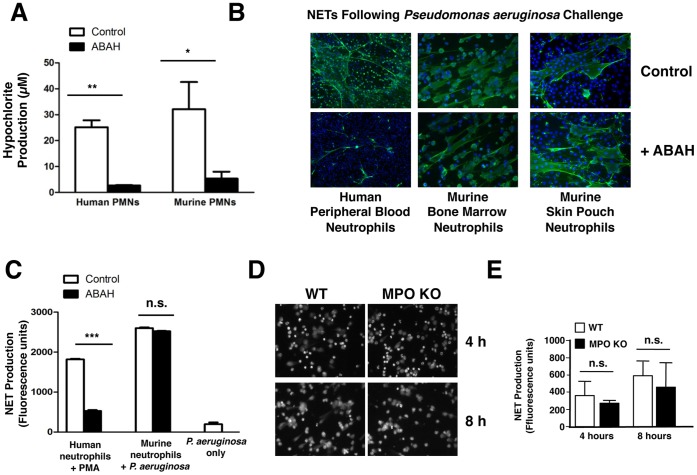
In human peripheral blood neutrophils, pharmacologic inhibition of MPO decreased NETosis. Absence of extracellular Cl(-), a substrate for MPO, also reduced NETosis. While exogenous addition of H(2)O(2) and HOCl stimulated NETosis, only exogenous HOCl could rescue NETosis in the setting of MPO inhibition. Neither pharmacological inhibition nor genetic deletion of MPO in murine neutrophils blocked NETosis, in contrast to findings in human neutrophils.
Our results pinpoint HOCl as the key ROS involved in human NETosis. This finding has implications for understanding innate immune function in diseases in which Cl(-) homeostasis is disturbed, such as cystic fibrosis. Our results also reveal an example of significant species-specific differences in NET phenotypes, and the need for caution in extrapolation to humans from studies of murine NETosis.
中性粒细胞释放基于 DNA 的细胞外陷阱(NETs)是一种新近被认识到的先天免疫现象,它对感染组织部位的细菌病原体的控制有重要贡献。NETs 也与非传染性疾病的发病机制有关,如小血管血管炎、狼疮和囊性纤维化肺病。活性氧(ROS)是 NET 生成(NETosis)的重要介质。ROS 产生减少的中性粒细胞,如慢性肉芽肿病或髓过氧化物酶(MPO)缺乏症患者的中性粒细胞,对炎症刺激的 NET 产生反应较少。为了更好地理解各种 ROS 在 NETosis 中的作用,我们探讨了 MPO 及其底物氯离子(Cl(-))和过氧化氢(H(2)O(2))及其产物次氯酸盐(HOCl)在 NETosis 中的作用。
在人外周血中性粒细胞中,MPO 的药理学抑制降低了 NETosis。MPO 的细胞外底物氯离子(Cl(-))的缺失也降低了 NETosis。虽然外源性添加 H(2)O(2)和 HOCl 刺激了 NETosis,但只有外源性 HOCl 可以在 MPO 抑制的情况下挽救 NETosis。与在人中性粒细胞中的发现相反,在鼠中性粒细胞中,MPO 的药理学抑制或基因缺失均未阻断 NETosis。
我们的结果指出 HOCl 是参与人 NETosis 的关键 ROS。这一发现对于理解 Cl(-)动态平衡紊乱的疾病中的先天免疫功能具有重要意义,如囊性纤维化。我们的结果还揭示了 NET 表型在物种间存在显著差异的实例,并且需要从对鼠 NETosis 的研究中对人类进行外推时要谨慎。