Department of Microbiology, Biocentre, University of Würzburg, Würzburg, Germany.
PLoS One. 2012;7(8):e43036. doi: 10.1371/journal.pone.0043036. Epub 2012 Aug 9.
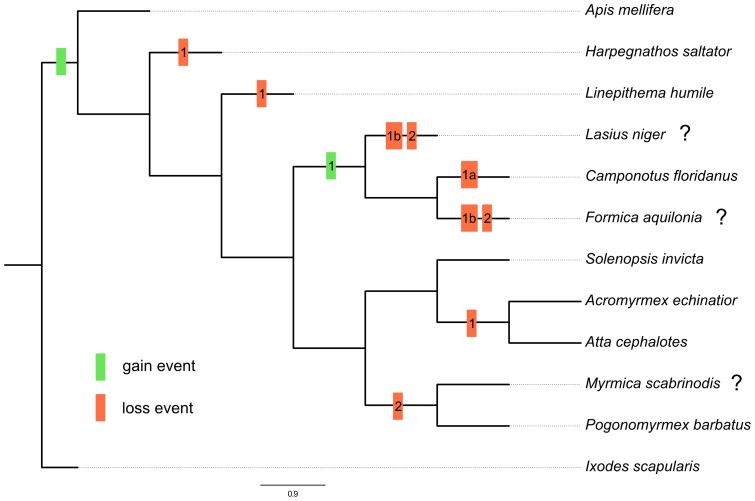
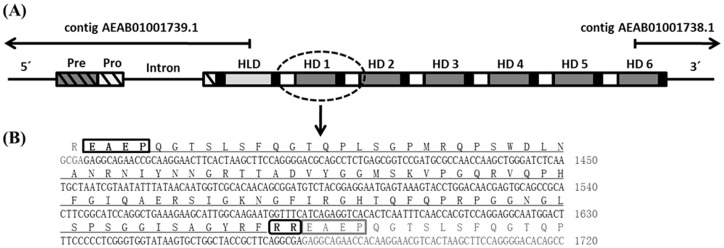
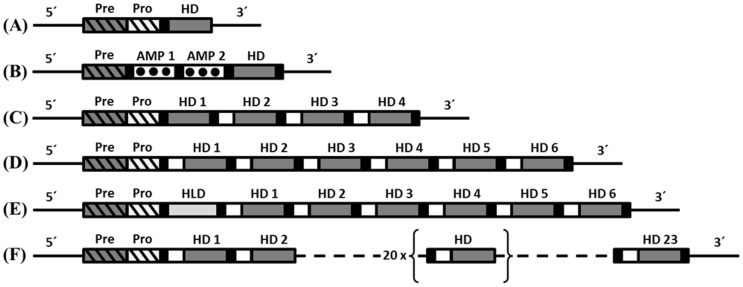
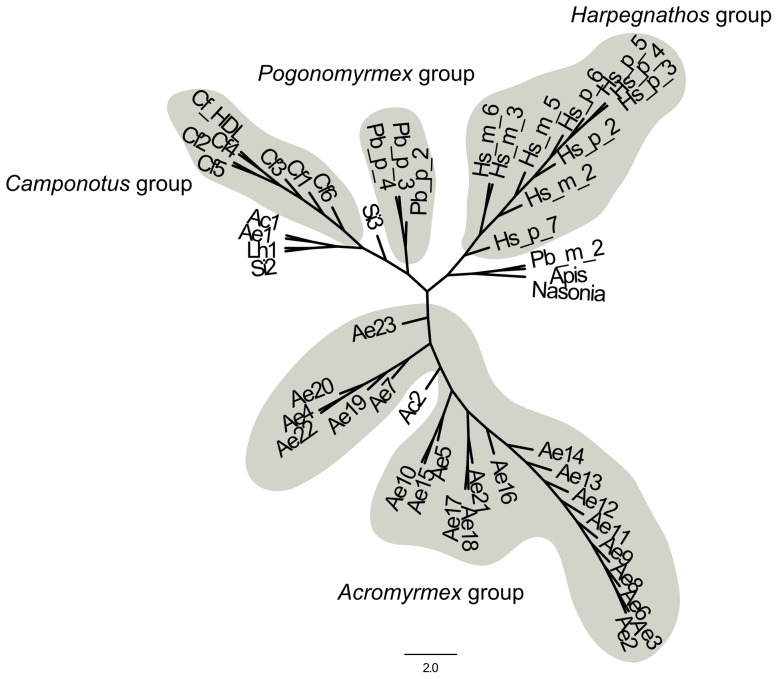
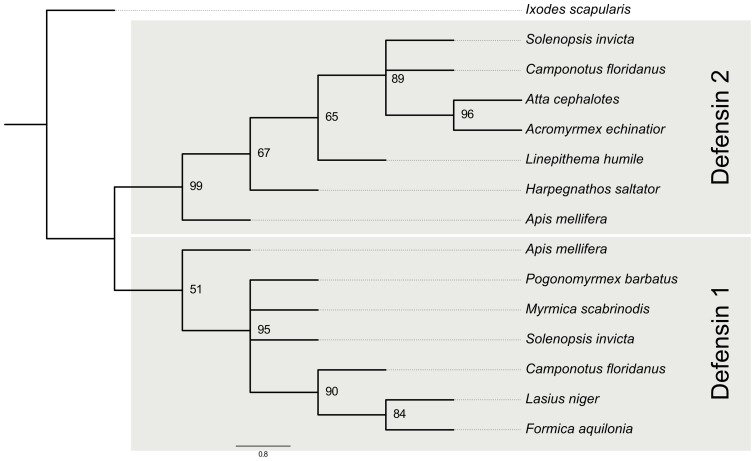
The production of antimicrobial peptides (AMPs) is a major defense mechanism against pathogen infestation and of particular importance for insects relying exclusively on an innate immune system. Here, we report on the characterization of three AMPs from the carpenter ant Camponotus floridanus. Due to sequence similarities and amino acid composition these peptides can be classified into the cysteine-rich (e.g. defensin) and glycine-rich (e.g. hymenoptaecin) AMP groups, respectively. The gene and cDNA sequences of these AMPs were established and their expression was shown to be induced by microbial challenge. We characterized two different defensin genes. The defensin-2 gene has a single intron, whereas the defensin-1 gene has two introns. The deduced amino acid sequence of the C. floridanus defensins is very similar to other known ant defensins with the exception of a short C-terminal extension of defensin-1. The hymenoptaecin gene has a single intron and a very peculiar domain structure. The corresponding precursor protein consists of a signal- and a pro-sequence followed by a hymenoptaecin-like domain and six directly repeated hymenoptaecin domains. Each of the hymenoptaecin domains is flanked by an EAEP-spacer sequence and a RR-site known to be a proteolytic processing site. Thus, proteolytic processing of the multipeptide precursor may generate several mature AMPs leading to an amplification of the immune response. Bioinformatical analyses revealed the presence of hymenoptaecin genes with similar multipeptide precursor structure in genomes of other ant species suggesting an evolutionary conserved important role of this gene in ant immunity.
抗菌肽(AMPs)的产生是抵御病原体侵袭的主要防御机制,对于仅依赖先天免疫系统的昆虫尤为重要。在这里,我们报告了三种来自木匠蚁 Camponotus floridanus 的 AMPs 的特性。由于序列相似性和氨基酸组成,这些肽可以分别归类为富含半胱氨酸(例如防御素)和富含甘氨酸(例如 hymenoptaecin)的 AMP 组。这些 AMP 的基因和 cDNA 序列已经建立,并且它们的表达显示出被微生物挑战诱导。我们对两种不同的防御素基因进行了表征。防御素-2 基因只有一个内含子,而防御素-1 基因有两个内含子。C. floridanus 防御素的推导氨基酸序列与其他已知的蚂蚁防御素非常相似,除了防御素-1 的短 C 端延伸外。 hymenoptaecin 基因只有一个内含子,并且具有非常特殊的结构域结构。相应的前体蛋白由一个信号肽和一个前肽组成,后面跟着一个 hymenoptaecin 样结构域和六个直接重复的 hymenoptaecin 结构域。每个 hymenoptaecin 结构域都被一个 EAEP-间隔序列和一个 RR-位点侧翼,该位点已知是一个蛋白水解加工位点。因此,多肽前体的蛋白水解加工可能会产生几种成熟的 AMP,从而放大免疫反应。生物信息学分析表明,其他蚂蚁物种的基因组中存在具有类似多肽前体结构的 hymenoptaecin 基因,这表明该基因在蚂蚁免疫中具有进化保守的重要作用。