Department of Orthopaedics, University of Duisburg-Essen, Essen, Germany.
BMC Musculoskelet Disord. 2012 Aug 22;13:154. doi: 10.1186/1471-2474-13-154.
Osteoclasts and osteoblasts regulate bone resorption and formation to allow bone remodeling and homeostasis. The balance between bone resorption and formation is disturbed by abnormal recruitment of osteoclasts. Osteoclast differentiation is dependent on the receptor activator of nuclear factor NF-kappa B (RANK) ligand (RANKL) as well as the macrophage colony-stimulating factor (M-CSF). The RANKL/RANK system and RANK signaling induce osteoclast formation mediated by various cytokines. The RANK/RANKL pathway has been primarily implicated in metabolic, degenerative and neoplastic bone disorders or osteolysis. The central role of RANK/RANKL interaction in osteoclastogenesis makes RANK an attractive target for potential therapies in treatment of osteolysis. The purpose of this study was to assess the effect of inhibition of RANK expression in mouse bone marrow macrophages on osteoclast differentiation and bone resorption.
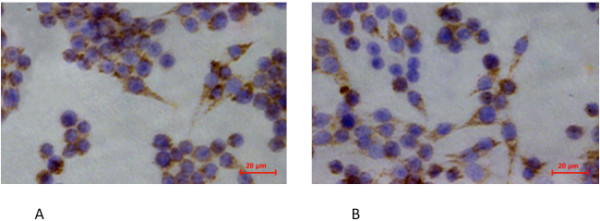
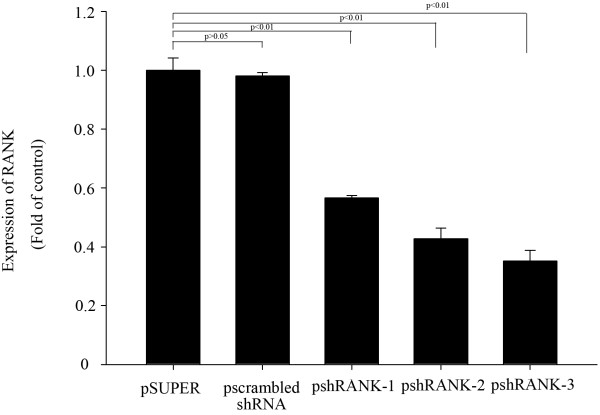
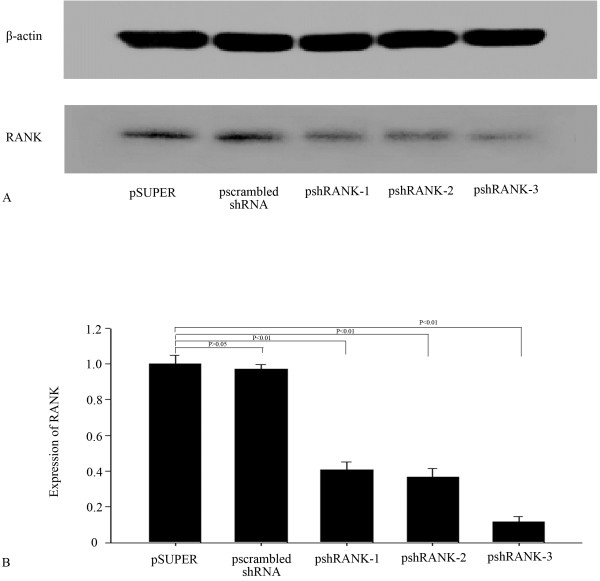
Three pairs of short hairpin RNAs (shRNA) targeting RANK were designed and synthesized. The optimal shRNA was selected among three pairs of shRNAs by RANK expression analyzed by Western blot and Real-time PCR. We investigated suppression of osteoclastogenesis of mouse bone marrow macrophages (BMMs) using the optimal shRNA by targeting RANK.
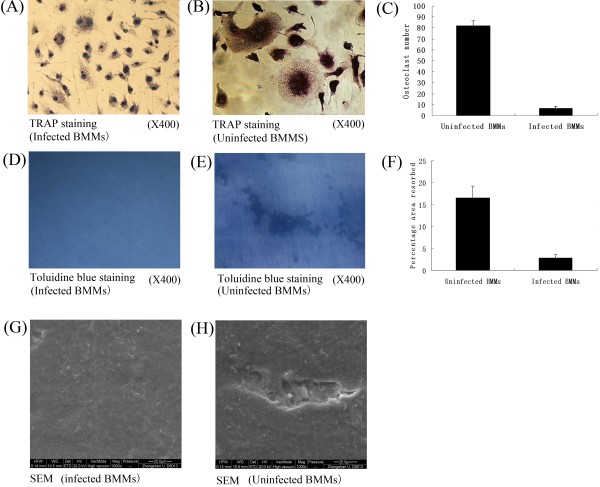
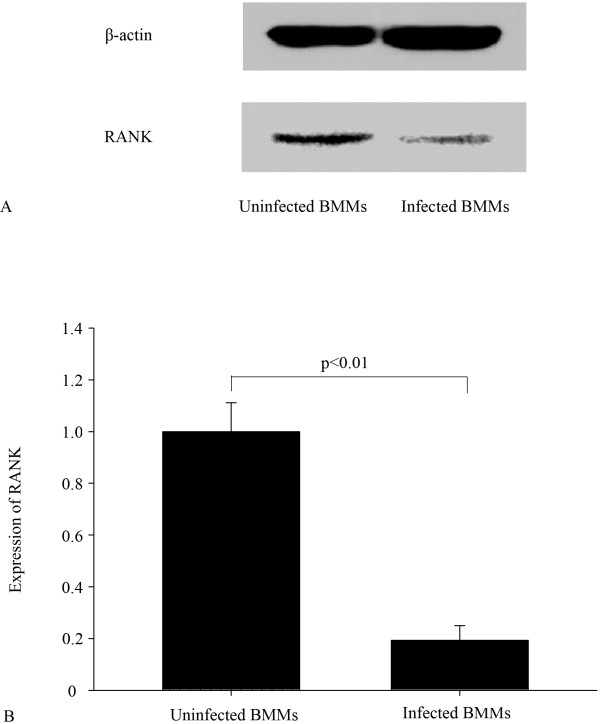
Among the three shRANKs examined, shRANK-3 significantly suppressed [88.3%] the RANK expression (p < 0.01). shRANK-3 also brought about a marked inhibition of osteoclast formation and bone resorption as demonstrated by tartrate-resistant acid phosphatase (TRAP) staining and osteoclast resorption assay. The results of our study show that retrovirus-mediated shRANK-3 suppresses osteoclast differentiation and osteolysis of BMMs.
These findings suggest that retrovirus-mediated shRNA targeting RANK inhibits osteoclast differentiation and osteolysis. It may appear an attractive target for preventing osteolysis in humans with a potential clinical application.
破骨细胞和成骨细胞调节骨吸收和形成,以允许骨重塑和动态平衡。破骨细胞的异常募集会破坏骨吸收和形成之间的平衡。破骨细胞分化依赖于核因子 NF-κB 受体激活剂(RANK)配体(RANKL)以及巨噬细胞集落刺激因子(M-CSF)。RANKL/RANK 系统和 RANK 信号通过各种细胞因子诱导破骨细胞形成。RANK/RANKL 途径主要涉及代谢性、退行性和肿瘤性骨疾病或溶骨性骨病变。RANK/RANKL 相互作用在破骨细胞发生中的核心作用使 RANK 成为治疗溶骨性骨病变的潜在治疗方法的有吸引力的靶标。本研究旨在评估抑制小鼠骨髓巨噬细胞中 RANK 表达对破骨细胞分化和骨吸收的影响。
设计并合成了三对针对 RANK 的短发夹 RNA(shRNA)。通过 Western blot 和实时 PCR 分析 RANK 表达,从三对 shRNA 中选择最佳 shRNA。我们通过靶向 RANK 用最佳 shRNA 研究了对小鼠骨髓巨噬细胞(BMM)破骨细胞发生的抑制作用。
在所检查的三个 shRANK 中,shRANK-3 显著抑制了 RANK 表达[88.3%](p <0.01)。shRANK-3 还通过抗酒石酸酸性磷酸酶(TRAP)染色和破骨细胞吸收试验导致破骨细胞形成和骨吸收的明显抑制。我们的研究结果表明,逆转录病毒介导的 shRANK-3 抑制 BMM 中的破骨细胞分化和骨溶解。
这些发现表明,逆转录病毒介导的靶向 RANK 的 shRNA 抑制破骨细胞分化和骨溶解。它可能成为预防人类溶骨性骨病变的有吸引力的靶标,并具有潜在的临床应用前景。