Department of Anatomy and Cell Biology, Nara Medical University, Kashihara, Nara, Japan.
J Neuroendocrinol. 2013 Feb;25(2):158-67. doi: 10.1111/j.1365-2826.2012.02377.x.
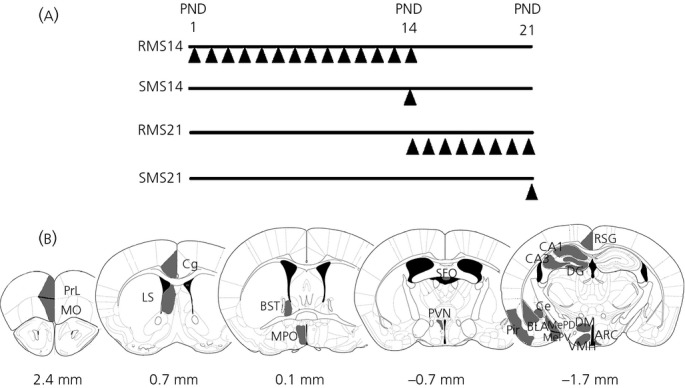
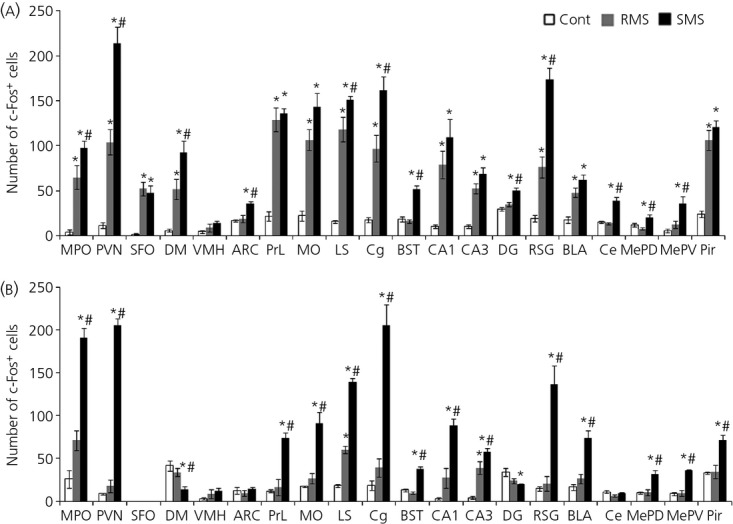
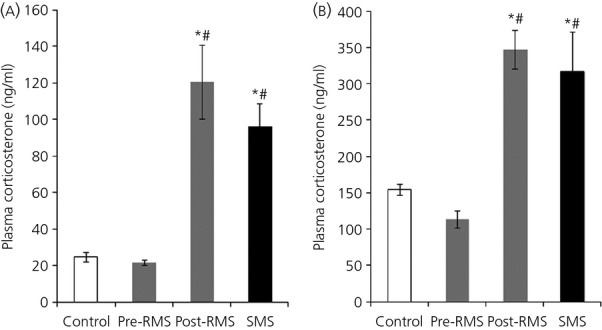
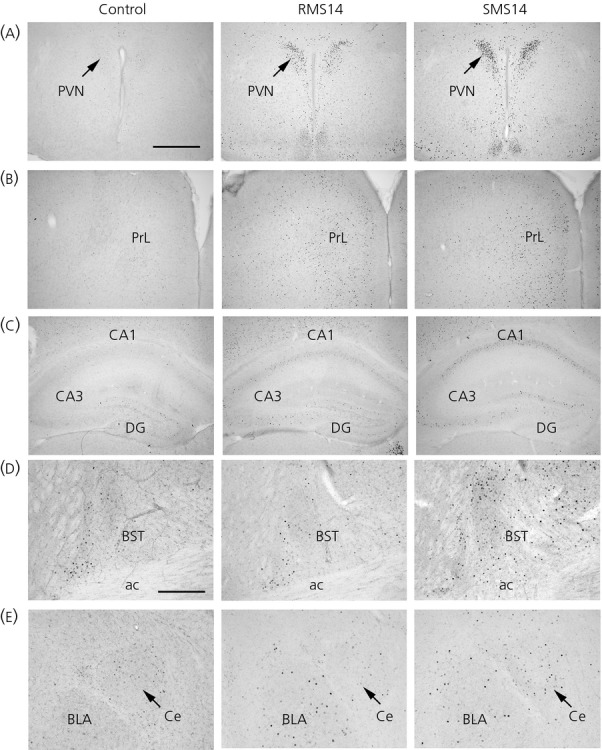
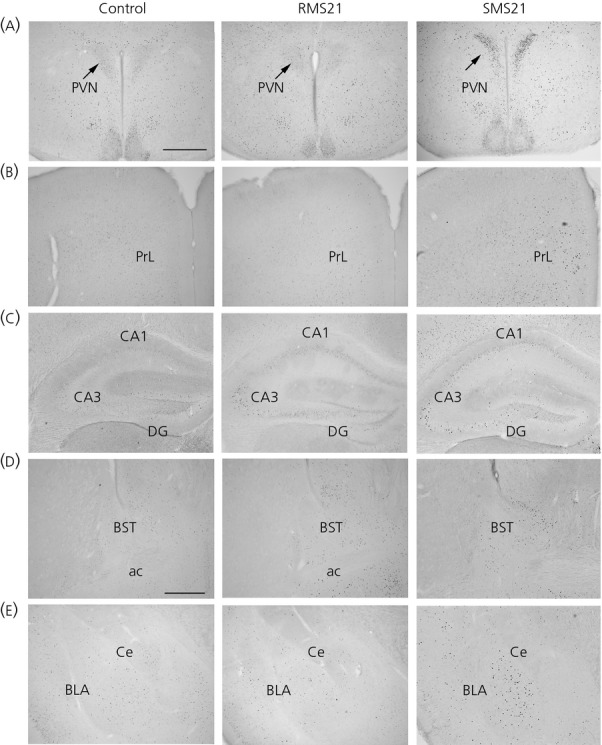
Early-life stress has long-lasting effects on neuroendocrine and behaviour in adulthood. Maternal separation (MS) is used as a model of early-life stress and daily repeated MS (RMS) for 3 h during the first two postnatal weeks is widely used in rodent studies. However, it is not fully understood whether early-life animals desensitise/habituate to repeated stress. In the present study, we investigated the effects of daily RMS for 3 h and acute/single time MS (SMS) for 3 h on the plasma corticosterone level and c-Fos expression in the brain in mice at different postnatal ages. Mice were subjected to: (i) RMS from postnatal day (PND) 1 to 14 (RMS14); (ii) RMS from PND14 to 21 (RMS21); (iii) SMS on PND14 (SMS14); and (iv) SMS on PND21 (SMS21). Plasma corticosterone and c-Fos expression were examined on the final day in each experiment. The basal corticosterone levels in RMS14 and RMS21 were equal to those in respective age-matched controls. After the final separation, the levels were significantly increased and were comparable with those after SMS14 and SMS21, respectively. Histological analysis indicated that c-Fos expression significantly increased in many brain regions, including the paraventricular nucleus, prefrontal cortex, hippocampus, and basolateral and medial amygdale in both SMS14 and SMS21 mice. However, c-Fos expression in RMS14 mice significantly increased in many regions, whereas such increases were hardly seen in RMS21 mice. These results indicate that repeated early-life stress neither increases basal corticosterone, nor decreases the magnitude of the corticosterone response during the first three postnatal weeks, although desensitisation of c-Fos expression induced by repeated stress is changed during postnatal development.
早期生活压力对成年后的神经内分泌和行为有持久影响。母体分离 (MS) 被用作早期生活压力的模型,在新生后两周内每天重复 MS (RMS) 3 小时,广泛用于啮齿动物研究。然而,早期动物是否对重复压力产生脱敏/习惯化尚不完全清楚。在本研究中,我们研究了每天 RMS 3 小时和急性/单次 MS (SMS) 3 小时对不同新生后年龄小鼠血浆皮质酮水平和大脑 c-Fos 表达的影响。小鼠接受以下处理:(i)从新生后第 1 天到第 14 天 (RMS14) 进行 RMS;(ii)从新生后第 14 天到第 21 天 (RMS21) 进行 RMS;(iii)在新生后第 14 天 (SMS14) 进行 SMS;和 (iv)在新生后第 21 天 (SMS21) 进行 SMS。在每个实验的最后一天检查血浆皮质酮和 c-Fos 表达。RMS14 和 RMS21 的基础皮质酮水平与相应年龄匹配的对照组相同。最后一次分离后,水平显著升高,分别与 SMS14 和 SMS21 后相当。组织学分析表明,在 SMS14 和 SMS21 小鼠的许多脑区,包括室旁核、前额叶皮层、海马体以及基底外侧和内侧杏仁核,c-Fos 表达显著增加。然而,在 RMS14 小鼠中,许多区域的 c-Fos 表达显著增加,而在 RMS21 小鼠中几乎看不到这种增加。这些结果表明,尽管重复应激诱导的 c-Fos 表达脱敏发生在出生后发育过程中发生变化,但在新生后前 3 周内,重复早期生活压力既不会增加基础皮质酮,也不会降低皮质酮反应的幅度。