Institute of Psychological Sciences, Faculty of Medicine and Health, University of Leeds, Leeds, LS2 9JT, UK.
Dis Model Mech. 2012 Sep;5(5):608-13. doi: 10.1242/dmm.009837.
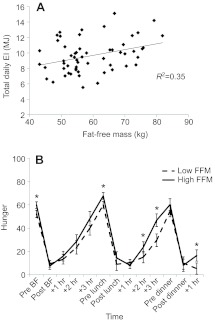
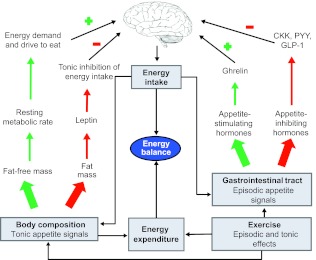
A long-running issue in appetite research concerns the influence of energy expenditure on energy intake. More than 50 years ago, Otto G. Edholm proposed that "the differences between the intakes of food [of individuals] must originate in differences in the expenditure of energy". However, a relationship between energy expenditure and energy intake within any one day could not be found, although there was a correlation over 2 weeks. This issue was never resolved before interest in integrative biology was replaced by molecular biochemistry. Using a psychobiological approach, we have studied appetite control in an energy balance framework using a multi-level experimental system on a single cohort of overweight and obese human subjects. This has disclosed relationships between variables in the domains of body composition [fat-free mass (FFM), fat mass (FM)], metabolism, gastrointestinal hormones, hunger and energy intake. In this Commentary, we review our own and other data, and discuss a new formulation whereby appetite control and energy intake are regulated by energy expenditure. Specifically, we propose that FFM (the largest contributor to resting metabolic rate), but not body mass index or FM, is closely associated with self-determined meal size and daily energy intake. This formulation has implications for understanding weight regulation and the management of obesity.
长期以来,食欲研究中的一个问题是能量消耗对能量摄入的影响。50 多年前,奥托·G·埃德霍姆(Otto G. Edholm)提出,“[个体]食物摄入量的差异必须源于能量消耗的差异”。然而,在任何一天内都无法找到能量消耗和能量摄入之间的关系,尽管在 2 周以上存在相关性。在综合生物学的兴趣被分子生物化学所取代之前,这个问题从未得到解决。我们使用心理生物学方法,在超重和肥胖的人类受试者的单一队列中使用多层次实验系统,在能量平衡框架内研究了食欲控制。这揭示了身体成分(去脂体重[FFM]、脂肪量[FM])、代谢、胃肠道激素、饥饿和能量摄入等领域变量之间的关系。在这篇评论中,我们回顾了我们自己和其他的数据,并讨论了一种新的表述,即食欲控制和能量摄入由能量消耗调节。具体来说,我们提出,FFM(静息代谢率的最大贡献者),而不是体重指数或 FM,与自主决定的进餐量和每日能量摄入密切相关。这种表述对理解体重调节和肥胖管理具有重要意义。