Tsuchiya Hironori, Mizogami Maki
Department of Dental Basic Education, Asahi University School of Dentistry, Mizuho, Gifu, Japan.
Local Reg Anesth. 2008;1:1-9. doi: 10.2147/lra.s3876. Epub 2008 Aug 6.
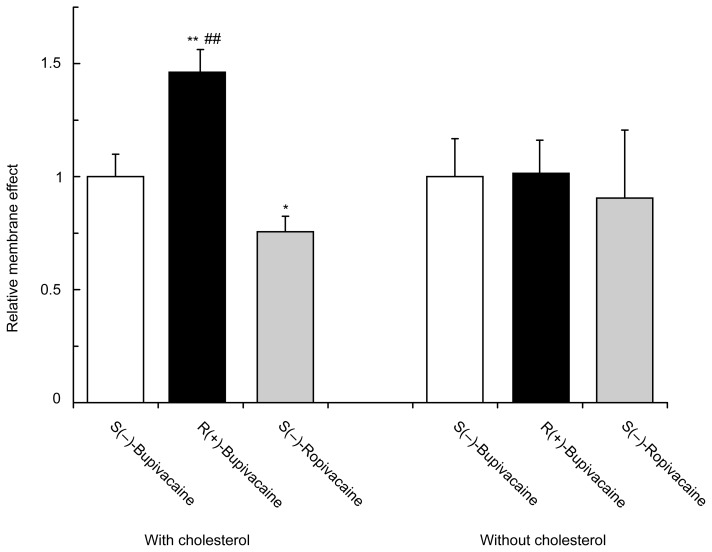
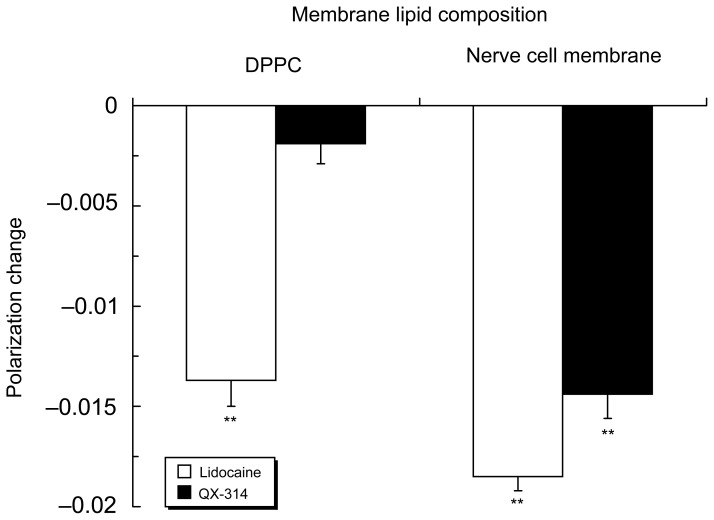
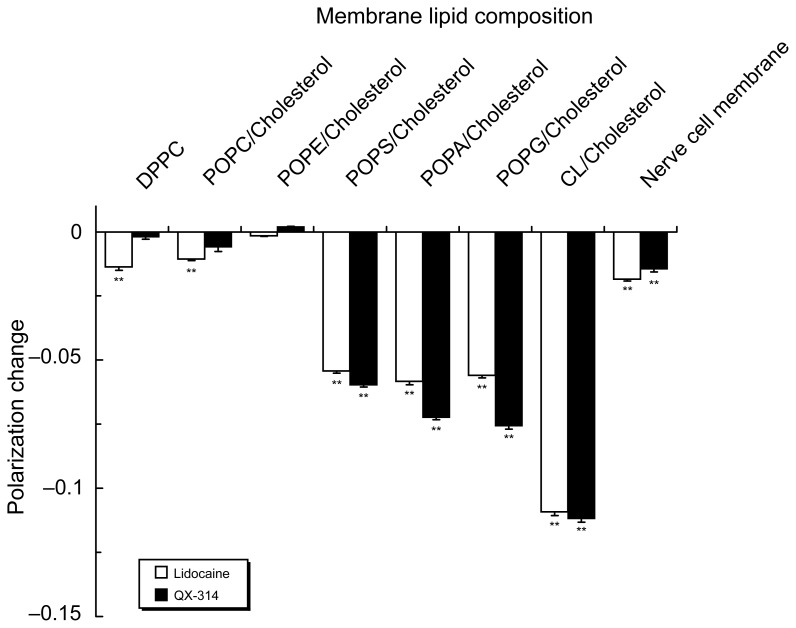
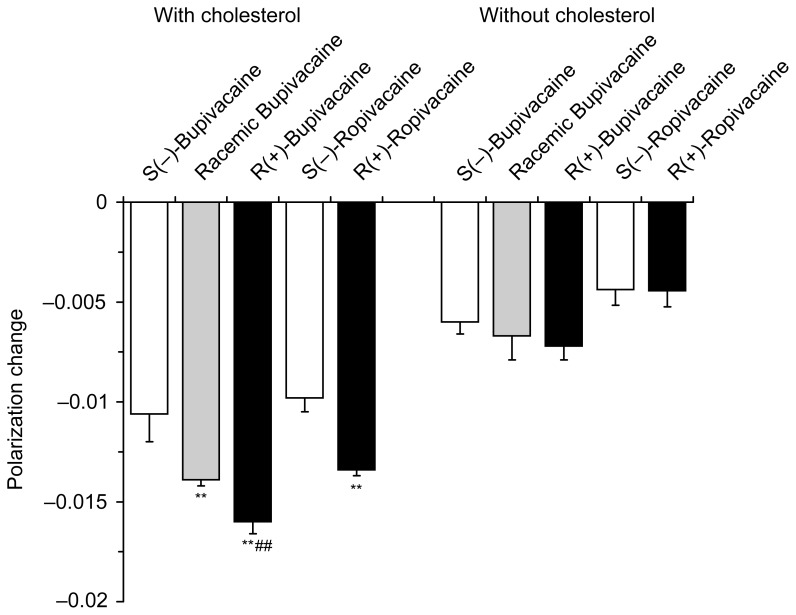
With respect to the membrane lipid theory as a molecular mechanism for local anesthetics, two critical subjects, the negligible effects of charged drugs when applied extracellularly and the stereoselective effects of enantiomers, were verified by paying particular attention to membrane components, phospholipids with the anionic property, and cholesterol with several chiral carbons. The membrane interactivities of structurally-different anesthetics were determined by their induced fluidity changes of liposomal membranes. Lidocaine (3.0 μmol/mL) fluidized phosphatidylcholine membranes, but not its quaternary derivative QX-314 (3.0 μmol/mL). Similarly to the mother molecule lidocaine, however, QX-314 fluidized phosphatidylserine-containing nerve cell model membranes and acidic phospholipids-constituting membranes depending on the acidity of membrane lipids. Positively charged local anesthetics are able to act on lipid bilayers by ion-pairing with anionic (acidic) phospholipids. Bupivacaine (0.75 mol/mL) and ropivacaine (0.75 and 1.0 μmol/mL) fluidized nerve cell model membranes with the potency being S(-)-enantiomer < racemate < R(+)-enantiomer (P < 0.01, vs antipode and racemate) and cardiac cell model membranes with the potency being S(-)-ropivacaine < S(-)-bupivacaine < R(+)-bupivacaine (P < 0.01). However, their membrane effects were not different when removing cholesterol from the model membranes. Stereoselectivity is producible by cholesterol which increases the chirality of lipid bilayers and enables to discriminate anesthetic enantiomers. The membrane lipid interaction should be reevaluated as the mode of action of local anesthetics.
关于膜脂质理论作为局部麻醉药的分子机制,通过特别关注膜成分、具有阴离子特性的磷脂和含有多个手性碳的胆固醇,验证了两个关键问题,即带电药物在细胞外应用时的可忽略不计的效应以及对映体的立体选择性效应。结构不同的局部麻醉药的膜相互作用是通过它们诱导的脂质体膜流动性变化来确定的。利多卡因(3.0 μmol/mL)使磷脂酰胆碱膜流动性增加,但其四元衍生物QX - 314(3.0 μmol/mL)则不然。然而,与母体分子利多卡因类似,QX - 314根据膜脂质的酸度使含磷脂酰丝氨酸的神经细胞模型膜和由酸性磷脂构成的膜流动性增加。带正电荷的局部麻醉药能够通过与阴离子(酸性)磷脂形成离子对作用于脂质双层。布比卡因(0.75 mol/mL)和罗哌卡因(0.75和1.0 μmol/mL)使神经细胞模型膜流动性增加,效力为S(-)-对映体<外消旋体<R(+)-对映体(P<0.01,与对映体和外消旋体相比),使心脏细胞模型膜流动性增加,效力为S(-)-罗哌卡因<S(-)-布比卡因<R(+)-布比卡因(P<0.01)。然而,当从模型膜中去除胆固醇时,它们的膜效应没有差异。胆固醇可产生立体选择性,它增加了脂质双层的手性并能够区分局部麻醉药对映体。膜脂质相互作用应作为局部麻醉药的作用方式重新评估。