Department of Mathematics, Statistics, and Computer Science, Macalester College, Saint Paul, Minnesota, United States of America.
PLoS Comput Biol. 2012;8(8):e1002642. doi: 10.1371/journal.pcbi.1002642. Epub 2012 Aug 16.
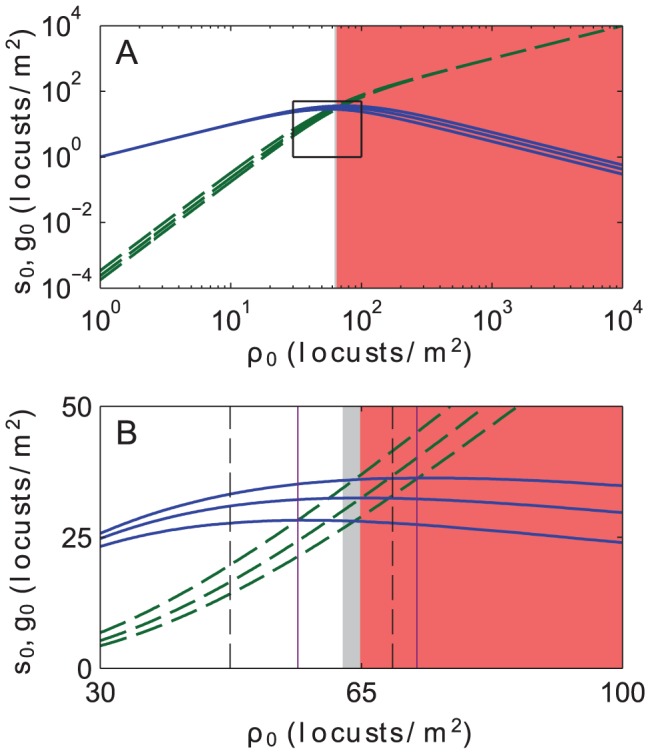
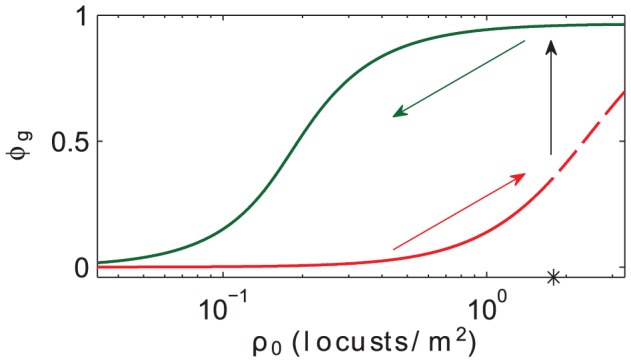
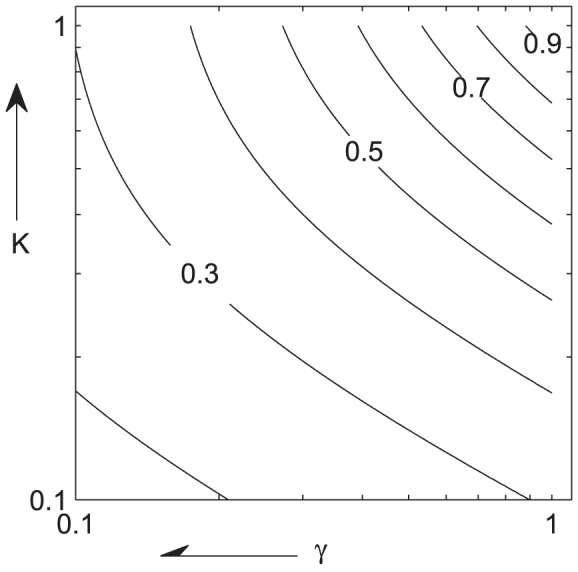
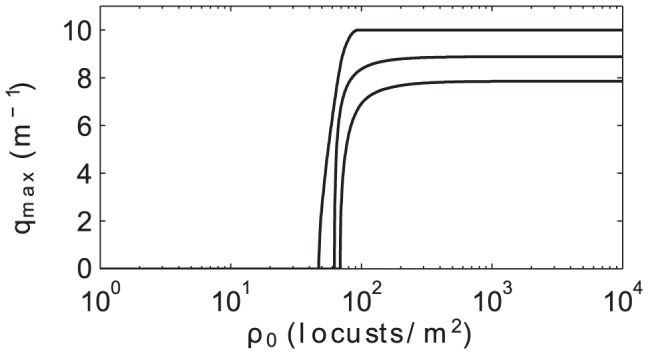
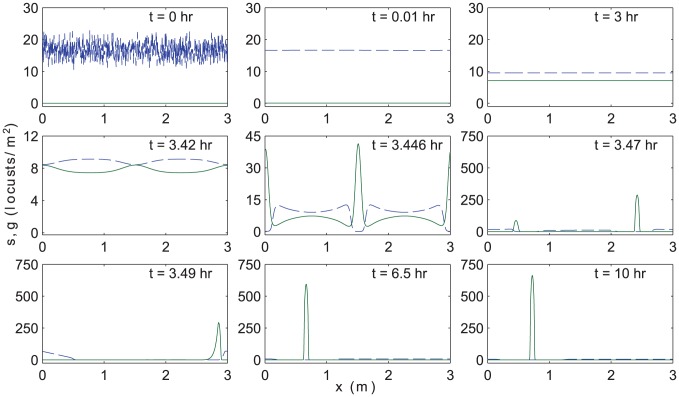
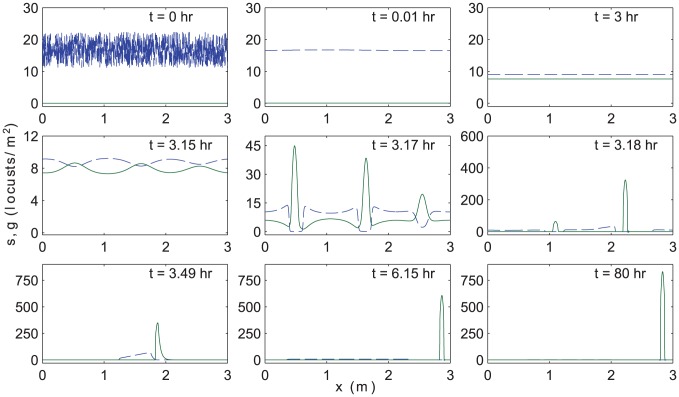
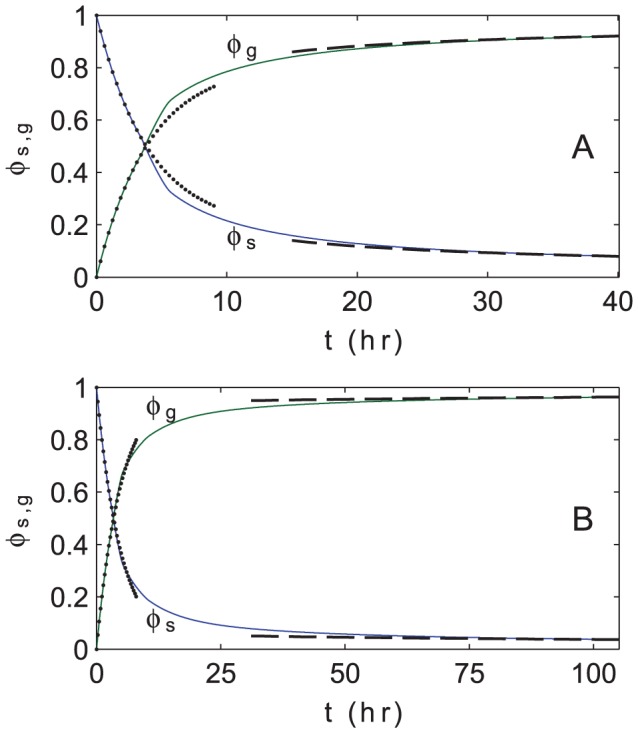
Locusts exhibit two interconvertible behavioral phases, solitarious and gregarious. While solitarious individuals are repelled from other locusts, gregarious insects are attracted to conspecifics and can form large aggregations such as marching hopper bands. Numerous biological experiments at the individual level have shown how crowding biases conversion towards the gregarious form. To understand the formation of marching locust hopper bands, we study phase change at the collective level, and in a quantitative framework. Specifically, we construct a partial integrodifferential equation model incorporating the interplay between phase change and spatial movement at the individual level in order to predict the dynamics of hopper band formation at the population level. Stability analysis of our model reveals conditions for an outbreak, characterized by a large scale transition to the gregarious phase. A model reduction enables quantification of the temporal dynamics of each phase, of the proportion of the population that will eventually gregarize, and of the time scale for this to occur. Numerical simulations provide descriptions of the aggregation's structure and reveal transiently traveling clumps of gregarious insects. Our predictions of aggregation and mass gregarization suggest several possible future biological experiments.
蝗虫表现出两种可转换的行为阶段,即孤独型和群居型。虽然孤独型个体排斥其他蝗虫,但群居昆虫则被同类吸引,并能形成大规模的聚集,如行军蝗群。在个体水平上进行的大量生物学实验表明,拥挤如何使转换偏向群居形式。为了理解行军蝗群的形成,我们在集体层面上进行了相位变化的研究,并建立了一个定量框架。具体来说,我们构建了一个偏积分微分方程模型,该模型结合了个体层面上相位变化和空间运动之间的相互作用,以便预测蝗群在种群水平上的形成动态。我们模型的稳定性分析揭示了爆发的条件,即大规模向群居阶段的转变。模型简化使每个阶段的时间动态、最终群居化的种群比例以及发生的时间尺度得以量化。数值模拟提供了聚集结构的描述,并揭示了群居昆虫的瞬时迁移团块。我们对聚集和大规模群居化的预测提出了几种可能的未来生物学实验。