Dipartimento di Sanità Pubblica Veterinaria, Facoltà di Medicina Veterinaria, Università degli Studi di Messina, Messina, Italy.
Parasit Vectors. 2012 Aug 23;5:178. doi: 10.1186/1756-3305-5-178.
Aelurostrongylus abstrusus is currently regarded as the main metastrongyloid infesting domestic cats, whereas the reports of Troglostrongylus spp. in domestic and wild felids largely remain anecdotic. This paper reports on pulmonary infestation caused by Troglostrongylus brevior and Troglostrongylus subcrenatus in two kittens and describes, for the first time, associated clinical presentations and pathological features. Morphometrical, molecular and phylogenetic analyses have also been conducted to differentiate here the examined Troglostrongylus species from A. abstrusus, towards a clearer delineation of metastrongyloids affecting cats.
Two kittens were referred for respiratory distress and hospitalized with a diagnosis of severe aelurostrongylosis, based on the presence of metastrongyloid larvae in the faeces. Despite prompt treatment, kittens died within 48 hours. Both kittens were submitted to necropsy to determine the cause of death.
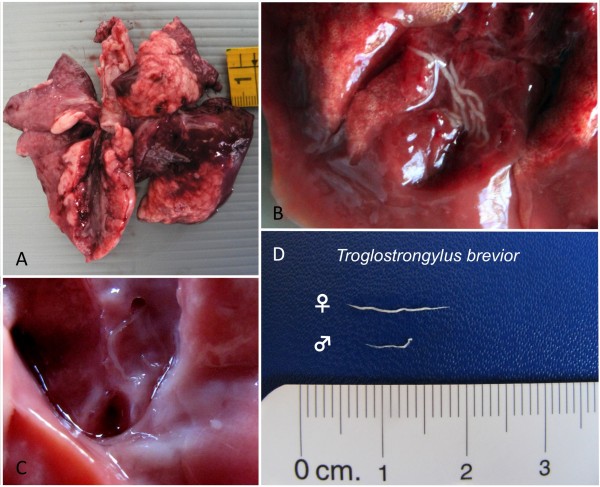
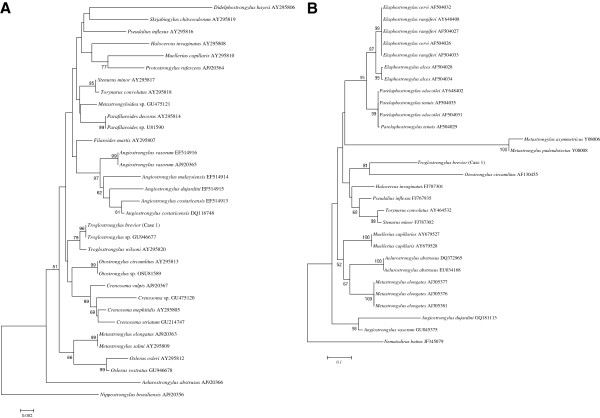
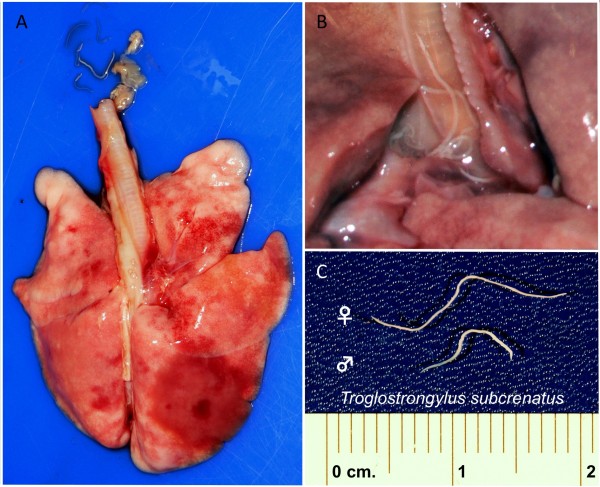
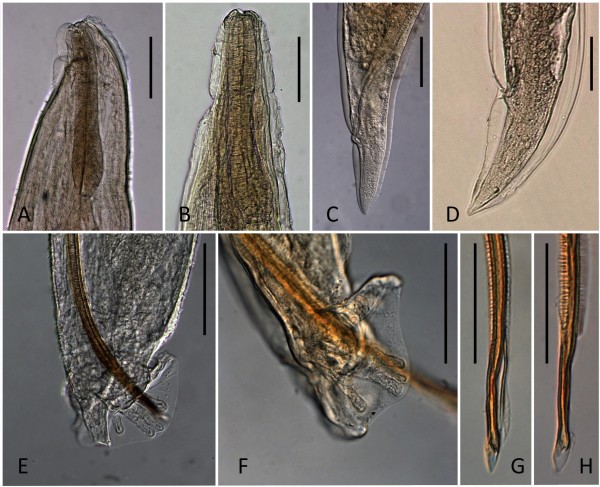
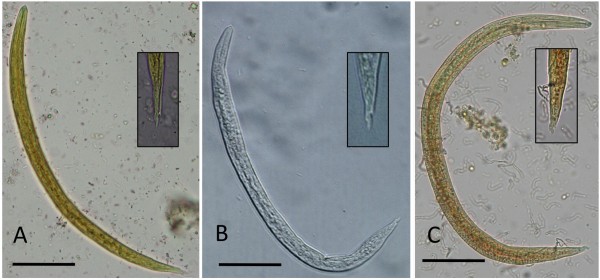
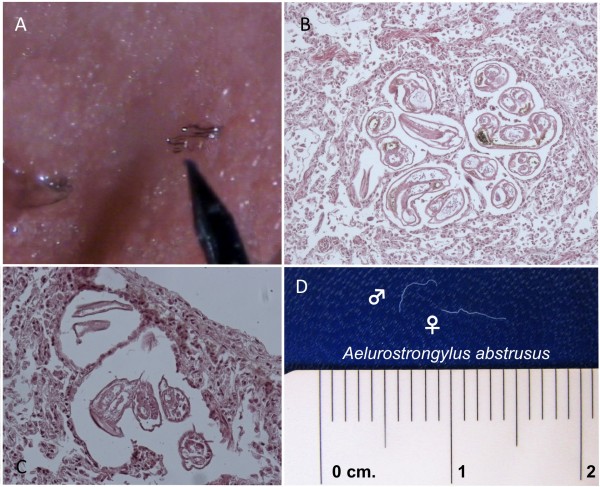
At necropsy, nematode specimens were found in the trachea, bronchi and bronchioles and were associated with respiratory signs (i.e., dyspnoea, polypnea, severe coughing and nasal discharge). Morphology and measurements of adult parasites found allowed the unequivocal identification of T. brevior and T. subcrenatus, even if first stage larvae were rather similar to those of A. abstrusus. Briefly, T. brevior and T. subcrenatus larvae were shorter in length and lacking the typical knob-like terminal end of A. abstrusus. Molecular and phylogenetic analyses corroborated morphological identification and provided data on mitochondrial and ribosomal DNA genes of T. brevior.
Data presented here indicate that T. brevior and T. subcrenatus may cause major respiratory distress in domestic cats. Consequently, these two species should be included, along with A. abstrusus, in the differential diagnosis of cat bronchopulmonary affections and treatment protocols need to be evaluated. Through research on the biology, epidemiology and control of Troglostrongylus spp. infestations in domestic cats are advisable to implement current knowledge on these neglected metastrongyloids.
目前,Aelurostrongylus abstrusus 被认为是主要感染家猫的并殖吸虫,而关于其他种类的旋尾目吸虫在 domestic 和 wild felids 中的报告大多仍为轶事。本文报道了两例幼猫因感染短首并殖吸虫和次睾并殖吸虫引起的肺部感染,并首次描述了相关的临床症状和病理特征。还进行了形态测量学、分子和系统发育分析,以将检查到的旋尾目吸虫与 A. abstrusus 区分开来,以便更清楚地划定影响猫的并殖吸虫。
两只幼猫因呼吸窘迫被转诊,并被诊断为严重的并殖吸虫病,粪便中存在并殖幼虫。尽管进行了及时的治疗,但两只幼猫都在 48 小时内死亡。两只幼猫均进行了尸检以确定死亡原因。
尸检时,在气管、支气管和细支气管中发现了线虫标本,这些标本与呼吸症状(即呼吸困难、过度呼吸、剧烈咳嗽和鼻分泌物)有关。发现的成虫的形态和测量值允许明确识别 T. brevior 和 T. subcrenatus,即使第一期幼虫与 A. abstrusus 的幼虫相当相似。简而言之,T. brevior 和 T. subcrenatus 的幼虫长度较短,并且没有 A. abstrusus 的典型末端结节。分子和系统发育分析证实了形态学鉴定,并提供了 T. brevior 的线粒体和核糖体 DNA 基因数据。
本文提供的数据表明,T. brevior 和 T. subcrenatus 可能会导致家猫出现严重的呼吸窘迫。因此,这两种物种应与 A. abstrusus 一起纳入猫支气管肺部疾病的鉴别诊断中,并且需要评估治疗方案。通过对 domestic cats 中的旋尾目吸虫感染的生物学、流行病学和控制进行研究,建议实施对这些被忽视的并殖吸虫的现有知识。