Department of Microbiology, The University of Texas Southwestern Medical Center Dallas, TX, USA.
Front Cell Infect Microbiol. 2012 Jul 12;2:90. doi: 10.3389/fcimb.2012.00090. eCollection 2012.
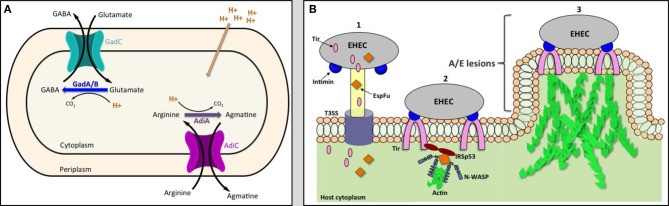
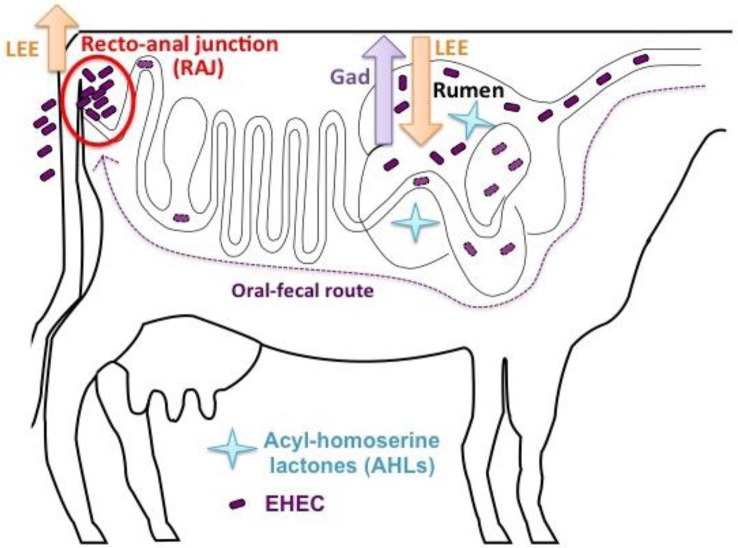
Enterohemorrhagic Escherichia coli (EHEC) serotype O157:H7 is a human pathogen responsible for outbreaks of bloody diarrhea and hemolytic uremic syndrome (HUS) worldwide. Conventional antimicrobials trigger an SOS response in EHEC that promotes the release of the potent Shiga toxin that is responsible for much of the morbidity and mortality associated with EHEC infection. Cattle are a natural reservoir of EHEC, and approximately 75% of EHEC outbreaks are linked to the consumption of contaminated bovine-derived products. This review will discuss how EHEC causes disease in humans but is asymptomatic in adult ruminants. It will also analyze factors utilized by EHEC as it travels through the bovine gastrointestinal (GI) tract that allow for its survival through the acidic environment of the distal stomachs, and for its ultimate colonization in the recto-anal junction (RAJ). Understanding the factors crucial for EHEC survival and colonization in cattle will aid in the development of alternative strategies to prevent EHEC shedding into the environment and consequent human infection.
肠出血性大肠杆菌(EHEC)血清型 O157:H7 是一种人类病原体,可导致全球范围内爆发血性腹泻和溶血性尿毒症综合征(HUS)。传统的抗菌药物会在 EHEC 中引发 SOS 反应,从而促进强效志贺毒素的释放,这是与 EHEC 感染相关的发病率和死亡率的主要原因。牛是 EHEC 的天然宿主,约 75%的 EHEC 暴发与食用受污染的牛源性产品有关。本文将讨论 EHEC 如何在人类中引起疾病,但在成年反刍动物中却无症状。它还将分析 EHEC 在穿过牛的胃肠道(GI)时利用的因素,这些因素使其能够在胃远端的酸性环境中存活,并最终在直肠-肛门交界处(RAJ)定植。了解 EHEC 在牛中生存和定植的关键因素将有助于开发替代策略,以防止 EHEC 排放到环境中并导致人类感染。