School of Chemistry, Queensland University of Technology, GPO Box 2434, Brisbane, QLD, 4001, Australia.
Biotechnol Biofuels. 2012 Aug 24;5(1):62. doi: 10.1186/1754-6834-5-62.
Effective pretreatment is key to achieving high enzymatic saccharification efficiency in processing lignocellulosic biomass to fermentable sugars, biofuels and value-added products. Ionic liquids (ILs), still relatively new class of solvents, are attractive for biomass pretreatment because some demonstrate the rare ability to dissolve all components of lignocellulosic biomass including highly ordered (crystalline) cellulose. In the present study, three ILs, 1-butyl-3-methylimidazolium chloride ([C4mim]Cl), 1-ethyl-3-methylimidazolium chloride ([C2mim]Cl), 1-ethyl-3-methylimidazolium acetate ([C2mim]OAc) are used to dissolve/pretreat and fractionate sugarcane bagasse. In these IL-based pretreatments the biomass is completely or partially dissolved in ILs at temperatures greater than 130°C and then precipitated by the addition of an antisolvent to the IL biomass mixture. For the first time mass balances of IL-based pretreatments are reported. Such mass balances, along with kinetics data, can be used in process modelling and design.
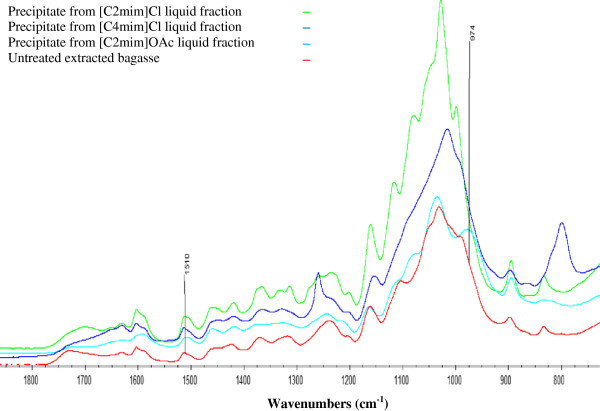
Lignin removals of 10% mass of lignin in bagasse with [C4mim]Cl, 50% mass with [C2mim]Cl and 60% mass with [C2mim]OAc, are achieved by limiting the amount of water added as antisolvent to 0.5 water:IL mass ratio thus minimising lignin precipitation. Enzyme saccharification (24 h, 15FPU) yields (% cellulose mass in starting bagasse) from the recovered solids rank as: [C2mim]OAc(83%) > >[C2mim]Cl(53%) = [C4mim]Cl(53%). Composition of [C2mim]OAc-treated solids such as low lignin, low acetyl group content and preservation of arabinosyl groups are characteristic of aqueous alkali pretreatments while those of chloride IL-treated solids resemble aqueous acid pretreatments. All ILs are fully recovered after use (100% mass as determined by ion chromatography).
In all three ILs regulated addition of water as an antisolvent effected a polysaccharide enriched precipitate since some of the lignin remained dissolved in the aqueous IL solution. Of the three IL studied [C2mim]OAc gave the best saccharification yield, material recovery and delignification. The effects of [C2mim]OAc pretreatment resemble those of aqueous alkali pretreatments while those of [C2mim]Cl and [C4mim]Cl resemble aqueous acid pretreatments. The use of imidazolium IL solvents with shorter alkyl chains results in accelerated dissolution, pretreatment and degradation.
在将木质纤维素生物质加工成可发酵糖、生物燃料和增值产品的过程中,有效的预处理是实现高酶糖化效率的关键。离子液体(ILs)仍然是一类相对较新的溶剂,由于它们具有溶解木质纤维素生物质所有成分的罕见能力,包括高度有序(结晶)的纤维素,因此在生物质预处理中具有吸引力。在本研究中,使用三种 IL,1-丁基-3-甲基咪唑氯化物([C4mim]Cl)、1-乙基-3-甲基咪唑氯化物([C2mim]Cl)和 1-乙基-3-甲基咪唑乙酸盐([C2mim]OAc)溶解/预处理和分级甘蔗渣。在这些基于 IL 的预处理中,生物质在高于 130°C 的温度下完全或部分溶解在 IL 中,然后通过向 IL-生物质混合物中添加反溶剂来沉淀。首次报道了基于 IL 的预处理的质量平衡。此类质量平衡以及动力学数据可用于过程建模和设计。
通过将作为反溶剂添加的水量限制在 0.5 水:IL 质量比,以实现 10%质量的木质素去除(相对于蔗渣中的木质素质量)用 [C4mim]Cl,50%质量用 [C2mim]Cl 和 60%质量用 [C2mim]OAc,从而最大限度地减少木质素沉淀。从回收的固体中获得的酶糖化(24 小时,15FPU)产率(起始蔗渣中纤维素质量的%)排序为:[C2mim]OAc(83%)>>>[C2mim]Cl(53%)= [C4mim]Cl(53%)。[C2mim]OAc 处理的固体的组成,如低木质素、低乙酰基含量和阿拉伯糖基的保留,是水性碱预处理的特征,而氯化物 IL 处理的固体的组成类似于水性酸预处理。所有 IL 在使用后均完全回收(通过离子色谱法确定为 100%质量)。
在所有三种 IL 中,通过调节添加水作为反溶剂的方式,可以得到富含多糖的沉淀物,因为部分木质素仍溶解在含水 IL 溶液中。在所研究的三种 IL 中,[C2mim]OAc 给出了最佳的糖化产率、材料回收率和脱木质素率。[C2mim]OAc 预处理的效果类似于水性碱预处理,而 [C2mim]Cl 和 [C4mim]Cl 的效果类似于水性酸预处理。使用具有较短烷基链的咪唑基 IL 溶剂可加速溶解、预处理和降解。