I.R.C.C.S. C.R.O.B. Regional Cancer Hospital, Rionero in Vulture, Italy.
Radiat Oncol. 2012 Aug 24;7:143. doi: 10.1186/1748-717X-7-143.
To investigate the correlation between the expression of Epidermal Growth Factor receptor (EGFr) and the reduction of the effective doubling time (TD) during radiotherapy treatment and also to determine the dose per fraction to be taken into account when the overall treatment time (OTT) is reduced in accelerated radiotherapy of head and neck squamous cell carcinoma (HNSCC).
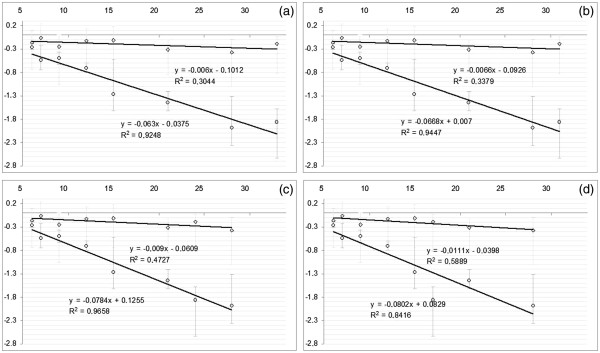
A survey of the published papers comparing 3-years of local regional control rate (LCR) for a total of 2162 patients treated with conventional and accelerated radiotherapy and with a pretreatment assessment of EGFr expression, was made. Different values of TD were obtained by a model incorporating the overall time corrected biologically effective dose (BED) and a 3-year clinical LCR for high and low EGFr groups of patients (HEGFr and LEGFr), respectively. By obtaining the TD from the above analysis and the sub-sites' potential doubling time (Tpot) from flow cytometry and immunohistochemical methods, we were able to estimate the average TD for each sub-site included in the analysis. Moreover, the dose that would be required to offset the modified proliferation occurring in one day (Dprolif), was estimated.
The averages of TD were 77 (27-90)95% days in LEGFr and 8.8 (7.3-11.0)95% days in HEGFr, if an onset of accelerated proliferation TK at day 21 was assumed. The correspondent HEGFr sub-sites' TD were 5.9 (6.6), 5.9 (6.6), 4.6 (6.1), 14.3 (12.9) days, with respect to literature immunohistochemical (flow cytometry) data of Tpot for Oral-Cavity, Oro-pharynx, Hypo-pharynx, and Larynx respectively. The Dprolif for the HEGFr groups were 0.33 (0.29), 0.33 (0.29), 0.42 (0.31), 0.14 (0.15) Gy/day if α = 0.3 Gy-1 and α/β = 10 Gy were assumed.
A higher expression of the EGFr leads to enhanced proliferation. This study allowed to quantify the extent of the effect which EGFr expression has in terms of reduced TD and Dprolif for each head and neck sub-site.
研究表皮生长因子受体(EGFr)的表达与头颈部鳞状细胞癌(HNSCC)加速放射治疗期间有效倍增时间(TD)缩短之间的相关性,并确定当总治疗时间(OTT)缩短时需要考虑的分次剂量。
对比较了 2162 例接受常规和加速放疗并在治疗前评估 EGFr 表达的患者的 3 年局部区域控制率(LCR)的已发表文献进行了调查。通过将总时间校正的生物有效剂量(BED)与高和低 EGFr 组患者的 3 年临床 LCR 相结合的模型,获得了不同的 TD 值(HEGFr 和 LEGFr)。通过从上述分析中获得 TD,并从流式细胞术和免疫组织化学方法中获得各亚部位的潜在倍增时间(Tpot),我们能够估计分析中包含的每个亚部位的平均 TD。此外,还估计了抵消一天中发生的修饰性增殖所需的剂量(Dprolif)。
如果假设加速增殖的起始时间为第 21 天,则 LEGFr 的平均 TD 为 77(27-90)95%天,HEGFr 为 8.8(7.3-11.0)95%天。相应的 HEGFr 亚部位的 TD 分别为口腔、口咽、下咽和喉的文献免疫组织化学(流式细胞术)数据 Tpot 的 5.9(6.6)、5.9(6.6)、4.6(6.1)、14.3(12.9)天。对于 HEGFr 组,假设 α=0.3 Gy-1 和 α/β=10 Gy,则 Dprolif 分别为 0.33(0.29)、0.33(0.29)、0.42(0.31)、0.14(0.15)Gy/天。
EGFr 的高表达导致增殖增强。本研究定量评估了 EGFr 表达对头颈部每个亚部位 TD 和 Dprolif 缩短的影响程度。