Divison of Urologic Surgery, Department of Surgery, Duke Prostate Center, Duke University School of Medicine, Durham, NC 27710, USA.
Eur Urol. 2012 Nov;62(5):910-6. doi: 10.1016/j.eururo.2012.08.015. Epub 2012 Aug 20.
Obesity is associated with an increased risk of biochemical recurrence (BCR) after radical prostatectomy (RP). It is unclear whether this is due to technical challenges related to operating on obese men or other biologic factors.
To examine whether obesity predicts higher prostate-specific antigen (PSA) nadir (as a measure of residual PSA-producing tissue) after RP and if this accounts for the greater BCR risk in obese men.
DESIGN, SETTING, AND PARTICIPANTS: A retrospective analysis of 1038 RP patients from 2001 to 2010 in the multicenter US Veterans Administration-based Shared Equal Access Regional Cancer Hospital database with median follow-up of 41 mo.
All patients underwent RP.
We evaluated the relationship between body mass index (BMI) and ultrasensitive PSA nadir within 6 mo after RP. Adjusted proportional hazards models were used to examine the association between BMI and BCR with and without PSA nadir.
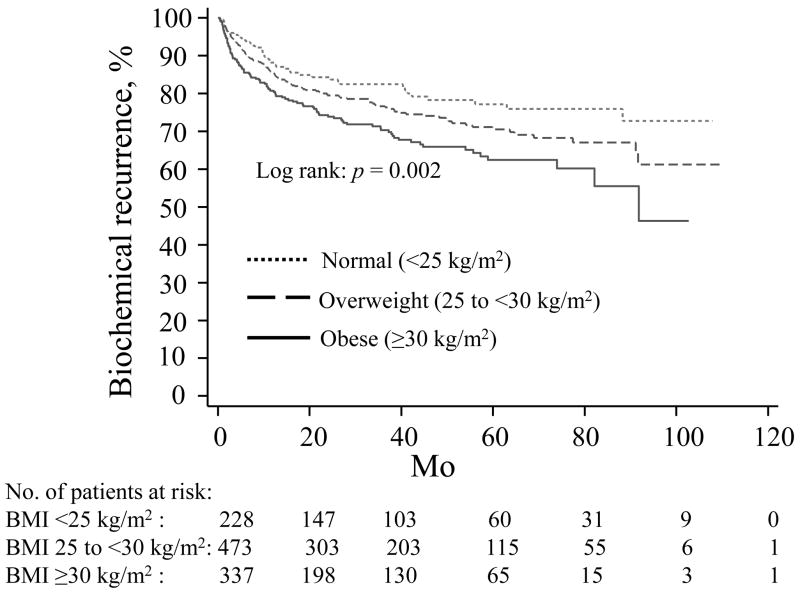
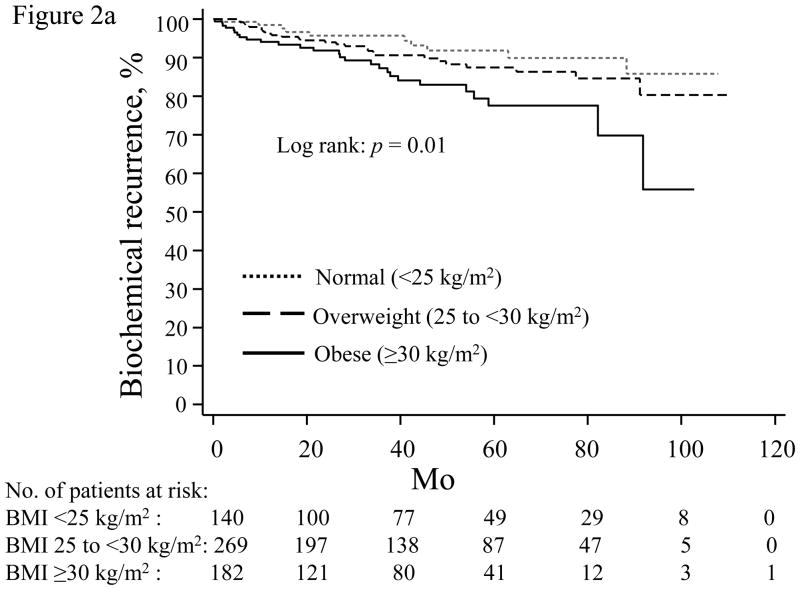
Mean BMI was 28.5 kg/m2. Higher BMI was associated with higher PSA nadir on both univariable (p=0.001) and multivariable analyses (p<0.001). Increased BMI was associated with increased BCR risk (hazard ratio [HR]: 1.06; p=0.007). Adjusting for PSA nadir slightly attenuated, but did not eliminate, this association (HR: 1.04, p=0.043). When stratified by PSA nadir, obesity only significantly predicted BCR in men with an undetectable nadir (p=0.006). Unfortunately, other clinically relevant end points such as metastasis or mortality were not available.
Obese men are more likely to have a higher PSA nadir, suggesting that either more advanced disease or technical issues confound an ideal operation. However, even after adjusting for the increased PSA nadir, obesity remained predictive of BCR, suggesting that tumors in obese men are growing faster. This provides further support for the idea that obesity is biologically associated with prostate cancer progression.
肥胖与根治性前列腺切除术(RP)后生化复发(BCR)的风险增加有关。目前尚不清楚这是由于肥胖男性手术操作的技术挑战,还是其他生物学因素所致。
研究肥胖是否预测 RP 后前列腺特异性抗原(PSA)最低值(作为残留 PSA 产生组织的衡量标准)更高,以及这是否解释了肥胖男性 BCR 风险更高的原因。
设计、地点和参与者:对 2001 年至 2010 年期间,在多中心美国退伍军人事务部共享平等获取区域癌症医院数据库中,1038 例 RP 患者进行回顾性分析,中位随访时间为 41 个月。
所有患者均接受 RP。
评估了 BMI 与 RP 后 6 个月内 ultrasensitive PSA 最低值之间的关系。使用调整后的比例风险模型,研究 BMI 与 BCR 的关系,以及在有无 PSA 最低值的情况下 BMI 与 BCR 的关系。
平均 BMI 为 28.5kg/m2。单变量(p=0.001)和多变量分析(p<0.001)均显示,BMI 越高,PSA 最低值越高。BMI 升高与 BCR 风险增加相关(风险比[HR]:1.06;p=0.007)。调整 PSA 最低值后,这种相关性略有减弱,但并未消除(HR:1.04,p=0.043)。按 PSA 最低值分层后,肥胖仅在 PSA 最低值不可检测的男性中显著预测 BCR(p=0.006)。遗憾的是,无法获得其他临床相关的终点,如转移或死亡率。
肥胖男性更有可能 PSA 最低值较高,这表明要么是疾病更晚期,要么是技术问题干扰了理想的手术操作。然而,即使调整了 PSA 最低值,肥胖仍然是 BCR 的预测因素,这表明肥胖男性的肿瘤生长更快。这进一步支持了肥胖与前列腺癌进展具有生物学相关性的观点。