Neurosciences and Mental Health, Sick Kids Research Institute, Toronto, Ontario, Canada.
Neurosci Lett. 2012 Oct 3;527(1):34-9. doi: 10.1016/j.neulet.2012.08.030. Epub 2012 Aug 25.
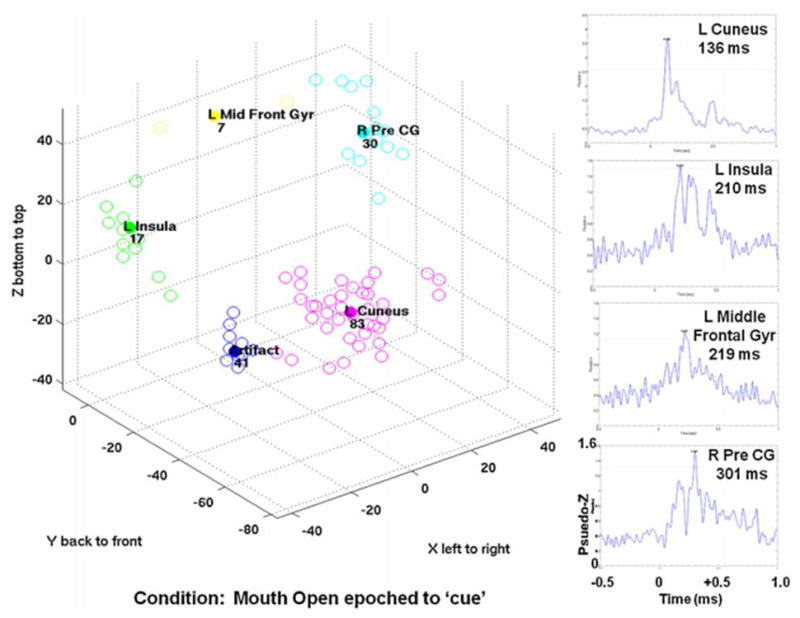
We used whole-head magnetoencephalography to investigate cortical activity during two oromotor activities foundational to speech production. 13 adults performed mouth opening and phoneme (/pa/) production tasks to a visual cue. Jaw movements were tracked with an ultrasound-emitting device. Trials were time-locked to both stimulus onset and peak of jaw displacement. An event-related beamformer source reconstruction algorithm was used to detect areas of cortical activity for each condition. Beamformer output was submitted to iterative K-means clustering analyses. The time course of neural activity at each cluster centroid was computed for each individual and condition. Peaks were identified and latencies submitted for statistical analysis to reveal the relative timing of activity in each brain region. Stimulus locked activations for the mouth open task included a progression from left cuneus to left frontal and then right pre-central gyrus. Phoneme generation revealed the same sequence but with bilateral frontal activation. When time locked to jaw displacement, the mouth open condition showed left frontal followed by right frontal-temporal areas. Phoneme generation showed a complicated sequence of bilateral temporal and frontal areas. This study used three unique approaches (beamforming, clustering and jaw tracking) to demonstrate the temporal progression of neural activations that underlie the motor control of two simple oromotor tasks. These findings have implications for understanding clinical conditions with deficits in articulatory control or motor speech planning.
我们使用全头磁脑图研究了与言语产生基础相关的两种口腔运动期间的皮质活动。13 名成年人根据视觉提示进行张口和音素 (/pa/) 产生任务。使用超声发射装置跟踪下颌运动。试验与刺激开始和下颌位移峰值时间锁定。使用事件相关波束形成器源重建算法检测每个条件的皮质活动区域。将波束形成器输出提交给迭代 K-均值聚类分析。为每个个体和条件计算每个聚类质心的神经活动的时间过程。识别峰并提交潜伏期进行统计分析,以揭示每个脑区活动的相对时间。张口任务的刺激锁定激活包括从左楔前叶到左额下回再到右中央前回的进展。音素生成显示出相同的序列,但双侧额区激活。当与下颌位移时间锁定时,张口条件显示左侧额下回,然后是右侧额颞区。音素生成显示出双侧颞区和额区的复杂序列。本研究使用三种独特的方法(波束形成、聚类和下颌跟踪)来证明运动控制两种简单口腔运动的神经激活的时间进展。这些发现对理解在发音控制或运动言语计划方面有缺陷的临床状况具有重要意义。