Dash Debadatta, Wisler Alan, Ferrari Paul, Davenport Elizabeth Moody, Maldjian Joseph, Wang Jun
Department of Electrical and Computer Engineering, The University of Texas at Austin, Austin, TX 78712, USA.
Department of Neurology, Dell Medical School, The University of Texas at Austin, Austin, TX 78712, USA.
IEEE Access. 2020;8:182320-182337. doi: 10.1109/access.2020.3028831. Epub 2020 Oct 6.
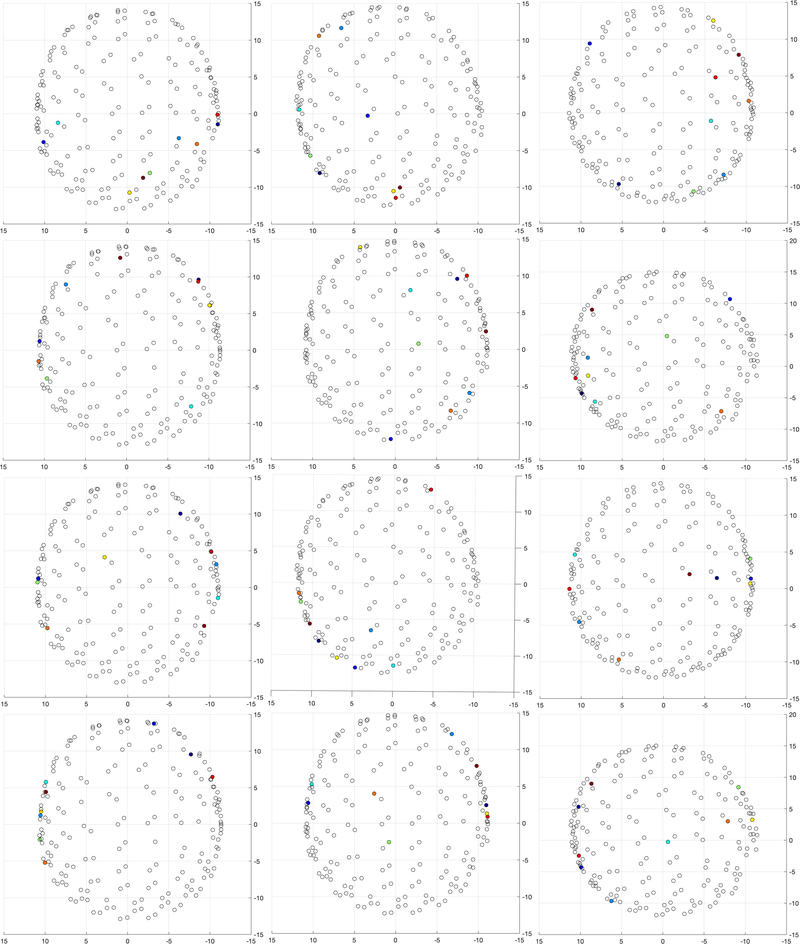
Direct decoding of speech from the brain is a faster alternative to current electroencephalography (EEG) speller-based brain-computer interfaces (BCI) in providing communication assistance to locked-in patients. Magnetoencephalography (MEG) has recently shown great potential as a non-invasive neuroimaging modality for neural speech decoding, owing in part to its spatial selectivity over other high-temporal resolution devices. Standard MEG systems have a large number of cryogenically cooled channels/sensors (200 - 300) encapsulated within a fixed liquid helium dewar, precluding their use as wearable BCI devices. Fortunately, recently developed optically pumped magnetometers (OPM) do not require cryogens, and have the potential to be wearable and movable making them more suitable for BCI applications. This design is also modular allowing for customized montages to include only the sensors necessary for a particular task. As the number of sensors bears a heavy influence on the cost, size, and weight of MEG systems, minimizing the number of sensors is critical for designing practical MEG-based BCIs in the future. In this study, we sought to identify an optimal set of MEG channels to decode imagined and spoken phrases from the MEG signals. Using a forward selection algorithm with a support vector machine classifier we found that nine optimally located MEG gradiometers provided higher decoding accuracy compared to using all channels. Additionally, the forward selection algorithm achieved similar performance to dimensionality reduction using a stacked-sparse-autoencoder. Analysis of spatial dynamics of speech decoding suggested that both left and right hemisphere sensors contribute to speech decoding. Sensors approximately located near Broca's area were found to be commonly contributing among the higher-ranked sensors across all subjects.
大脑语音直接解码是一种比当前基于脑电图(EEG)拼写器的脑机接口(BCI)更快的方式,可为闭锁综合征患者提供通信辅助。最近,脑磁图(MEG)作为一种用于神经语音解码的非侵入性神经成像方式显示出巨大潜力,部分原因在于其相对于其他高时间分辨率设备具有空间选择性。标准MEG系统有大量低温冷却通道/传感器(200 - 300个)封装在固定的液氦杜瓦瓶内,这使得它们无法用作可穿戴BCI设备。幸运的是,最近开发的光泵磁力仪(OPM)不需要低温冷却剂,并且有可能可穿戴和可移动,使其更适合BCI应用。这种设计也是模块化的,允许定制组装,只包括特定任务所需的传感器。由于传感器数量对MEG系统的成本、尺寸和重量有很大影响,未来设计实用的基于MEG的BCI时,尽量减少传感器数量至关重要。在本研究中,我们试图确定一组最佳的MEG通道,以便从MEG信号中解码想象和说出的短语。使用带有支持向量机分类器的前向选择算法,我们发现与使用所有通道相比,九个最佳定位的MEG梯度仪提供了更高的解码准确率。此外,前向选择算法实现了与使用堆叠稀疏自动编码器进行降维相似的性能。语音解码的空间动态分析表明,左右半球的传感器都对语音解码有贡献。发现在所有受试者中,排名较高的传感器中通常有大约位于布洛卡区附近的传感器起作用。