Institute of Dentistry, University of Helsinki, POB 41, 00014 HY, Helsinki, Finland.
Med Oral Patol Oral Cir Bucal. 2013 Jan 1;18(1):e7-11. doi: 10.4317/medoral.18232.
The aims were to analyze whether the levels of self-reported bruxism and anxiety associate among otherwise healthy subjects, and to investigate the independent effects of anxiety and stress experience on the probability of self-reported bruxism.
As part of a study on irregular shift work, a questionnaire was mailed to all employees of the Finnish Broadcasting Company with irregular shift work (number of subjects: n=750) and to an equal number of randomly selected employees in the same company with regular eight-hour daytime work.
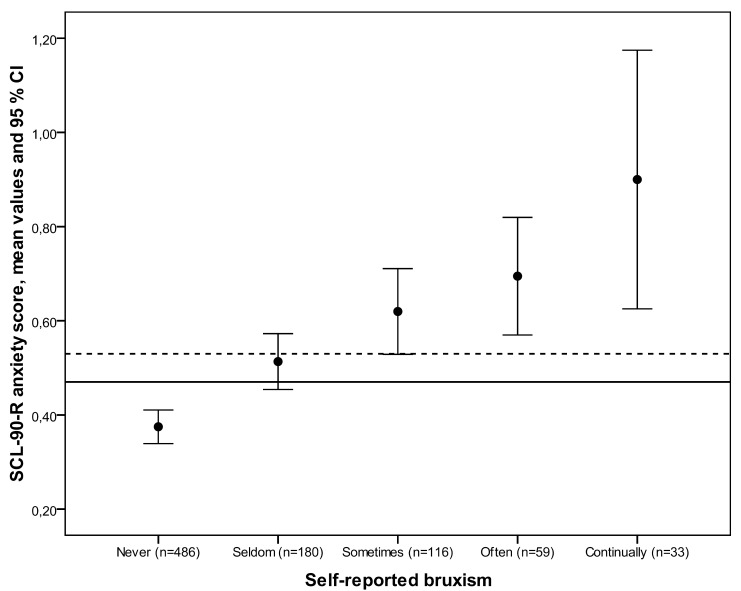
The response rates were 82.3% (56.6 % men) and 34.3 % (46.7 % men), respectively. Among the 874 respondents, those aware of more frequent bruxism reported significantly more severe anxiety (p<0.001). Adjusted by age and gender, frequent bruxers were more than two times more likely to report severe stress (odds ratio 2.5; 95% confidence interval 1.5-4.2) and anxiety (odds ratio 2.2; 95% confidence interval 1.3-3.6) than non-or-mild bruxers.
Present findings suggest that self-reported bruxism and psychological states such as anxiety or stress may be related in working age subjects.
分析在其他健康人群中,自我报告的磨牙症和焦虑症水平是否相关,并探讨焦虑和压力体验对自我报告的磨牙症的可能性的独立影响。
作为一项关于不规则轮班工作的研究的一部分,向芬兰广播公司所有从事不规则轮班工作的员工(调查对象人数:n=750)和同公司中随机选择的同样从事 8 小时白班工作的员工邮寄了一份问卷。
回复率分别为 82.3%(56.6%为男性)和 34.3%(46.7%为男性)。在 874 名应答者中,那些报告磨牙症更频繁的人报告的焦虑症明显更严重(p<0.001)。调整年龄和性别后,频繁磨牙者报告严重压力(比值比 2.5;95%置信区间 1.5-4.2)和焦虑(比值比 2.2;95%置信区间 1.3-3.6)的可能性是偶尔或轻度磨牙者的两倍多。
目前的研究结果表明,自我报告的磨牙症和焦虑等心理状态在工作年龄段人群中可能相关。