Singh Rishi, Alpern Louis, Jaffe Glenn J, Lehmann Robert P, Lim John, Reiser Harvey J, Sall Kenneth, Walters Thomas, Sager Dana
Cole Eye Institute, Cleveland Clinic Foundation, Cleveland, OH.
Clin Ophthalmol. 2012;6:1259-69. doi: 10.2147/OPTH.S31902. Epub 2012 Aug 3.
The purpose of this study was to evaluate nepafenac ophthalmic suspension 0.1% (Nevanac(®); Alcon Research Ltd) in the prevention of macular edema following cataract surgery in diabetic retinopathy patients.
This was a multicenter, randomized, double-masked, vehicle-controlled study of 263 adult diabetic patients with nonproliferative diabetic retinopathy requiring cataract surgery. Patients were randomized (1:1) to instill nepafenac or vehicle three times daily beginning 1 day prior to surgery through day 90. Efficacy included the percentage of patients who developed macular edema (≥30% increase in central subfield macular thickness from baseline) and the percentage of patients with decreases of more than five letters in best-corrected visual acuity from day 7 to 90.
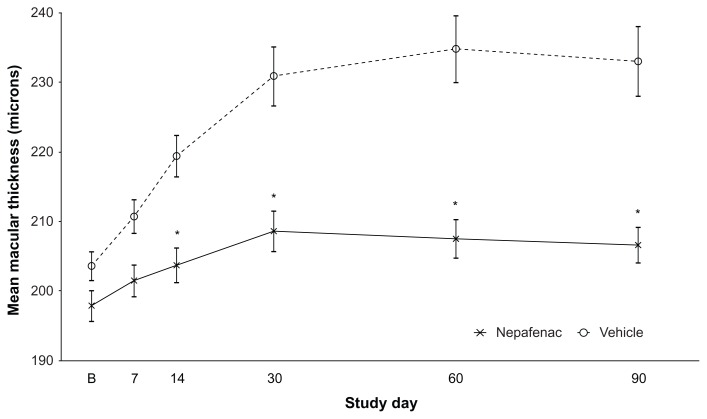
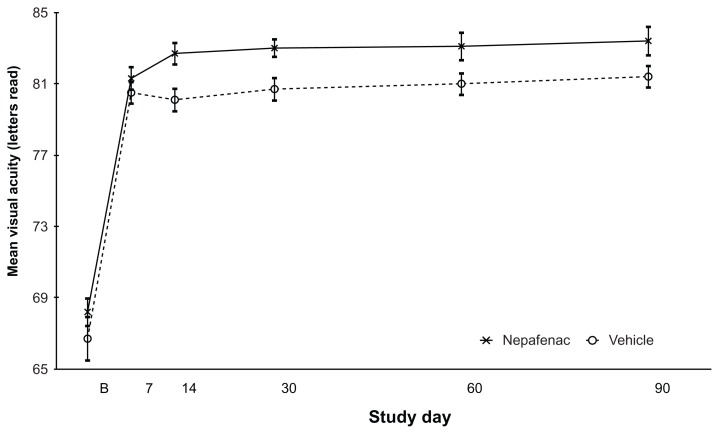
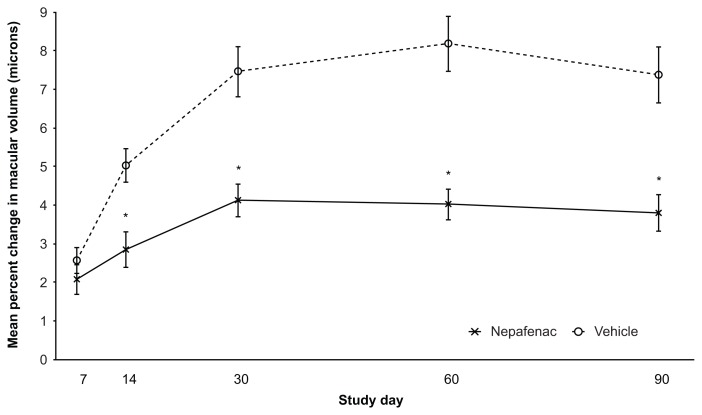
A significantly lower percentage of patients in the nepafenac group developed macular edema relative to patients in the vehicle group (3.2% versus 16.7%; P < 0.001). A significantly lower percentage of patients in the nepafenac group had best-corrected visual acuity decreases of more than five letters relative to patients in the vehicle group on day 30 (P < 0.001), day 60 (P = 0.002), and day 90 (P = 0.006). The mean central subfield macular thickness and mean percent change from baseline in macular volume were also significantly lower in the nepafenac group versus the vehicle group at days 14 through 90 (P ≤ 0.005). No safety issues or trends were identified when dosing was increased to 90 days that negatively impacted the favorable benefit/risk profile of nepafenac.
Nepafenac demonstrated statistically significant and clinically relevant advantages compared with vehicle in preventing macular edema and maintaining visual acuity in diabetic patients following cataract surgery. These advantages were seen at multiple time points over the course of the 90-day therapy period. There was no clinically relevant increase in risk from 90 days dosing compared with 14 days. Therefore, with a similar safety profile and benefit in preventing macular edema and maintaining vision, the risk/benefit to the diabetic patient undergoing cataract surgery appears to be positive.
本研究旨在评估0.1%奈帕芬酸眼用混悬液(内万灵(®);爱尔康研究有限公司)在预防糖尿病视网膜病变患者白内障手术后黄斑水肿方面的效果。
这是一项多中心、随机、双盲、赋形剂对照研究,纳入了263例需要进行白内障手术的非增殖性糖尿病视网膜病变成年患者。患者被随机分组(1:1),从手术前1天开始至术后90天,每天滴注奈帕芬酸或赋形剂3次。疗效指标包括出现黄斑水肿(中心子野黄斑厚度较基线增加≥30%)的患者百分比,以及从第7天至90天最佳矫正视力下降超过5行的患者百分比。
与赋形剂组相比,奈帕芬酸组出现黄斑水肿的患者百分比显著更低(3.2%对16.7%;P<0.001)。在第30天(P<0.001)、第60天(P = 0.002)和第90天(P = 0.006),奈帕芬酸组最佳矫正视力下降超过5行的患者百分比显著低于赋形剂组。在第14天至90天,奈帕芬酸组的平均中心子野黄斑厚度和黄斑体积相对于基线的平均变化百分比也显著低于赋形剂组(P≤0.005)。当给药时间延长至90天时,未发现对奈帕芬酸有利的获益/风险状况产生负面影响的安全性问题或趋势。
与赋形剂相比,奈帕芬酸在预防糖尿病患者白内障手术后黄斑水肿和维持视力方面具有统计学显著且临床相关的优势。这些优势在90天治疗期的多个时间点均可见。与14天给药相比,90天给药在临床上并未导致风险显著增加。因此,鉴于其相似的安全性以及在预防黄斑水肿和维持视力方面的获益,对于接受白内障手术的糖尿病患者而言,其风险/获益似乎是有利的。