Department of Psychiatry, University Hospital of Bellvitge-IDIBELL, Barcelona, Spain.
PLoS One. 2012;7(8):e43382. doi: 10.1371/journal.pone.0043382. Epub 2012 Aug 21.
Extreme weight conditions (EWC) groups along a continuum may share some biological risk factors and intermediate neurocognitive phenotypes. A core cognitive trait in EWC appears to be executive dysfunction, with a focus on decision making, response inhibition and cognitive flexibility. Differences between individuals in these areas are likely to contribute to the differences in vulnerability to EWC. The aim of the study was to investigate whether there is a common pattern of executive dysfunction in EWC while comparing anorexia nervosa patients (AN), obese subjects (OB) and healthy eating/weight controls (HC).
Thirty five AN patients, fifty two OB and one hundred thirty seven HC were compared using the Wisconsin Card Sorting Test (WCST); Stroop Color and Word Test (SCWT); and Iowa Gambling Task (IGT). All participants were female, aged between 18 and 60 years.
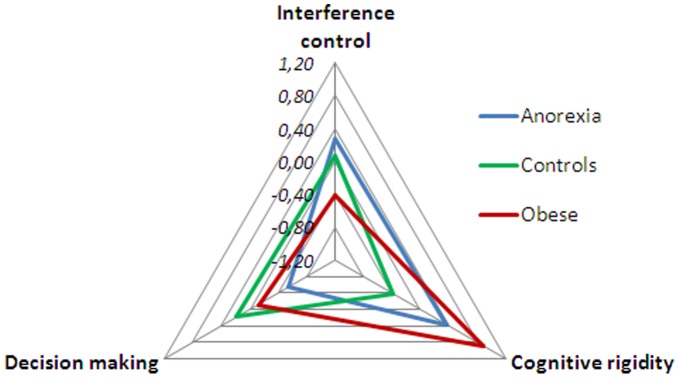
There was a significant difference in IGT score (F(1.79); p<.001), with AN and OB groups showing the poorest performance compared to HC. On the WCST, AN and OB made significantly more errors than controls (F(25.73); p<.001), and had significantly fewer correct responses (F(2.71); p<.001). Post hoc analysis revealed that the two clinical groups were not significantly different from each other. Finally, OB showed a significant reduced performance in the inhibition response measured with the Stroop test (F(5.11); p<.001) compared with both AN and HC.
These findings suggest that EWC subjects (namely AN and OB) have similar dysfunctional executive profile that may play a role in the development and maintenance of such disorders.
极端体重状况(EWC)组沿着连续统可能具有一些共同的生物学风险因素和中间神经认知表型。 EWC 中的核心认知特征似乎是执行功能障碍,重点是决策、反应抑制和认知灵活性。这些领域中个体之间的差异可能导致 EWC 易感性的差异。本研究的目的是在比较神经性厌食症患者(AN)、肥胖患者(OB)和健康饮食/体重对照组(HC)时,探讨 EWC 中是否存在共同的执行功能障碍模式。
使用威斯康星卡片分类测验(WCST)、Stroop 颜色和文字测验(SCWT)和爱荷华赌博任务(IGT)比较了 35 名 AN 患者、52 名 OB 和 137 名 HC。所有参与者均为女性,年龄在 18 至 60 岁之间。
IGT 评分存在显著差异(F(1.79);p<.001),AN 和 OB 组的表现明显差于 HC。在 WCST 上,AN 和 OB 比对照组犯了更多的错误(F(25.73);p<.001),且正确反应数明显减少(F(2.71);p<.001)。事后分析显示,这两个临床组彼此之间没有显著差异。最后,OB 在 Stroop 测试中抑制反应的表现明显降低(F(5.11);p<.001),与 AN 和 HC 相比。
这些发现表明,EWC 受试者(即 AN 和 OB)具有相似的功能失调执行功能障碍特征,可能在这些疾病的发展和维持中起作用。