Pediatric Oncology, Benjamin Bloom National Children's Hospital, San Salvador, El Salvador.
PLoS One. 2012;7(8):e43639. doi: 10.1371/journal.pone.0043639. Epub 2012 Aug 22.
Infection remains the most common cause of death from toxicity in children with cancer in low- and middle-income countries. Rapid administration of antibiotics when fever develops can prevent progression to sepsis and shock, and serves as an important indicator of the quality of care in children with acute lymphoblastic leukemia and acute myeloid leukemia. We analyzed factors associated with (1) Longer times from fever onset to hospital presentation/antibiotic treatment and (2) Sepsis and infection-related mortality.
This prospective cohort study included children aged 0-16 years with newly diagnosed acute leukemia treated at Benjamin Bloom Hospital, San Salvador. We interviewed parents/caregivers within one month of diagnosis and at the onset of each new febrile episode. Times from initial fever to first antibiotic administration and occurrence of sepsis and infection-related mortality were documented.
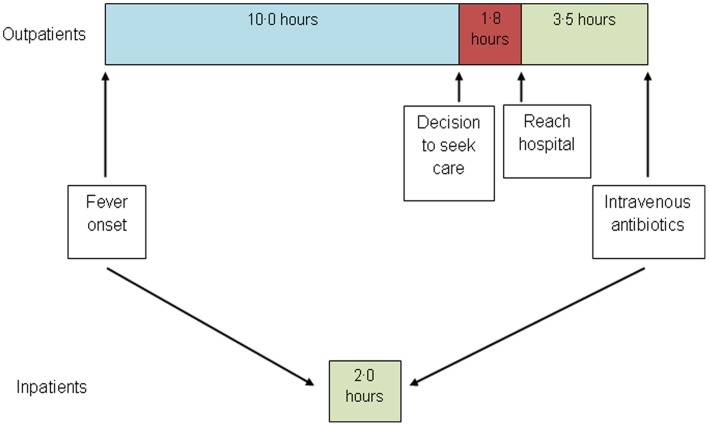
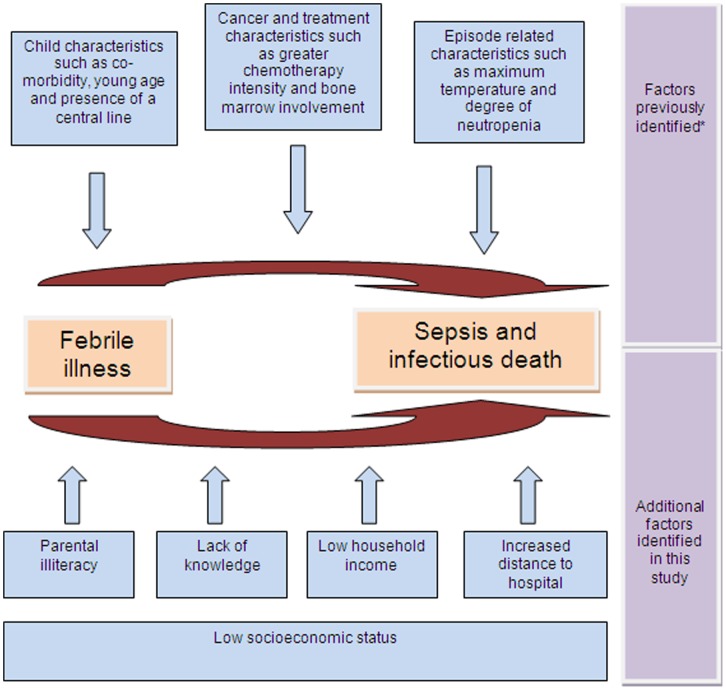
Of 251 children enrolled, 215 had acute lymphoblastic leukemia (85.7%). Among 269 outpatient febrile episodes, median times from fever to deciding to seek medical care was 10.0 hours (interquartile range [IQR] 5.0-20.0), and from decision to seek care to first hospital visit was 1.8 hours (IQR 1.0-3.0). Forty-seven (17.5%) patients developed sepsis and 7 (2.6%) died of infection. Maternal illiteracy was associated with longer time from fever to decision to seek care (P = 0.029) and sepsis (odds ratio [OR] 3.06, 95% confidence interval [CI] 1.09-8.63; P = 0.034). More infectious deaths occurred in those with longer travel time to hospital (OR 1.36, 95% CI 1.03-1.81; P = 0.031) and in families with an annual household income <US$2,000 (OR 13.90, 95% CI 1.62-119.10; P = 0.016).
Illiteracy, poverty, and longer travel times are associated with delays in assessment and treatment of fever and with sepsis and infectious mortality in pediatric leukemia. Providing additional education to high-risk families and staying at a nearby guest house during periods of neutropenia may decrease sepsis and infectious mortality.
在中低收入国家,感染仍然是导致癌症儿童因毒性而死亡的最常见原因。当发烧发生时,迅速给予抗生素可以防止发展为败血症和休克,并作为急性淋巴细胞白血病和急性髓细胞白血病患儿护理质量的重要指标。我们分析了与以下因素相关的因素:(1)从发热发作到医院就诊/抗生素治疗的时间延长;(2)败血症和感染相关的死亡率。
本前瞻性队列研究纳入了在圣萨尔瓦多本杰明布鲁姆医院接受新诊断的急性白血病治疗的 0-16 岁儿童。我们在诊断后一个月内和每次新发热发作时对父母/照顾者进行访谈。记录从首次发热到首次使用抗生素的时间,以及发生败血症和感染相关死亡率的情况。
在 251 名入组的儿童中,有 215 名患有急性淋巴细胞白血病(85.7%)。在 269 例门诊发热病例中,从发热到决定就医的中位数时间为 10.0 小时(IQR 5.0-20.0),从决定就医到首次就诊的中位数时间为 1.8 小时(IQR 1.0-3.0)。47 名(17.5%)患者发生败血症,7 名(2.6%)患者因感染死亡。母亲文盲与从发热到决定就医的时间延长相关(P=0.029)和败血症(比值比[OR]3.06,95%置信区间[CI]1.09-8.63;P=0.034)。在住院时间较长的患者(OR 1.36,95% CI 1.03-1.81;P=0.031)和家庭年收入<2000 美元的患者(OR 13.90,95% CI 1.62-119.10;P=0.016)中,发生更多的感染性死亡。
文盲、贫困和较长的旅行时间与对发热的评估和治疗的延迟以及儿科白血病患者的败血症和感染性死亡率有关。为高危家庭提供额外的教育,并在中性粒细胞减少期间住在附近的宾馆,可能会降低败血症和感染性死亡率。