Department of Physiology and Pharmacology, Federal University of Pernambuco, Recife, Brazil.
PLoS One. 2012;7(8):e43791. doi: 10.1371/journal.pone.0043791. Epub 2012 Aug 22.
High Na(+) intake is a reality in nowadays and is frequently accompanied by renal and cardiovascular alterations. In this study, renal mechanisms underlying perinatal Na(+) overload-programmed alterations in Na(+) transporters and the renin/angiotensin system (RAS) were investigated, together with effects of short-term treatment with enalapril in terms of reprogramming molecular alterations in kidney.
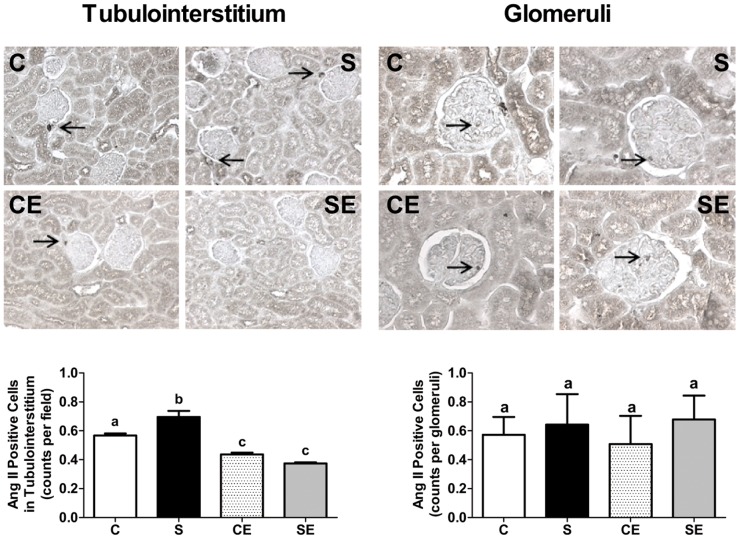
METHODOLOGY/PRINCIPAL FINDINGS: Male adult Wistar rats were obtained from dams maintained throughout pregnancy and lactation on a standard diet and drinking water (control) or 0.17 M NaCl (saline group). Enalapril (100 mg/l), an angiotensin converting enzyme inhibitor, was administered for three weeks after weaning. Ninety day old offspring from dams that drank saline presented with proximal tubules exhibiting increased (Na(+)+K(+))ATPase expression and activity. Ouabain-insensitive Na(+)-ATPase activity remained unchanged but its response to angiotensin II (Ang II) was lost. PKC, PKA, renal thiobarbituric acid reactive substances (TBARS), macrophage infiltration and collagen deposition markedly increased, and AT(2) receptor expression decreased while AT(1) expression was unaltered. Early treatment with enalapril reduced expression and activity of (Na(+)+K(+))ATPase, partially recovered the response of Na(+)-ATPase to Ang II, and reduced PKC and PKA activities independently of whether offspring were exposed to high perinatal Na(+) or not. In addition, treatment with enalapril per se reduced AT(2) receptor expression, and increased TBARS, macrophage infiltration and collagen deposition. The perinatally Na(+)-overloaded offspring presented high numbers of Ang II-positive cortical cells, and significantly lower circulating Ang I, indicating that programming/reprogramming impacted systemic and local RAS.
CONCLUSIONS/SIGNIFICANCE: Maternal Na(+) overload programmed alterations in renal Na(+) transporters and in its regulation, as well as severe structural lesions in adult offspring. Enalapril was beneficial predominantly through its influence on Na(+) pumping activities in adult offspring. However, side effects including down-regulation of PKA, PKC and AT(2) receptors and increased TBARS could impair renal function in later life.
目前,高钠(Na+)摄入是一种现实,经常伴随着肾脏和心血管的改变。在这项研究中,我们研究了围产期 Na+超负荷引起的肾脏 Na+转运体和肾素-血管紧张素系统(RAS)变化的机制,以及短期用依那普利治疗对肾脏分子变化的再编程作用。
方法/主要发现:雄性成年 Wistar 大鼠从孕鼠中获得,这些孕鼠在整个孕期和哺乳期都被喂食标准饮食和饮用水(对照组)或 0.17 M NaCl(盐水组)。断奶后,用依那普利(100mg/l)治疗三周。从喝盐水的母鼠所生的 90 天大的幼鼠表现出近端肾小管中(Na++K+)ATP 酶表达和活性增加。哇巴因不敏感的 Na+-ATP 酶活性保持不变,但对血管紧张素 II(Ang II)的反应消失。PKC、PKA、肾丙二醛(TBARS)、巨噬细胞浸润和胶原沉积明显增加,AT2 受体表达减少,而 AT1 受体表达不变。早期用依那普利治疗可降低(Na++K+)ATP 酶的表达和活性,部分恢复 Na+-ATP 酶对 Ang II 的反应,并降低 PKC 和 PKA 的活性,无论幼鼠是否暴露于高围产期 Na+。此外,依那普利本身降低了 AT2 受体的表达,并增加了 TBARS、巨噬细胞浸润和胶原沉积。围产期 Na+超负荷的后代皮质细胞中 Ang II 阳性细胞数量较多,而循环 Ang I 水平显著降低,这表明编程/再编程对全身和局部 RAS 都有影响。
结论/意义:母体 Na+超负荷编程改变了肾脏 Na+转运体及其调节,并导致成年后代出现严重的结构损伤。依那普利主要通过影响成年后代的 Na+泵活动而有益。然而,包括 PKA、PKC 和 AT2 受体下调以及 TBARS 增加在内的副作用可能会在以后的生活中损害肾功能。