World Health Organization, Regional Office for Africa, Brazzaville, Congo.
BMC Int Health Hum Rights. 2012 Aug 28;12:16. doi: 10.1186/1472-698X-12-16.
The 58th World Health Assembly and 56th WHO Regional Committee for Africa adopted resolutions urging Member States to ensure that health financing systems included a method for prepayment to foster financial risk sharing among the population and avoid catastrophic health-care expenditure. The Regional Committee asked countries to strengthen or develop comprehensive health financing policies. This paper presents the findings of a survey conducted among senior staff of selected Eritrean ministries and agencies to elicit views on some of the elements likely to be part of a national health financing policy.
This is a descriptive study. A questionnaire was prepared and sent to 19 senior staff (Directors) in the Ministry of Health, Labour Department, Civil Service Administration, Eritrean Confederation of Workers, National Insurance Corporation of Eritrea and Ministry of Local Government. The respondents were selected by the Ministry of Health as key informants.
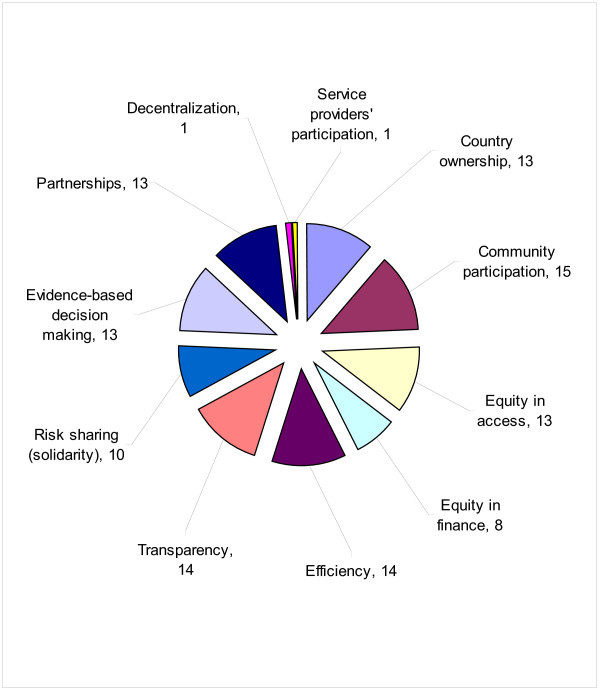
The key findings were as follows: the response rate was 84.2% (16/19); 37.5% (6/16) and 18.8% said that the vision of Eritrean National Health Financing Policy (NHFP) should include the phrases 'equitable and accessible quality health services' and 'improve efficiency or reduce waste' respectively; over 68% indicated that NHFP should include securing adequate funding, ensuring efficiency, ensuring equitable financial access, protection from financial catastrophe, and ensuring provider payment mechanisms create positive incentives to service providers; over 80% mentioned community participation, efficiency, transparency, country ownership, equity in access, and evidence-based decision making as core values of NHFP; over 62.5% confirmed that NHFP components should consist of stewardship (oversight), revenue collection, revenue pooling and risk management, resource allocation and purchasing of health services, health economics research, and development of human resources for health; over 68.8% indicated cost-sharing, taxation and social health insurance as preferred revenue collection mechanisms; and 68.75% indicated their preferred provider payment mechanism to be a global (lump sum) budget.
This study succeeded in gathering the preliminary views of senior staff of selected Eritrean ministries and agencies regarding the likely elements of the NHFP, i.e. the vision, objectives, components, provider payment mechanisms, and health financing agency and its governance. In addition to stakeholder surveys, it would be helpful to inform the development of the NHFP with other pieces of evidence, including cost-effectiveness analysis of health services and interventions, financial feasibility analysis of financing options, a survey of the political and professional acceptability of financing options, national health accounts, and equity analyses.

第 58 届世界卫生大会和第 56 届世卫组织非洲区域委员会通过决议,敦促会员国确保卫生融资系统包括预付款方法,以促进人口之间的财务风险分担并避免灾难性的医疗支出。区域委员会要求各国加强或制定全面的卫生融资政策。本文介绍了在选定的厄立特里亚部委和机构的高级工作人员中进行的一项调查的结果,以征求他们对国家卫生融资政策可能包含的一些要素的看法。
这是一项描述性研究。编写并向卫生部、劳动部门、公务员管理局、厄立特里亚工人联合会、厄立特里亚国家保险公司和地方政府部的 19 名高级工作人员(主任)发送了一份问卷。这些受访者是由卫生部作为主要信息来源选定的。
主要发现如下:答复率为 84.2%(16/19);37.5%(6/16)和 18.8%表示,厄立特里亚国家卫生融资政策(NHFP)的愿景应分别包括“公平和可及的优质卫生服务”和“提高效率或减少浪费”;超过 68%的人表示,NHFP 应包括确保充足的资金、确保效率、确保公平的财务获取、防范财务灾难以及确保提供者支付机制为提供者创造积极的激励措施;超过 80%的人提到社区参与、效率、透明度、国家所有权、公平获取以及循证决策作为 NHFP 的核心价值观;超过 62.5%的人证实,NHFP 组成部分应包括管理(监督)、收入征收、收入汇集和风险管理、资源分配和卫生服务采购、卫生经济学研究以及卫生人力资源开发;超过 68.8%的人表示,成本分担、税收和社会健康保险是首选的收入征收机制;68.75%的人表示他们首选的提供者支付机制是全球(总额)预算。
这项研究成功地收集了选定的厄立特里亚部委和机构的高级工作人员对 NHFP 可能要素的初步意见,即愿景、目标、组成部分、提供者支付机制以及卫生融资机构及其治理。除利益相关者调查外,还可以通过其他证据来为 NHFP 的制定提供信息,包括卫生服务和干预措施的成本效益分析、融资选择的财务可行性分析、对融资选择的政治和专业接受度的调查、国家卫生账户和公平性分析。