Department of Pathology & Laboratory Medicine, Lineberger Comprehensive Cancer Center, University of North Carolina, 913 Brinkhous-Bullitt Building, Chapel Hill, NC, 27599-7525, USA.
Infect Agent Cancer. 2012 Aug 28;7(1):21. doi: 10.1186/1750-9378-7-21.
EBV DNA is found within the malignant cells of 10% of gastric cancers. Modern molecular technology facilitates identification of virus-related biochemical effects that could assist in early diagnosis and disease management.
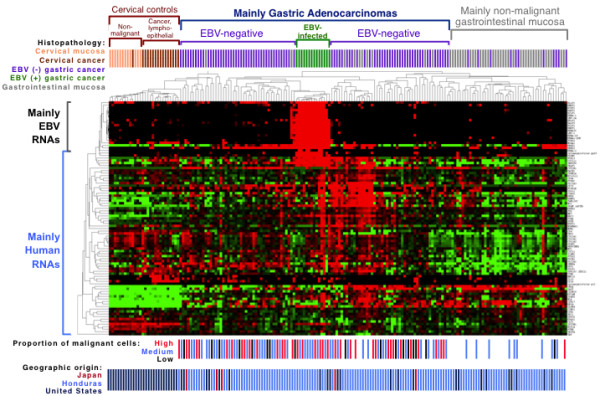
In this study, RNA expression profiling was performed on 326 macrodissected paraffin-embedded tissues including 204 cancers and, when available, adjacent non-malignant mucosa. Nanostring nCounter probes targeted 96 RNAs (20 viral, 73 human, and 3 spiked RNAs).
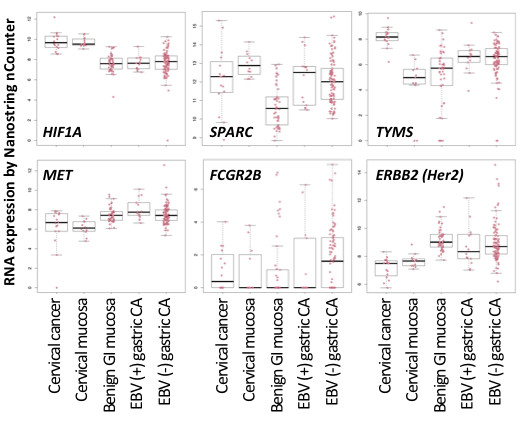
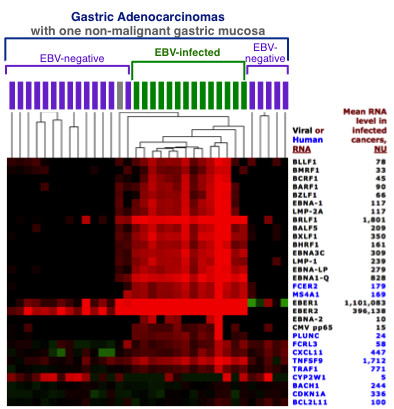
In 182 tissues with adequate housekeeper RNAs, distinct profiles were found in infected versus uninfected cancers, and in malignant versus adjacent benign mucosa. EBV-infected gastric cancers expressed nearly all of the 18 latent and lytic EBV RNAs in the test panel. Levels of EBER1 and EBER2 RNA were highest and were proportional to the quantity of EBV genomes as measured by Q-PCR. Among protein coding EBV RNAs, EBNA1 from the Q promoter and BRLF1 were highly expressed while EBNA2 levels were low positive in only 6/14 infected cancers. Concomitant upregulation of cellular factors implies that virus is not an innocent bystander but rather is linked to NFKB signaling (FCER2, TRAF1) and immune response (TNFSF9, CXCL11, IFITM1, FCRL3, MS4A1 and PLUNC), with PPARG expression implicating altered cellular metabolism. Compared to adjacent non-malignant mucosa, gastric cancers consistently expressed INHBA, SPP1, THY1, SERPINH1, CXCL1, FSCN1, PTGS2 (COX2), BBC3, ICAM1, TNFSF9, SULF1, SLC2A1, TYMS, three collagens, the cell proliferation markers MYC and PCNA, and EBV BLLF1 while they lacked CDH1 (E-cadherin), CLDN18, PTEN, SDC1 (CD138), GAST (gastrin) and its downstream effector CHGA (chromogranin). Compared to lymphoepithelioma-like carcinoma of the uterine cervix, gastric cancers expressed CLDN18, EPCAM, REG4, BBC3, OLFM4, PPARG, and CDH17 while they had diminished levels of IFITM1 and HIF1A. The druggable targets ERBB2 (Her2), MET, and the HIF pathway, as well as several other potential pharmacogenetic indicators (including EBV infection itself, as well as SPARC, TYMS, FCGR2B and REG4) were identified in some tumor specimens.
This study shows how modern molecular technology applied to archival fixed tissues yields novel insights into viral oncogenesis that could be useful in managing affected patients.
10%的胃癌细胞中存在 EBV DNA。现代分子技术有助于识别病毒相关的生化效应,从而有助于早期诊断和疾病管理。
本研究对包括 204 例癌症在内的 326 例宏观解剖石蜡包埋组织进行了 RNA 表达谱分析,如有可能,还包括相邻的非恶性粘膜。纳米串 nCounter 探针靶向 96 个 RNA(20 个病毒、73 个人类和 3 个 Spike RNA)。
在 182 个具有足够管家 RNA 的组织中,感染与未感染的癌症之间以及恶性与相邻良性粘膜之间存在不同的特征。感染的胃癌表达了测试面板中几乎所有的 18 种潜伏和裂解 EBV RNA。EBER1 和 EBER2 RNA 的水平最高,并且与通过 Q-PCR 测量的 EBV 基因组数量成正比。在编码 EBV RNA 的蛋白质中,来自 Q 启动子的 EBNA1 和 BRLF1 表达水平较高,而 EBNA2 水平在 14 例感染的癌症中仅为低阳性。伴随细胞因子的上调表明病毒不是无辜的旁观者,而是与 NFKB 信号(FCER2、TRAF1)和免疫反应(TNFSF9、CXCL11、IFITM1、FCRL3、MS4A1 和 PLUNC)相关联,PPARG 的表达暗示着细胞代谢的改变。与相邻的非恶性粘膜相比,胃癌一致地表达 INHBA、SPP1、THY1、SERPINH1、CXCL1、FSCN1、PTGS2(COX2)、BBC3、ICAM1、TNFSF9、SULF1、SLC2A1、TYMS、三种胶原蛋白、细胞增殖标志物 MYC 和 PCNA,而缺乏 CDH1(E-钙粘蛋白)、CLDN18、PTEN、SDC1(CD138)、GAST(胃泌素)及其下游效应物 CHGA(嗜铬粒蛋白)。与子宫颈的淋巴上皮样癌相比,胃癌表达 CLDN18、EPCAM、REG4、BBC3、OLFM4、PPARG 和 CDH17,而 IFITM1 和 HIF1A 的水平降低。在一些肿瘤标本中发现了可靶向的药物靶点 ERBB2(Her2)、MET 和 HIF 通路,以及其他一些潜在的药物遗传学指标(包括 EBV 感染本身,以及 SPARC、TYMS、FCGR2B 和 REG4)。
本研究表明,现代分子技术应用于存档固定组织如何产生病毒致癌的新见解,这可能有助于管理受影响的患者。