Department of Lymphoma and Myeloma, The University of Texas MD Anderson Cancer Center, 1515 Holcombe Blvd, Houston, TX 77030, USA.
J Exp Clin Cancer Res. 2012 Aug 28;31(1):69. doi: 10.1186/1756-9966-31-69.
Although significant progress has been made in the treatment of lymphomas, many lymphomas exhibit resistance to cell death, suggesting a defective Fas signaling, which remains poorly understood. We previously reported that cells expressing the K1 protein of human herpesvirus 8 (HHV-8) resist death through the complex formation of the Ig-like domain of K1 with Fas. Recently, we investigated whether peptides derived from the Ig-like domain of the K1 protein may affect cell death.
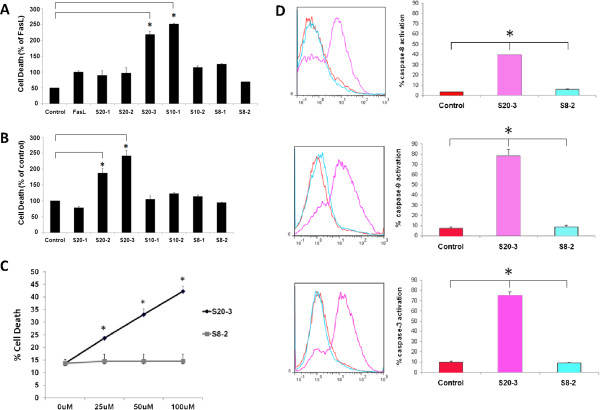
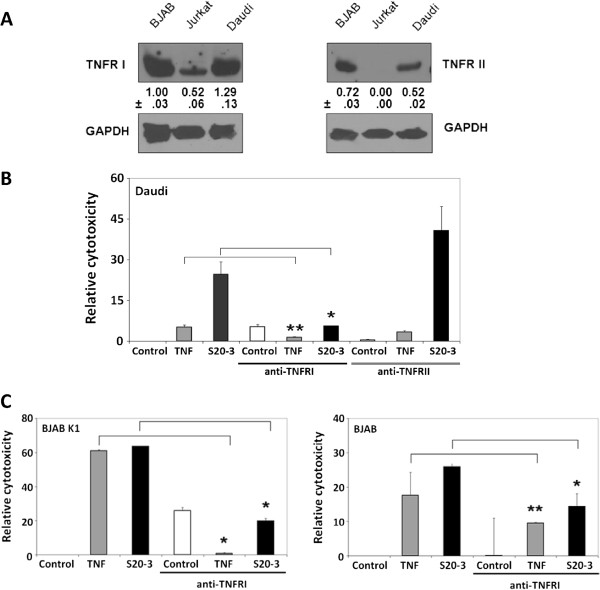
K1 positive and negative cell lines were incubated with the K1-derived peptides, and cell death (apoptotic and necrotic) was assessed by flow cytometry and LDH assay. Activation of caspases was assessed by fluorometric assay and flow cytometry. Fas receptor-independent, peptide-mediated cell killing was tested in the Fas-resistant Daudi cell line and Jurkat cell clones deficient in caspase-8 and FADD functionality. Activation of TNF receptors I and II was blocked by pre-incubation with corresponding blocking antibodies. The effect of the K1 peptide in vivo was tested in a mouse xenograft model.
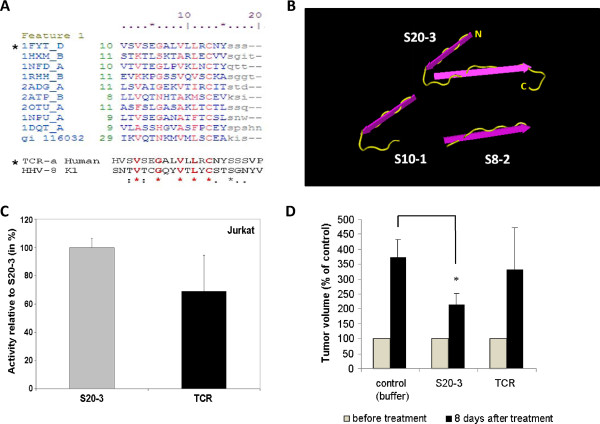
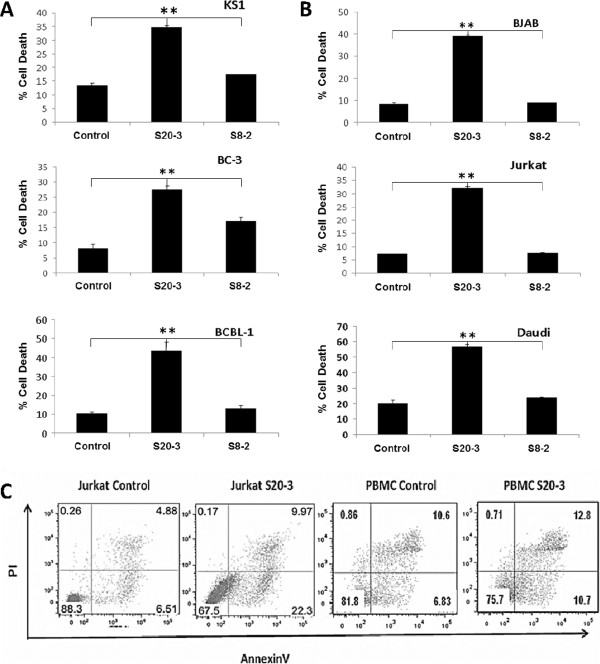
We observed that the peptide S20-3 enhanced cell death in K1-positive BJAB cells and HHV-8 positive primary effusion lymphoma (PEL) cell lines. Similar effects of this peptide were observed in B-cell lymphoma and T-lymphoblastic leukemia cells without K1 expression but not in normal human peripheral blood mononuclear cells. A single intratumoral injection of the S20-3 peptide decreased the growth of Jurkat xenografts in SCID mice. The mechanism of tumor cell death induced by the S20-3 peptide was associated with activation of caspases, but this activity was only partially inhibited by the pan-caspase inhibitor z-VAD. Furthermore, the K1 peptide also killed Fas-resistant Daudi cells, and this killing effect was inhibited by pre-incubation of cells with antibodies blocking TNFRI.
Taken together, these findings indicate that the S20-3 peptide can selectively induce the death of malignant hematological cell lines by Fas- and/or TNFRI-dependent mechanisms, suggesting the K1-derived peptide or peptidomimetic may have promising therapeutic potential for the treatment of hematological cancers.
尽管淋巴瘤的治疗已经取得了显著进展,但许多淋巴瘤对细胞死亡表现出抗性,表明 Fas 信号转导存在缺陷,这方面的研究仍知之甚少。我们之前报道过,表达人类疱疹病毒 8(HHV-8)K1 蛋白的细胞通过 K1 的 Ig 样结构域与 Fas 形成复合物来抵抗死亡。最近,我们研究了 K1 蛋白的 Ig 样结构域衍生肽是否会影响细胞死亡。
用 K1 衍生肽孵育 K1 阳性和阴性细胞系,并通过流式细胞术和 LDH 测定评估细胞死亡(凋亡和坏死)。通过荧光法和流式细胞术评估半胱天冬酶的激活。在 Fas 抗性 Daudi 细胞系和缺乏 caspase-8 和 FADD 功能的 Jurkat 细胞克隆中测试 Fas 受体非依赖性、肽介导的细胞杀伤。用相应的阻断抗体预先孵育来阻断 TNF 受体 I 和 II 的激活。在小鼠异种移植模型中测试 K1 肽的体内作用。
我们观察到,肽 S20-3 增强了 K1 阳性 BJAB 细胞和 HHV-8 阳性原发性渗出性淋巴瘤(PEL)细胞系中的细胞死亡。在没有 K1 表达的 B 细胞淋巴瘤和 T 淋巴细胞白血病细胞中也观察到了这种肽的类似作用,但在正常人类外周血单核细胞中没有观察到。单次肿瘤内注射 S20-3 肽可减少 SCID 小鼠 Jurkat 异种移植物的生长。S20-3 肽诱导肿瘤细胞死亡的机制与半胱天冬酶的激活有关,但这种活性仅被广谱半胱天冬酶抑制剂 z-VAD 部分抑制。此外,K1 肽还能杀死 Fas 抗性的 Daudi 细胞,这种杀伤作用可以通过预先用阻断 TNFRI 的抗体孵育细胞来抑制。
总之,这些发现表明,S20-3 肽可以通过 Fas 和/或 TNFRI 依赖的机制选择性诱导恶性血液细胞系死亡,这表明 K1 衍生肽或类肽可能具有治疗血液癌的潜在治疗价值。