Berkova Zuzana, Wang Shu, Ao Xue, Wise Jillian F, Braun Frank K, Rezaeian Abdol H, Sehgal Lalit, Goldenberg David M, Samaniego Felipe
Department of Lymphoma and Myeloma, The University of Texas MD Anderson Cancer Center, 1515 Holcombe Blvd., Houston, TX, 77030, USA.
Immunomedics, Inc., Morris Plains, NJ, 07950, USA.
J Exp Clin Cancer Res. 2014 Oct 10;33(1):80. doi: 10.1186/s13046-014-0080-y.
Resistance to Fas-mediated apoptosis limits the efficacy of currently available chemotherapy regimens. We identified CD74, which is known to be overexpressed in hematological malignancies, as one of the factors interfering with Fas-mediated apoptosis.
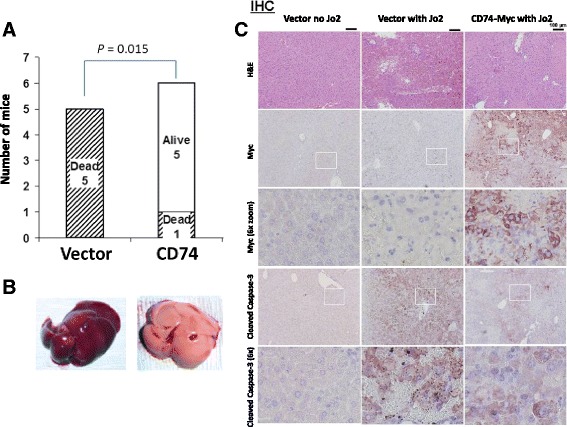
CD74 expression was suppressed in human B-lymphoma cell lines, BJAB and Raji, by either transduction with lentivirus particles or transfection with episomal vector, both encoding CD74-specific shRNAs or non-target shRNA. Effect of CD74 expression on Fas signaling was evaluated by comparing survival of mice hydrodynamically transfected with vector encoding full-length CD74 or empty vector. Sensitivity of cells with suppressed CD74 expression to FasL, edelfosine, doxorubicin, and a humanized CD74-specific antibody, milatuzumab, was evaluated by flow cytometry and compared to control cells. Fas signaling in response to FasL stimulation and the expression of Fas signaling components were evaluated by Western blot. Surface expression of Fas was detected by flow cytometry.
We determined that cells with suppressed CD74 are more sensitive to FasL-induced apoptosis and Fas signaling-dependent chemotherapies, edelfosine and doxorubicin, than control CD74-expressing cells. On the other hand, expression of full-length CD74 in livers protected the mice from a lethal challenge with agonistic anti-Fas antibody Jo2. A detailed analysis of Fas signaling in cells lacking CD74 and control cells revealed increased cleavage/activation of pro-caspase-8 and corresponding enhancement of caspase-3 activation in the absence of CD74, suggesting that CD74 affects the immediate early steps in Fas signaling at the plasma membrane. Cells with suppressed CD74 expression showed increased staining of Fas receptor on their surface. Pre-treatment with milatuzumab sensitized BJAB cells to Fas-mediated apoptosis.
We anticipate that specific targeting of the CD74 on the cell surface will sensitize CD74-expressing cancer cells to Fas-mediated apoptosis, and thus will increase effectiveness of chemotherapy regimens for hematological malignancies.
对Fas介导的凋亡产生抗性限制了当前可用化疗方案的疗效。我们确定CD74是干扰Fas介导凋亡的因素之一,已知其在血液系统恶性肿瘤中过表达。
通过用慢病毒颗粒转导或用游离型载体转染,在人B淋巴瘤细胞系BJAB和Raji中抑制CD74表达,这两种方法均编码CD74特异性短发夹RNA(shRNA)或非靶向shRNA。通过比较经流体动力学转染全长CD74编码载体或空载体的小鼠的存活率,评估CD74表达对Fas信号传导的影响。通过流式细胞术评估CD74表达受抑制的细胞对FasL、依地福新、阿霉素和人源化CD74特异性抗体米妥珠单抗的敏感性,并与对照细胞进行比较。通过蛋白质免疫印迹法评估对FasL刺激的Fas信号传导以及Fas信号传导成分的表达。通过流式细胞术检测Fas的表面表达。
我们确定,与表达对照CD74的细胞相比,CD74表达受抑制的细胞对FasL诱导的凋亡以及Fas信号传导依赖性化疗药物依地福新和阿霉素更敏感。另一方面,肝脏中全长CD74的表达保护小鼠免受激动性抗Fas抗体Jo2的致命攻击。对缺乏CD74的细胞和对照细胞中Fas信号传导的详细分析显示,在没有CD74的情况下,前体半胱天冬酶-8的切割/激活增加,并且半胱天冬酶-3的激活相应增强,这表明CD74影响质膜上Fas信号传导的早期步骤。CD74表达受抑制的细胞在其表面显示Fas受体染色增加。用米妥珠单抗预处理使BJAB细胞对Fas介导的凋亡敏感。
我们预计细胞表面CD74的特异性靶向将使表达CD74的癌细胞对Fas介导的凋亡敏感,从而提高血液系统恶性肿瘤化疗方案的有效性。