Verkerk Arie O, Remme Carol Ann
Department of Anatomy, Embryology, and Physiology, Academic Medical Center, University of Amsterdam Amsterdam, Netherlands.
Front Physiol. 2012 Jul 10;3:255. doi: 10.3389/fphys.2012.00255. eCollection 2012.
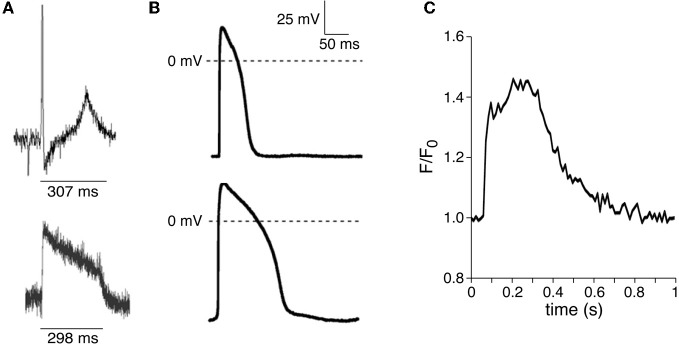
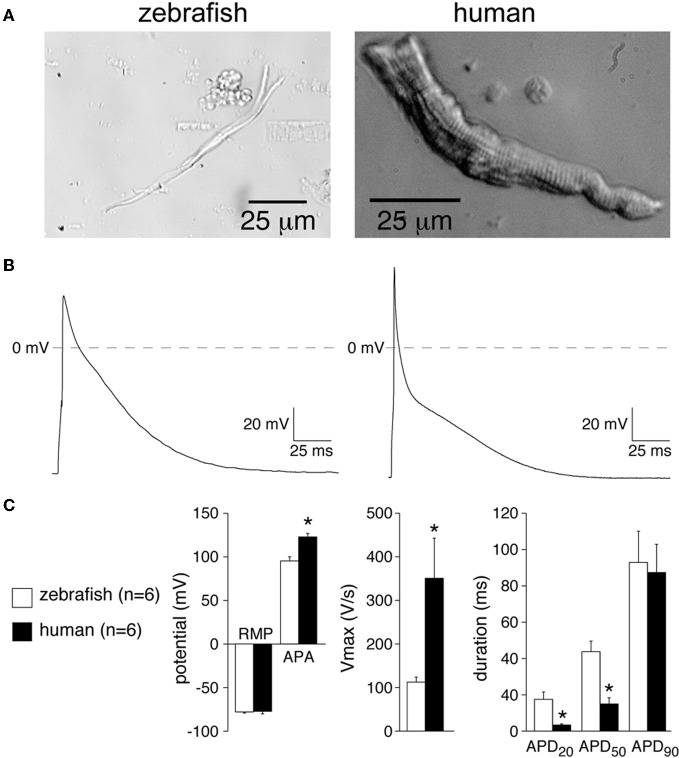
The zebrafish is a cold-blooded tropical freshwater teleost with two-chamber heart morphology. A major advantage of the zebrafish for heart studies is that the embryo is transparent, allowing for easy assessment of heart development, heart rate analysis and phenotypic characterization. Moreover, rapid and effective gene-specific knockdown can be achieved using morpholino oligonucleotides. Lastly, zebrafish are small in size, are easy to maintain and house, grow fast, and have large offspring size, making them a cost-efficient research model. Zebrafish embryonic and adult heart rates as well as action potential (AP) shape and duration and electrocardiogram morphology closely resemble those of humans. However, whether the zebrafish is truly an attractive alternative model for human cardiac electrophysiology depends on the presence and gating properties of the various ion channels in the zebrafish heart, but studies into the latter are as yet limited. The rapid component of the delayed rectifier K(+) current (I(Kr)) remains the best characterized and validated ion current in zebrafish myocytes, and zebrafish may represent a valuable model to investigate human I(Kr) channel-related disease, including long QT syndrome. Arguments against the use of zebrafish as model for human cardiac (patho)electrophysiology include its cold-bloodedness and two-chamber heart morphology, absence of t-tubuli, sarcoplamatic reticulum function, and a different profile of various depolarizing and repolarizing ion channels, including a limited Na(+) current density. Based on the currently available literature, we propose that zebrafish may constitute a relevant research model for investigating ion channel disorders associated with abnormal repolarization, but may be less suitable for studying depolarization disorders or Ca(2+)-modulated arrhythmias.
斑马鱼是一种具有两腔心脏形态的冷血热带淡水硬骨鱼。斑马鱼用于心脏研究的一个主要优势在于其胚胎是透明的,便于对心脏发育、心率分析和表型特征进行评估。此外,使用吗啉代寡核苷酸可以实现快速有效的基因特异性敲低。最后,斑马鱼体型小,易于饲养和安置,生长迅速,且后代数量多,使其成为一种经济高效的研究模型。斑马鱼胚胎和成体的心率以及动作电位(AP)的形状、持续时间和心电图形态与人类非常相似。然而,斑马鱼是否真的是人类心脏电生理学有吸引力的替代模型,取决于斑马鱼心脏中各种离子通道的存在和门控特性,但对后者的研究目前还很有限。延迟整流钾电流(I(Kr))的快速成分仍然是斑马鱼心肌细胞中特征最明显且经过验证的离子电流,斑马鱼可能是研究包括长QT综合征在内的与人类I(Kr)通道相关疾病的有价值模型。反对将斑马鱼用作人类心脏(病理)电生理学模型的理由包括其冷血特性和两腔心脏形态、缺乏横管、肌浆网功能,以及各种去极化和复极化离子通道的不同分布,包括有限的钠电流密度。基于目前可得的文献,我们认为斑马鱼可能是研究与复极异常相关的离子通道疾病的相关研究模型,但可能不太适合研究去极化疾病或钙(Ca2+)调节的心律失常。