Miyazawa Taiki, Horiuchi Masahiro, Ichikawa Daisuke, Subudhi Andrew W, Sugawara Jun, Ogoh Shigehiko
Center for Biomedical Engineering Research, Toyo University Kawagoe, Japan.
Front Physiol. 2012 Aug 2;3:308. doi: 10.3389/fphys.2012.00308. eCollection 2012.
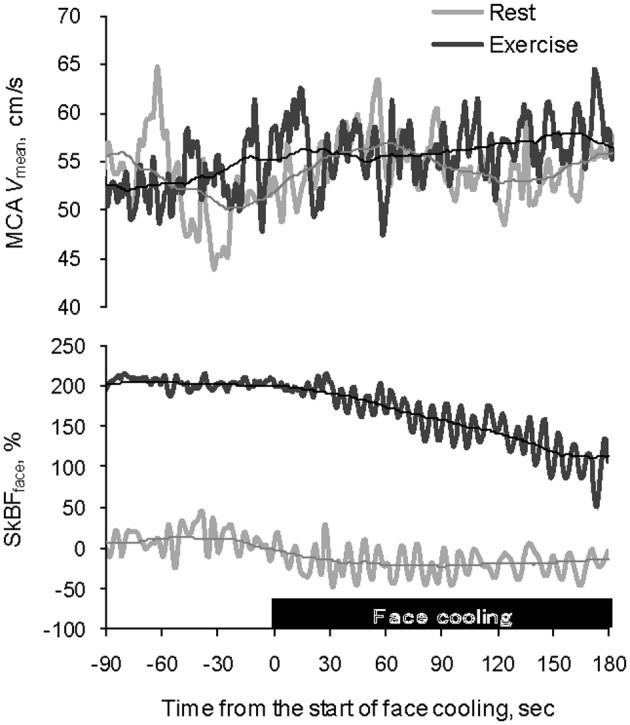
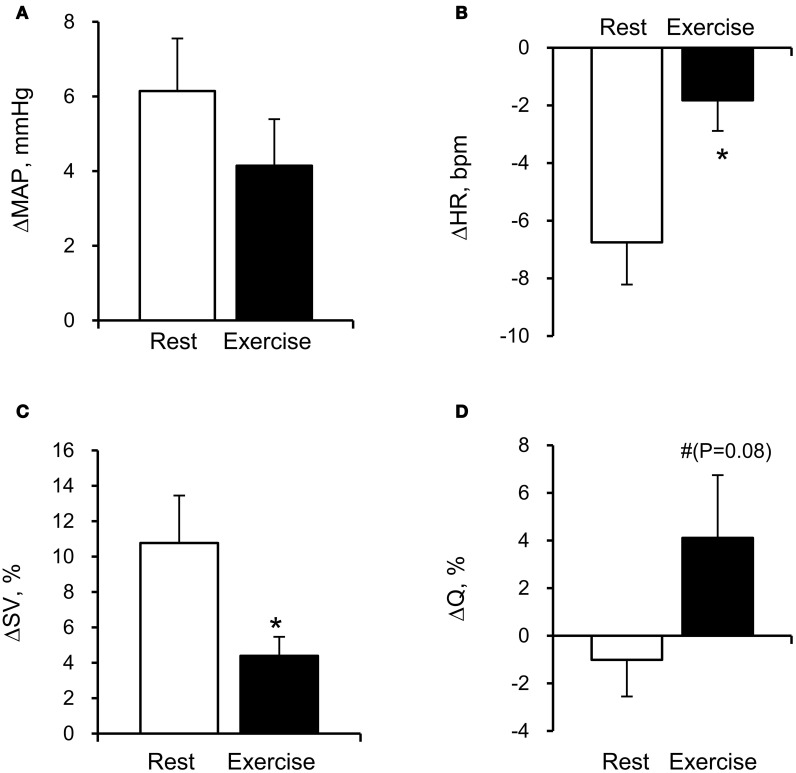
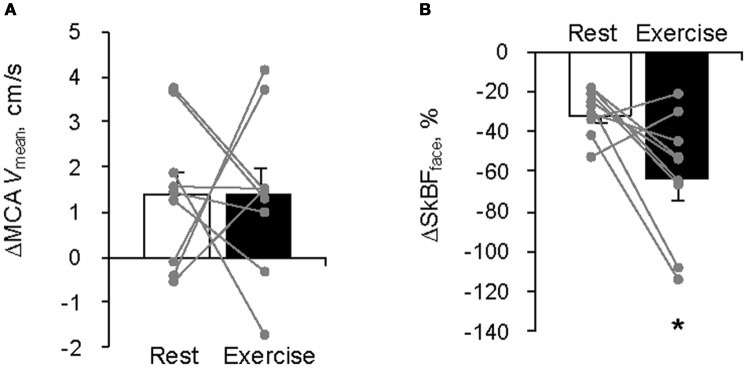
Facial cooling (FC) increases cerebral blood flow (CBF) at rest and during exercise; however, the mechanism of this response remains unclear. The purpose of the present study was to test our hypothesis that FC causes facial vasoconstriction that diverts skin blood flow (SkBF(face)) toward the middle cerebral artery (MCA V(mean)) at rest and to a greater extent during exercise. Nine healthy young subjects (20 ± 2 years) underwent 3 min of FC by fanning and spraying the face with a mist of cold water (~4°C) at rest and during steady-state exercise [heart rate (HR) of 120 bpm]. We focused on the difference between the averaged data acquired from 1 min immediately before FC and last 1 min of FC. SkBF(face), MCA V(mean), and mean arterial blood pressure (MAP) were higher during exercise than at rest. As hypothesized, FC decreased SkBF(face) at rest (-32 ± 4%) and to a greater extent during exercise (-64 ± 10%, P = 0.012). Although MCA V(mean) was increased by FC (Rest, +1.4 ± 0.5 cm/s; Exercise, +1.4 ± 0.6 cm/s), the amount of the FC-evoked changes in MCA V(mean) at rest and during exercise differed among subjects. In addition, changes in MCA V(mean) with FC did not correlate with concomitant changes in SkBF(face) (r = 0.095, P = 0.709). MAP was also increased by FC (Rest, +6.2 ± 1.4 mmHg; Exercise, +4.2 ± 1.2 mmHg). These findings suggest that the FC-induced increase in CBF during exercise could not be explained only by change in SkBF(face).
面部冷却(FC)可增加静息和运动时的脑血流量(CBF);然而,这种反应的机制尚不清楚。本研究的目的是检验我们的假设,即FC会导致面部血管收缩,使皮肤血流量(SkBF(face))在静息时转向大脑中动脉(MCA V(mean)),在运动时这种转向程度更大。九名健康年轻受试者(20±2岁)在静息和稳态运动[心率(HR)为120次/分钟]期间,通过用扇子扇和向面部喷洒冷水雾(约4°C)进行3分钟的FC。我们关注FC前1分钟和FC最后1分钟采集的平均数据之间的差异。运动时SkBF(face)、MCA V(mean)和平均动脉血压(MAP)高于静息时。如假设的那样,FC使静息时的SkBF(face)降低(-32±4%),在运动时降低幅度更大(-64±10%,P = 0.012)。尽管FC使MCA V(mean)增加(静息时,+1.4±0.5 cm/s;运动时,+1.4±0.6 cm/s),但静息和运动时FC引起的MCA V(mean)变化量在受试者之间存在差异。此外,FC引起的MCA V(mean)变化与SkBF(face)的伴随变化不相关(r = 0.095,P = 0.709)。FC也使MAP升高(静息时,+6.2±1.4 mmHg;运动时,+4.2±1.2 mmHg)。这些发现表明,运动期间FC诱导的CBF增加不能仅用SkBF(face)的变化来解释。