Guetta E, Mincberg M, Mousset S, Bertinchamps C, Rommelaere J, Tal J
Biology Department, Ben-Gurion University of the Negev, Beer-Sheva, Israel.
J Virol. 1990 Jan;64(1):458-62. doi: 10.1128/JVI.64.1.458-462.1990.
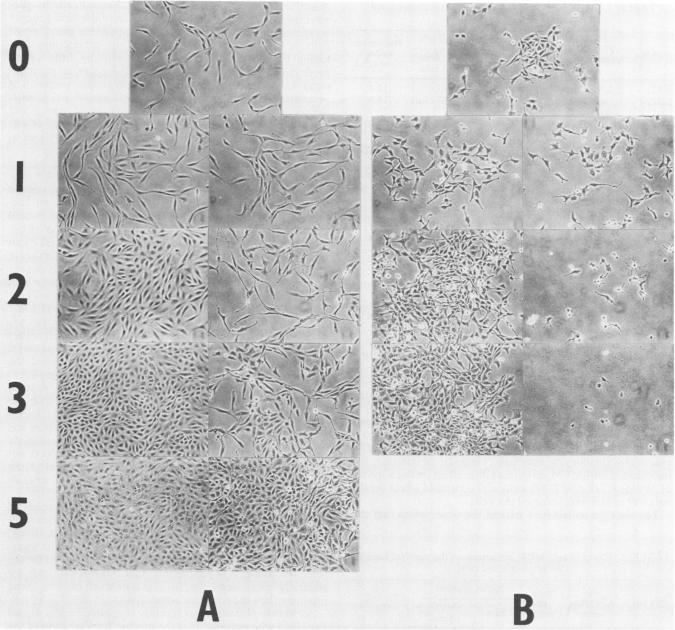
Fischer rat fibroblasts, naturally resistant to killing by the fibrotropic strain of minute virus of mice [(parvovirus MVM(p)], became sensitive to MVM when transformed by polyomavirus. This sensitization did not involve an increase in the percentage of cells which synthesized viral capsid antigens or in the percentage of cells which produced infectious virus. The addition of anti-MVM antiserum to the growth medium of MVM-infected cells had only a small effect on their survival rates, indicating that the majority of the killing effect of MVM occurs in a single cycle of infection. The data indicate that cell killing by MVM is independent of infectious virus production and thus support the notion that the preferential cytolytic effect is affected by viral cytotoxic gene products which accumulate to intolerable levels in transformed cells but not in normal ones. Finally, using cells transformed with polyomavirus and genomic and subgenomic clones of polyomavirus, we showed that the extent of sensitization to killing by MVM depended on the transforming agent used.
费舍尔大鼠成纤维细胞对亲纤维性小鼠微小病毒株[细小病毒MVM(p)]的杀伤作用天然具有抗性,当被多瘤病毒转化后,它们对MVM变得敏感。这种致敏作用并不涉及合成病毒衣壳抗原的细胞百分比增加,也不涉及产生感染性病毒的细胞百分比增加。向感染MVM的细胞生长培养基中添加抗MVM抗血清对其存活率只有很小的影响,这表明MVM的大部分杀伤作用发生在单个感染周期内。数据表明,MVM对细胞的杀伤作用与感染性病毒的产生无关,因此支持这样一种观点,即优先的溶细胞作用受病毒细胞毒性基因产物的影响,这些产物在转化细胞中积累到无法忍受的水平,而在正常细胞中则不会。最后,使用用多瘤病毒以及多瘤病毒的基因组和亚基因组克隆转化的细胞,我们表明对MVM杀伤作用的致敏程度取决于所使用的转化剂。