Department of Optometry and Visual Science, City University London, London, UK.
BMC Ophthalmol. 2012 Aug 31;12:45. doi: 10.1186/1471-2415-12-45.
Glaucoma has been shown to lead to disability in many daily tasks including visual search. This study aims to determine whether the saccadic eye movements of people with glaucoma differ from those of people with normal vision, and to investigate the association between eye movements and impaired visual search.
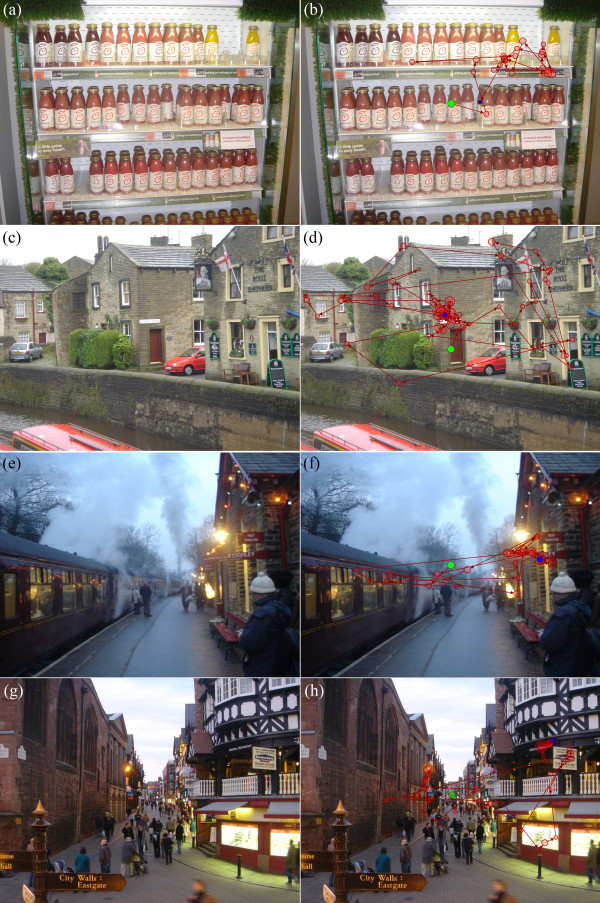
Forty patients (mean age: 67 [SD: 9] years) with a range of glaucomatous visual field (VF) defects in both eyes (mean best eye mean deviation [MD]: -5.9 (SD: 5.4) dB) and 40 age-related people with normal vision (mean age: 66 [SD: 10] years) were timed as they searched for a series of target objects in computer displayed photographs of real world scenes. Eye movements were simultaneously recorded using an eye tracker. Average number of saccades per second, average saccade amplitude and average search duration across trials were recorded. These response variables were compared with measurements of VF and contrast sensitivity.
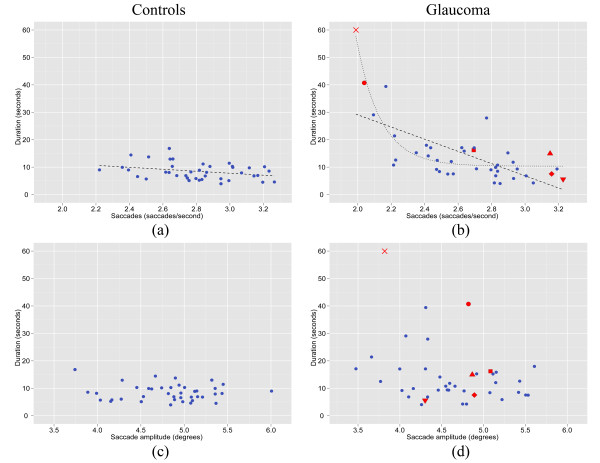
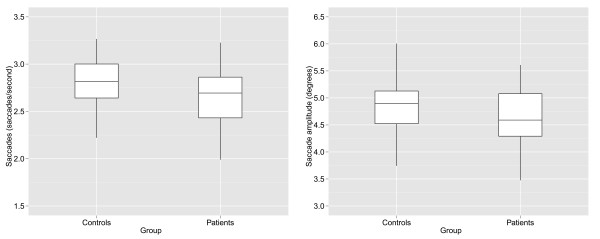
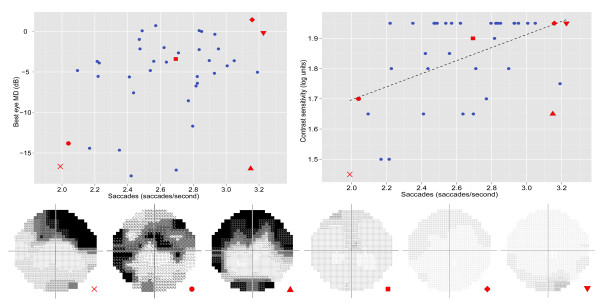
The average rate of saccades made by the patient group was significantly smaller than the number made by controls during the visual search task (P = 0.02; mean reduction of 5.6% (95% CI: 0.1 to 10.4%). There was no difference in average saccade amplitude between the patients and the controls (P = 0.09). Average number of saccades was weakly correlated with aspects of visual function, with patients with worse contrast sensitivity (PR logCS; Spearman's rho: 0.42; P = 0.006) and more severe VF defects (best eye MD; Spearman's rho: 0.34; P = 0.037) tending to make less eye movements during the task. Average detection time in the search task was associated with the average rate of saccades in the patient group (Spearman's rho = -0.65; P < 0.001) but this was not apparent in the controls.
The average rate of saccades made during visual search by this group of patients was fewer than those made by people with normal vision of a similar average age. There was wide variability in saccade rate in the patients but there was an association between an increase in this measure and better performance in the search task. Assessment of eye movements in individuals with glaucoma might provide insight into the functional deficits of the disease.
青光眼已被证实会导致许多日常任务的障碍,包括视觉搜索。本研究旨在确定青光眼患者的眼跳运动是否与正常视力者不同,并探讨眼动与视觉搜索受损之间的关系。
40 名患者(平均年龄:67 [SD:9] 岁)双眼均有不同程度的青光眼视野(VF)缺损(平均最佳眼平均偏差 [MD]:-5.9 [SD:5.4] dB),以及 40 名年龄匹配的正常视力者(平均年龄:66 [SD:10] 岁),他们在计算机显示的真实场景照片中搜索一系列目标物体时被计时。使用眼动仪同时记录眼动。记录了每个试验的平均每秒眼跳次数、平均眼跳幅度和平均搜索时间。将这些反应变量与 VF 和对比敏感度的测量值进行比较。
患者组的平均眼跳速度明显小于对照组(P = 0.02;平均减少 5.6%(95%CI:0.1 至 10.4%)。患者和对照组之间的平均眼跳幅度没有差异(P = 0.09)。平均眼跳次数与视觉功能的某些方面呈弱相关,对比敏感度较差的患者(PR logCS;Spearman's rho:0.42;P = 0.006)和 VF 缺损更严重的患者(最佳眼 MD;Spearman's rho:0.34;P = 0.037)在任务中往往眼跳较少。搜索任务中的平均检测时间与患者组的平均眼跳率相关(Spearman's rho = -0.65;P < 0.001),但在对照组中并不明显。
该组患者在视觉搜索过程中的平均眼跳速度低于年龄相近的正常视力者。患者的眼跳率差异很大,但该指标的增加与搜索任务中的表现改善有关。评估青光眼患者的眼动可能有助于深入了解该疾病的功能缺陷。