Department of Neurology, University of Michigan, 109 Zina Pitcher Place, Ann Arbor 5017 AAT-BSRBMI, USA.
Mol Neurodegener. 2012 Aug 31;7:44. doi: 10.1186/1750-1326-7-44.
Amyotrophic lateral sclerosis (ALS) is a fatal disorder involving the degeneration and loss of motor neurons. The mechanisms of motor neuron loss in ALS are unknown and there are no effective treatments. Defects in the distal axon and at the neuromuscular junction are early events in the disease course, and zebrafish provide a promising in vivo system to examine cellular mechanisms and treatments for these events in ALS pathogenesis.
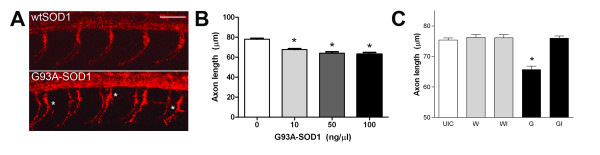
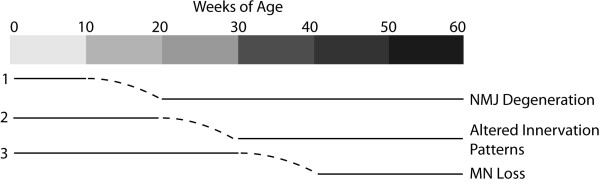
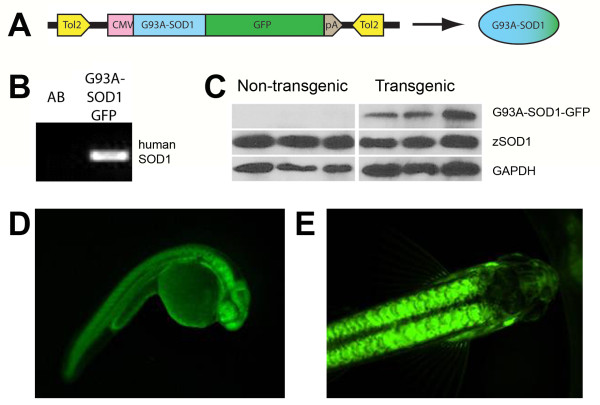
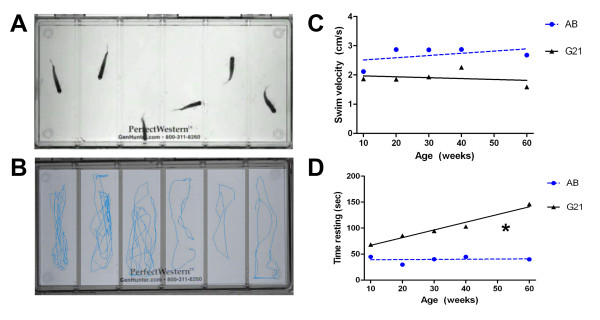
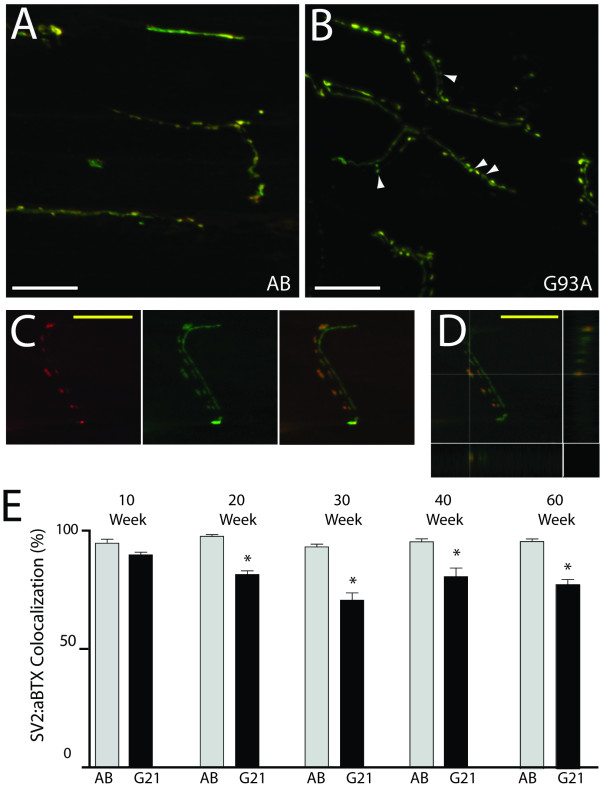
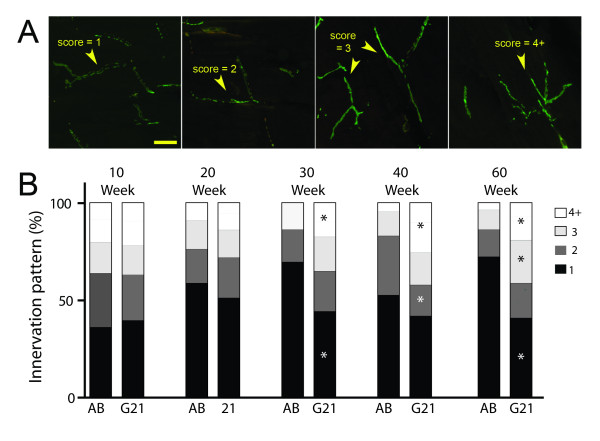
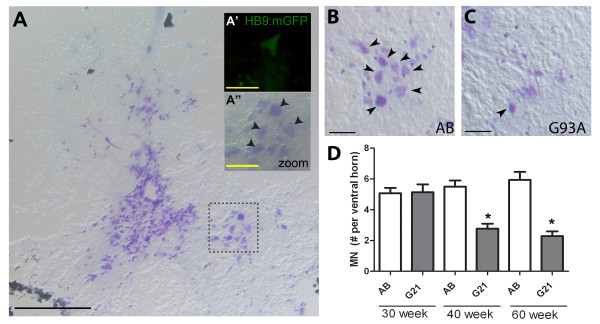
We demonstrate that transient genetic manipulation of zebrafish to express G93A-SOD1, a mutation associated with familial ALS, results in early defects in motor neuron outgrowth and axonal branching. This is consistent with previous reports on motor neuron axonal defects associated with familial ALS genes following knockdown or mutant protein overexpression. We also demonstrate that upregulation of growth factor signaling is capable of rescuing these early defects, validating the potential of the model for therapeutic discovery. We generated stable transgenic zebrafish lines expressing G93A-SOD1 to further characterize the consequences of G93A-SOD1 expression on neuromuscular pathology and disease progression. Behavioral monitoring reveals evidence of motor dysfunction and decreased activity in transgenic ALS zebrafish. Examination of neuromuscular and neuronal pathology throughout the disease course reveals a loss of neuromuscular junctions and alterations in motor neuron innervations patterns with disease progression. Finally, motor neuron cell loss is evident later in the disease.
This sequence of events reflects the stepwise mechanisms of degeneration in ALS, and provides a novel model for mechanistic discovery and therapeutic development for neuromuscular degeneration in ALS.
肌萎缩侧索硬化症(ALS)是一种致命的疾病,涉及运动神经元的退化和丧失。ALS 运动神经元丧失的机制尚不清楚,也没有有效的治疗方法。运动神经元轴突远端和神经肌肉接头的缺陷是疾病过程中的早期事件,而斑马鱼提供了一个有前途的体内系统,可用于研究 ALS 发病机制中这些事件的细胞机制和治疗方法。
我们证明,斑马鱼的瞬时遗传操作表达 G93A-SOD1(与家族性 ALS 相关的突变),导致运动神经元突起和轴突分支的早期缺陷。这与先前关于家族性 ALS 基因敲低或突变蛋白过表达后运动神经元轴突缺陷的报告一致。我们还证明,上调生长因子信号能够挽救这些早期缺陷,验证了该模型在治疗发现中的潜力。我们生成了稳定的转基因斑马鱼系,表达 G93A-SOD1,以进一步表征 G93A-SOD1 表达对神经肌肉病理学和疾病进展的影响。行为监测显示转基因 ALS 斑马鱼存在运动功能障碍和活动减少的证据。在疾病过程中检查神经肌肉和神经元病理学,发现神经肌肉接头丧失和运动神经元支配模式改变随着疾病进展。最后,运动神经元细胞丢失在疾病后期明显。
这一系列事件反映了 ALS 中退化的逐步机制,并为 ALS 神经肌肉退化的机制发现和治疗开发提供了一个新的模型。