MND Research Centre, Macquarie Medical School, Faculty of Medicine, Health and Human Sciences, Macquarie University, 75 Talavera Road, Sydney, NSW, 2109, Australia.
La Trobe Institute for Molecular Science, La Trobe University, Bundoora, Melbourne, VIC, 3086, Australia.
Cell Mol Life Sci. 2024 Mar 2;81(1):111. doi: 10.1007/s00018-024-05164-9.
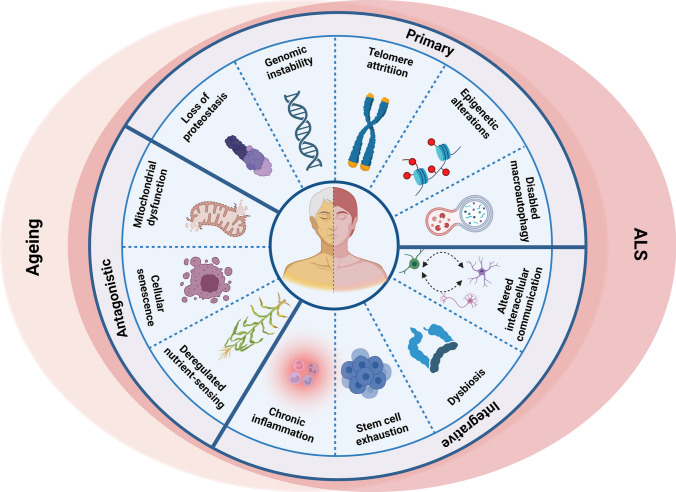
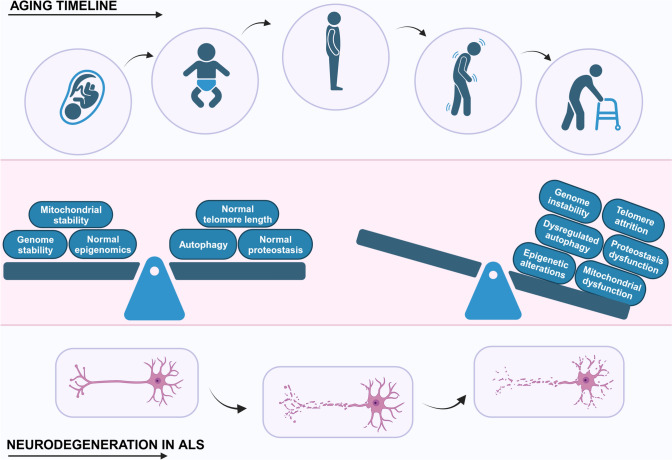
Amyotrophic lateral sclerosis (ALS) is a fatal, severely debilitating and rapidly progressing disorder affecting motor neurons in the brain, brainstem, and spinal cord. Unfortunately, there are few effective treatments, thus there remains a critical need to find novel interventions that can mitigate against its effects. Whilst the aetiology of ALS remains unclear, ageing is the major risk factor. Ageing is a slowly progressive process marked by functional decline of an organism over its lifespan. However, it remains unclear how ageing promotes the risk of ALS. At the molecular and cellular level there are specific hallmarks characteristic of normal ageing. These hallmarks are highly inter-related and overlap significantly with each other. Moreover, whilst ageing is a normal process, there are striking similarities at the molecular level between these factors and neurodegeneration in ALS. Nine ageing hallmarks were originally proposed: genomic instability, loss of telomeres, senescence, epigenetic modifications, dysregulated nutrient sensing, loss of proteostasis, mitochondrial dysfunction, stem cell exhaustion, and altered inter-cellular communication. However, these were recently (2023) expanded to include dysregulation of autophagy, inflammation and dysbiosis. Hence, given the latest updates to these hallmarks, and their close association to disease processes in ALS, a new examination of their relationship to pathophysiology is warranted. In this review, we describe possible mechanisms by which normal ageing impacts on neurodegenerative mechanisms implicated in ALS, and new therapeutic interventions that may arise from this.
肌萎缩侧索硬化症(ALS)是一种致命的、严重致残且快速进展的疾病,影响大脑、脑干和脊髓中的运动神经元。不幸的是,目前有效的治疗方法很少,因此仍然迫切需要寻找新的干预措施来减轻其影响。虽然 ALS 的病因尚不清楚,但衰老是主要的危险因素。衰老是一个缓慢进展的过程,其特征是生物体在其寿命过程中功能下降。然而,衰老如何促进 ALS 的发病机制仍不清楚。在分子和细胞水平上,有一些与正常衰老相关的特定特征。这些特征高度相关,彼此之间有很大的重叠。此外,虽然衰老是一个正常的过程,但在分子水平上,这些因素与 ALS 中的神经退行性变之间存在惊人的相似性。最初提出了九个衰老特征:基因组不稳定性、端粒丢失、衰老、表观遗传修饰、营养感应失调、蛋白质稳态丧失、线粒体功能障碍、干细胞衰竭和细胞间通讯改变。然而,最近(2023 年)将自噬失调、炎症和微生态失调也包括在内。因此,鉴于这些特征的最新更新及其与 ALS 中疾病过程的密切关联,有必要重新检查它们与病理生理学的关系。在这篇综述中,我们描述了正常衰老影响 ALS 中涉及的神经退行性机制的可能机制,以及可能由此产生的新的治疗干预措施。