Department of Orofacial Sciences, University of California San Francisco, San Francisco, CA, USA.
Clin Genet. 2013 Jun;83(6):539-44. doi: 10.1111/cge.12005. Epub 2012 Sep 27.
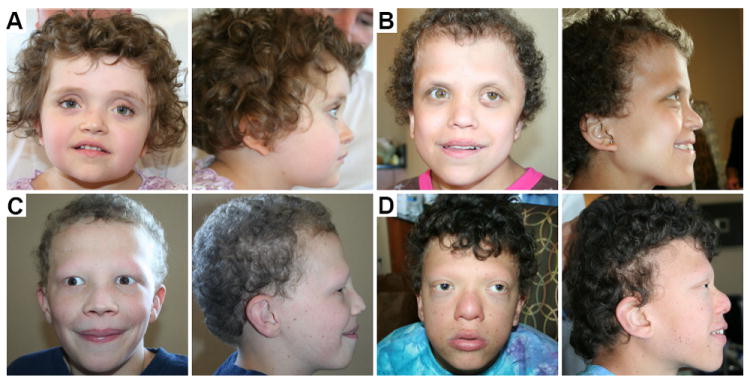
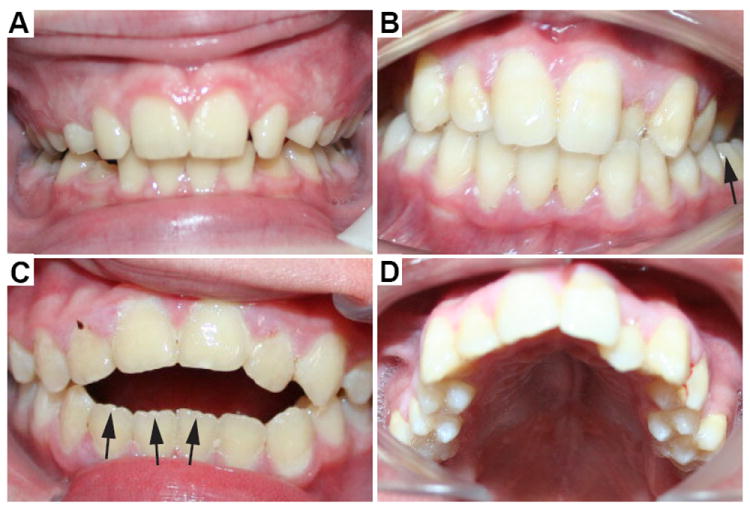
Cardio-facio-cutaneous syndrome (CFC) is a RASopathy that is characterized by craniofacial, dermatologic, gastrointestinal, ocular, cardiac, and neurologic anomalies. CFC is caused by activating mutations in the Ras/mitogen-activated protein kinase (MAPK) signaling pathway that is downstream of receptor tyrosine kinase (RTK) signaling. RTK signaling is known to play a central role in craniofacial and dental development, but to date, no studies have systematically examined individuals with CFC to define key craniofacial and dental features. To fill this critical gap in our knowledge, we evaluated the craniofacial and dental phenotype of a large cohort (n = 32) of CFC individuals who attended the 2009 and 2011 CFC International Family Conferences. We quantified common craniofacial features in CFC which include macrocephaly, bitemporal narrowing, convex facial profile, and hypoplastic supraorbital ridges. In addition, there is a characteristic dental phenotype in CFC syndrome that includes malocclusion with open bite, posterior crossbite, and a high-arched palate. This thorough evaluation of the craniofacial and dental phenotype in CFC individuals provides a step forward in our understanding of the role of RTK/MAPK signaling in human craniofacial development and will aid clinicians who treat patients with CFC.
心面 cuts 综合征 (CFC) 是一种 RAS 病,其特征是颅面、皮肤、胃肠道、眼部、心脏和神经系统异常。CFC 是由受体酪氨酸激酶 (RTK) 信号下游 Ras/丝裂原活化蛋白激酶 (MAPK) 信号通路的激活突变引起的。RTK 信号在颅面和牙齿发育中起着核心作用,但迄今为止,尚无研究系统地检查 CFC 患者以确定关键的颅面和牙齿特征。为了填补我们知识中的这一关键空白,我们评估了参加 2009 年和 2011 年 CFC 国际家庭会议的 32 名 CFC 个体的颅面和牙齿表型。我们量化了 CFC 中的常见颅面特征,包括大头畸形、颞部变窄、凸面型和发育不良的眶上嵴。此外,CFC 综合征还存在一种特征性的牙齿表型,包括开颌、后交叉颌和高拱形腭的错颌。对 CFC 个体的颅面和牙齿表型进行的这种全面评估,有助于我们进一步了解 RTK/MAPK 信号在人类颅面发育中的作用,并将有助于治疗 CFC 患者的临床医生。