Klein Ophir D, Lyons David B, Balooch Guive, Marshall Grayson W, Basson M Albert, Peterka Miroslav, Boran Tomas, Peterkova Renata, Martin Gail R
Department of Anatomy and Program in Developmental Biology, School of Medicine, University of California at San Francisco, San Francisco, CA 94143-2711, USA.
Development. 2008 Jan;135(2):377-85. doi: 10.1242/dev.015081. Epub 2007 Dec 12.
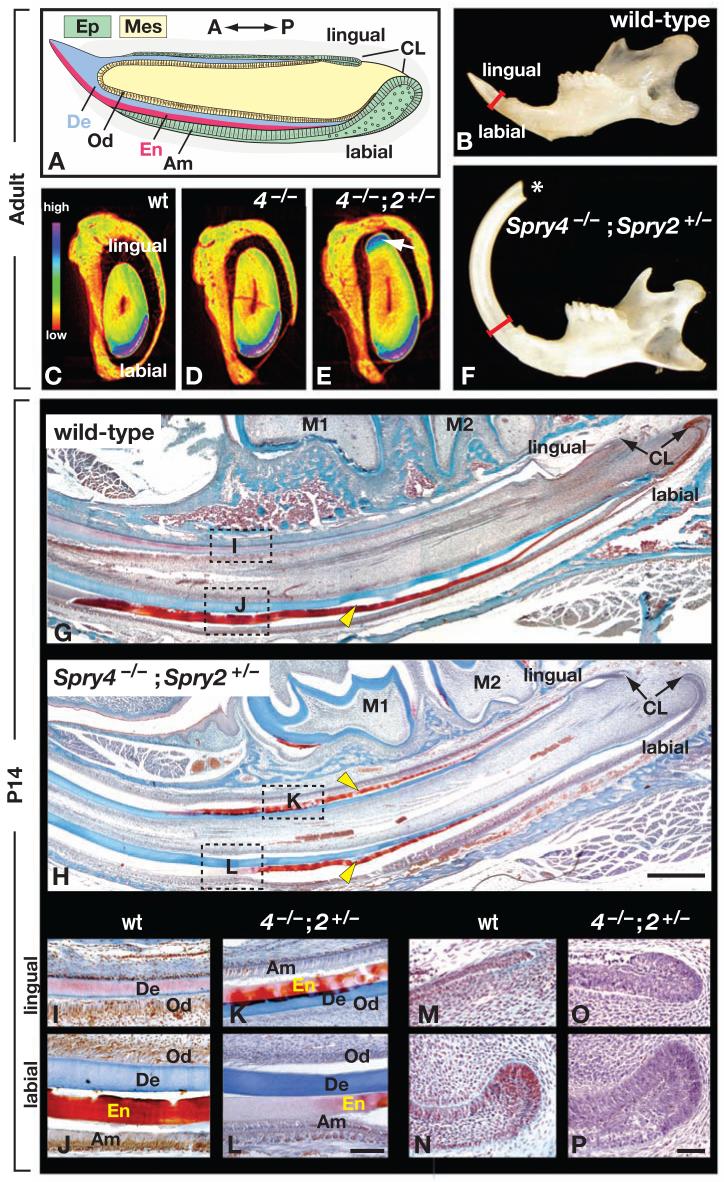
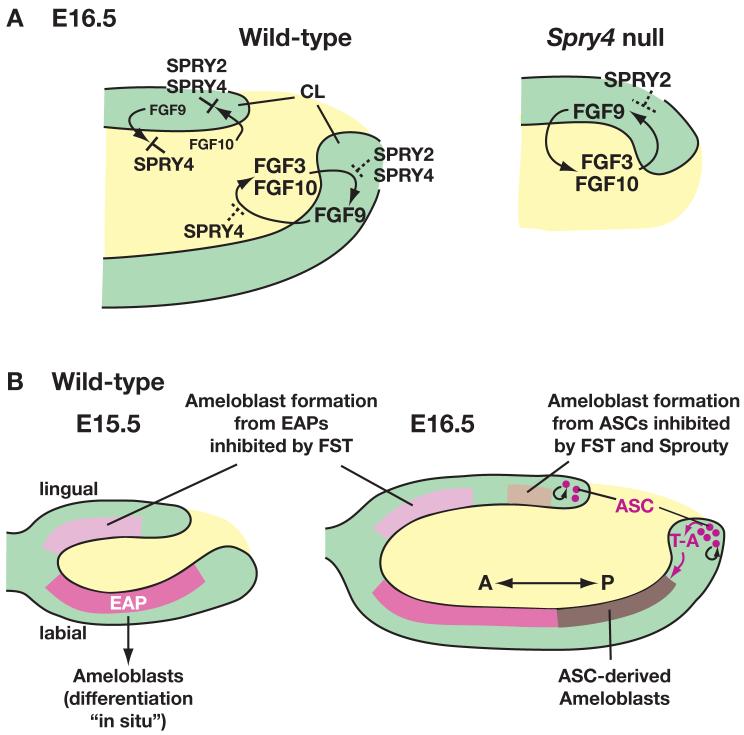
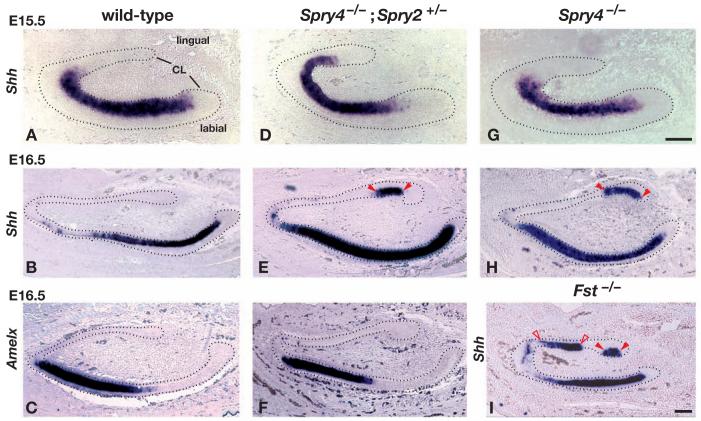
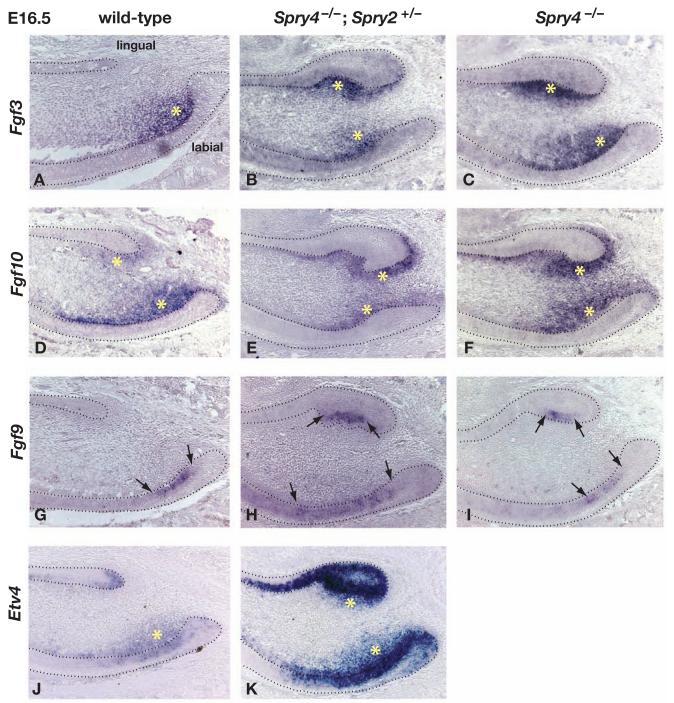
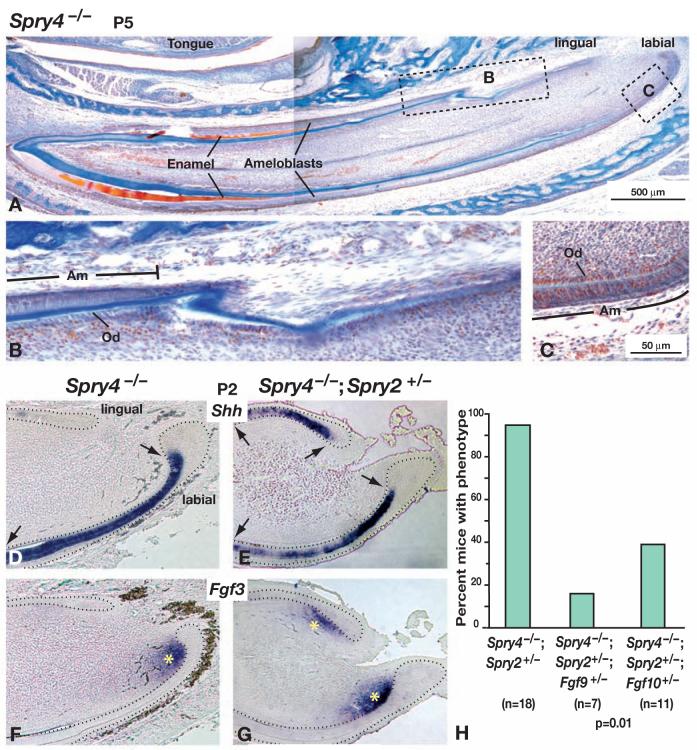
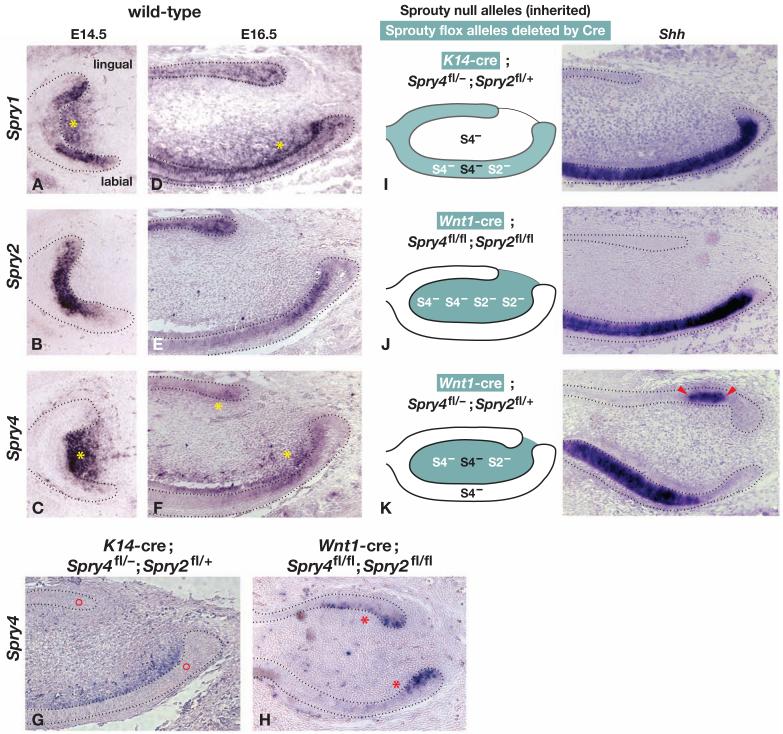
Rodent incisors grow throughout adult life, but are prevented from becoming excessively long by constant abrasion, which is facilitated by the absence of enamel on one side of the incisor. Here we report that loss-of-function of sprouty genes, which encode antagonists of receptor tyrosine kinase signaling, leads to bilateral enamel deposition, thus impeding incisor abrasion and resulting in unchecked tooth elongation. We demonstrate that sprouty genes function to ensure that enamel-producing ameloblasts are generated on only one side of the tooth by inhibiting the formation of ectopic ameloblasts from self-renewing stem cells, and that they do so by preventing the establishment of an epithelial-mesenchymal FGF signaling loop. Interestingly, although inactivation of Spry4 alone initiates ectopic ameloblast formation in the embryo, the dosage of another sprouty gene must also be reduced to sustain it after birth. These data reveal that the generation of differentiated progeny from a particular stem cell population can be differently regulated in the embryo and adult.
啮齿动物的门齿在成年后会持续生长,但由于门齿一侧没有牙釉质,不断的磨损使其不会长得过长。在此,我们报告称,编码受体酪氨酸激酶信号拮抗剂的Sprouty基因功能缺失会导致双侧牙釉质沉积,从而阻碍门齿磨损并导致牙齿不受控制地伸长。我们证明,Sprouty基因通过抑制自我更新干细胞形成异位成釉细胞,来确保仅在牙齿的一侧生成产生牙釉质的成釉细胞,并且它们通过阻止上皮-间充质FGF信号回路的建立来实现这一点。有趣的是,虽然单独使Spry4失活会在胚胎中引发异位成釉细胞形成,但另一个Sprouty基因的剂量也必须降低才能在出生后维持这种情况。这些数据表明,特定干细胞群体分化后代的产生在胚胎期和成年期可能受到不同的调控。