Department of Medicine, Karolinska Institutet, Stockholm, Sweden.
BMC Neurol. 2012 Sep 4;12:87. doi: 10.1186/1471-2377-12-87.
Human cytomegalovirus (CMV) is an ubiquitous pathogen capable of modulating the host immune system. Immune dysfunction is common during CMV infection and includes autoimmune phenomena. Here we focus on a case of primary CMV infection associated with encephalopathy in a patient with a rudimentary spleen. We discuss diagnostic challenges and immunological aspects as well as the hypothesis that CMV may break tolerance and induce potentially encephalitogenic autoantibodies.
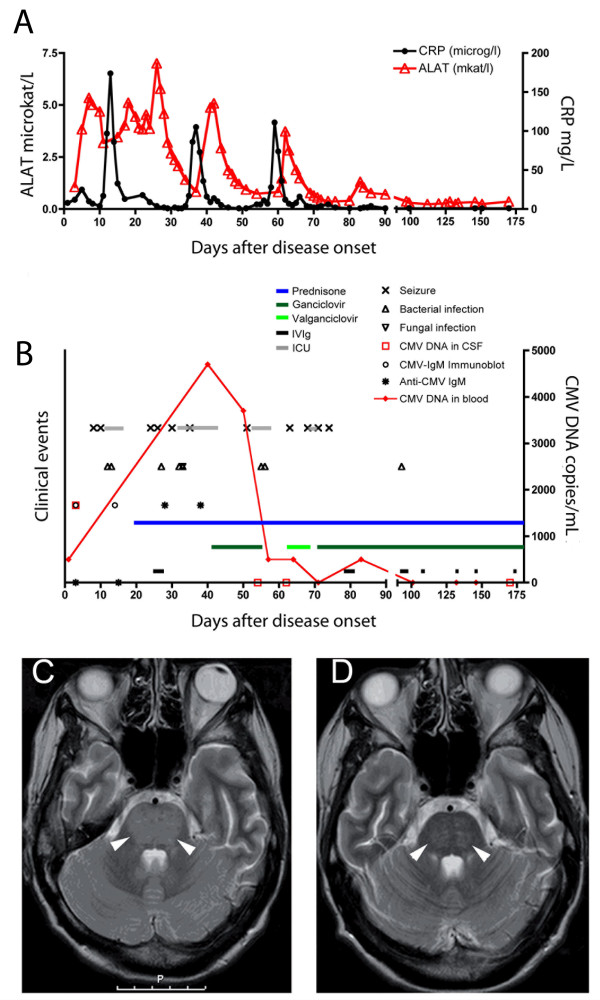
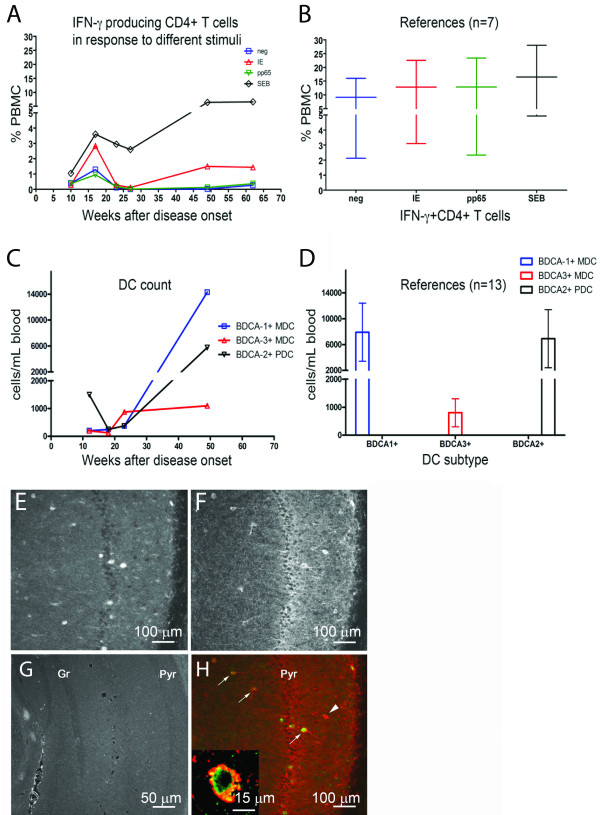
A 33-year-old woman was admitted with features of encephalitis, rapidly progressing into a catatonic state. The patient tested negative for presence of herpes simplex virus DNA in cerebrospinal fluid (CSF), and had elevated liver enzymes and hepatomegaly at computed tomography scan (CT) examination. CT scan and magnetic resonance imaging (MRI) showed only a rudimentary spleen. Initially, serum was negative for anti-CMV IgM, but borderline for anti-CMV IgG by enzyme-linked immunosorbent assay. However, a more sensitive assay resulted in a positive specific IgM Western blot profile and low IgG avidity, suggesting primary CMV infection. Further, CMV DNA was retrospectively detected in a CSF sample collected at admission. We also detected antineuronal autoantibodies, which stained GAD-positive neurons in the hippocampus. The patient was treated by a combination of prednisone, intravenous immunoglobulins (IVIg) and antivirals, which resulted in a dramatic amelioration of the patient's neurological status. One year after admission the patient exhibited a nearly complete recovery with mild deficits in attention and memory.
A possible reason for the critical course of CMV infection could be the lack of a functional spleen in this patient, a condition previously associated with severe CMV infection. Prompt treatment with antiviral drugs, steroids and IVIg was most likely important for the positive outcome in this case and should be considered for similar cases of severe primary CMV infection associated with immunopathological phenomena.
人巨细胞病毒(CMV)是一种普遍存在的病原体,能够调节宿主的免疫系统。CMV 感染时常见免疫功能障碍,包括自身免疫现象。在这里,我们关注的是一例与伴发无脑回畸形的脾功能不全患者的 CMV 原发性感染相关的脑病。我们讨论了诊断方面的挑战和免疫学方面的问题,以及 CMV 可能打破耐受并诱导潜在致脑炎自身抗体的假说。
一名 33 岁女性因脑炎表现入院,病情迅速进展为木僵状态。患者的脑脊液(CSF)中单纯疱疹病毒 DNA 检测为阴性,计算机断层扫描(CT)检查显示肝功能酶升高和肝肿大。CT 扫描和磁共振成像(MRI)仅显示脾功能不全。最初,血清抗 CMV IgM 检测为阴性,但酶联免疫吸附试验检测抗 CMV IgG 为临界值。然而,更敏感的检测方法导致抗 CMV 特异性 IgM 免疫印迹谱呈阳性和 IgG 亲和力降低,提示为 CMV 原发性感染。此外,我们还在入院时采集的 CSF 样本中检测到 CMV DNA。我们还检测到抗神经元自身抗体,该抗体可在海马的 GAD 阳性神经元上染色。患者接受了泼尼松、静脉注射免疫球蛋白(IVIg)和抗病毒药物的联合治疗,使患者的神经状态得到显著改善。入院一年后,患者的认知和记忆轻度受损,基本恢复。
该患者 CMV 感染的严重病程可能是由于缺乏功能性脾脏所致,这种情况以前与严重的 CMV 感染有关。抗病毒药物、类固醇和 IVIg 的及时治疗可能对本例患者的良好预后非常重要,对于类似的伴有免疫病理学现象的严重原发性 CMV 感染病例,应考虑采用这种治疗方法。