Palafox Sánchez Claudia Azucena, Satoh Minoru, Chan Edward Kl, Carcamo Wendy C, Muñoz Valle José Francisco, Orozco Barocio Gerardo, Oregon Romero Edith, Navarro Hernández Rosa Elena, Salazar Páramo Mario, Cabral Castañeda Antonio, Vázquez Del Mercado Mónica
Instituto de Investigación en Reumatología y del Sistema Músculo Esquelético (IIRSME), Centro Universitario de Ciencias de la Salud, Universidad de Guadalajara, Sierra Mojada 950, Guadalajara, Jalisco, CP 44340, México.
Arthritis Res Ther. 2009;11(1):R27. doi: 10.1186/ar2621. Epub 2009 Feb 20.
Systemic lupus erythematosus is characterized by production of autoantibodies to RNA or DNA-protein complexes such as small nuclear ribonucleoproteins (snRNPs). A role of Epstein-Barr virus in the pathogenesis has been suggested. Similar to Epstein-Barr virus, cytomegalovirus (CMV) infects the majority of individuals at a young age and establishes latency with a potential for reactivation. Homology of CMV glycoprotein B (UL55) with the U1snRNP-70 kDa protein (U1-70 k) has been described; however, the role of CMV infection in production of anti-snRNPs is controversial. We investigated the association of CMV serology and autoantibodies in systemic lupus erythematosus.
Sixty-one Mexican patients with systemic lupus erythematosus were tested for CMV and Epstein-Barr virus serology (viral capsid antigen, IgG, IgM) and autoantibodies by immunoprecipitation and ELISA (IgG and IgM class, U1RNP/Sm, U1-70 k, P peptide, rheumatoid factor, dsDNA, beta2-glycoprotein I).
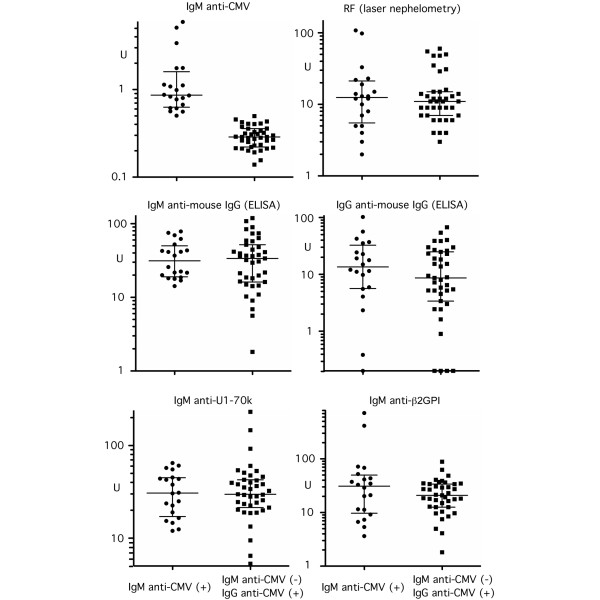
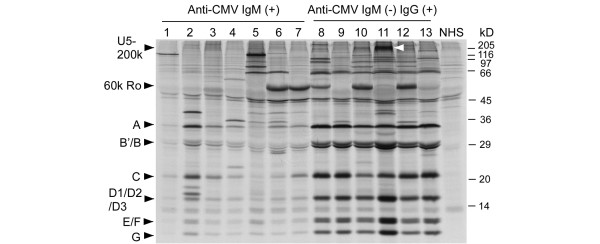
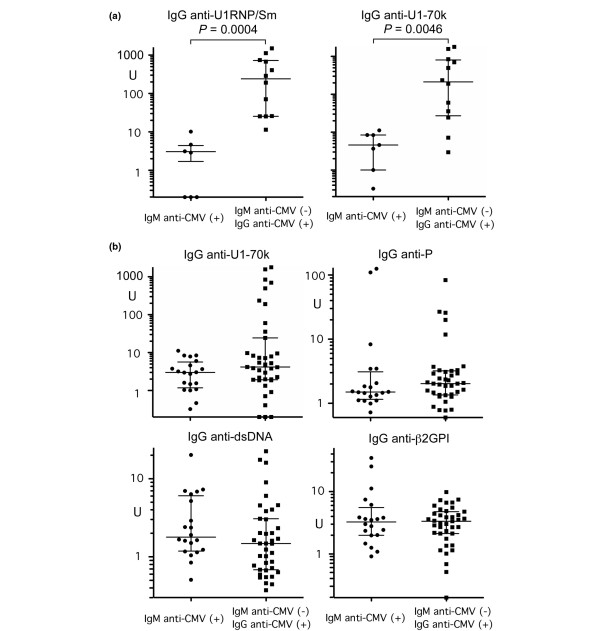
IgG anti-CMV and IgM anti-CMV were positive in 95% (58/61) and 33% (20/61), respectively, and two cases were negative for both. Clinical manifestation and autoantibodies in the IgM anti-CMV+ group (n = 20) versus the IgM anti-CMV(-)IgG+ (n = 39) group were compared. Most (19/20) of the IgM anti-CMV+ cases were IgG anti-CMV+, consistent with reactivation or reinfection. IgM anti-CMV was unrelated to rheumatoid factor or IgM class autoantibodies and none was positive for IgM anti-Epstein-Barr virus-viral capsid antigen, indicating that this is not simply due to false positive results caused by rheumatoid factor or nonspecific binding by certain IgM. The IgM anti-CMV+ group has significantly lower levels of IgG anti-U1RNP/Sm and IgG anti-U1-70 k (P = 0.0004 and P = 0.0046, respectively). This finding was also confirmed by immunoprecipitation. Among the IgM anti-CMV(-) subset, anti-Su was associated with anti-U1RNP and anti-Ro (P < 0.05). High levels of IgG anti-CMV were associated with production of lupus-related autoantibodies to RNA or DNA-protein complex (P = 0.0077).
Our findings suggest a potential role of CMV in regulation of autoantibodies to snRNPs and may provide a unique insight to understand the pathogenesis.
系统性红斑狼疮的特征是产生针对RNA或DNA - 蛋白质复合物(如小核核糖核蛋白(snRNP))的自身抗体。有人提出爱泼斯坦 - 巴尔病毒在发病机制中起作用。与爱泼斯坦 - 巴尔病毒类似,巨细胞病毒(CMV)在年轻时感染大多数个体并建立潜伏状态,具有重新激活的可能性。已描述了CMV糖蛋白B(UL55)与U1snRNP - 70 kDa蛋白(U1 - 70 k)的同源性;然而,CMV感染在抗snRNP产生中的作用存在争议。我们研究了CMV血清学与系统性红斑狼疮中自身抗体的关联。
对61名墨西哥系统性红斑狼疮患者进行了CMV和爱泼斯坦 - 巴尔病毒血清学检测(病毒衣壳抗原、IgG、IgM),并通过免疫沉淀和ELISA检测自身抗体(IgG和IgM类、U1RNP/Sm、U1 - 70 k、P肽、类风湿因子、双链DNA、β2 - 糖蛋白I)。
IgG抗CMV和IgM抗CMV分别在95%(58/61)和33%(20/61)的患者中呈阳性,2例两者均为阴性。比较了IgM抗CMV阳性组(n = 20)与IgM抗CMV阴性IgG阳性组(n = 39)的临床表现和自身抗体。大多数(19/20)IgM抗CMV阳性病例为IgG抗CMV阳性,与病毒重新激活或再次感染一致。IgM抗CMV与类风湿因子或IgM类自身抗体无关,且无一例IgM抗爱泼斯坦 - 巴尔病毒 - 病毒衣壳抗原呈阳性,表明这并非简单地由于类风湿因子导致的假阳性结果或某些IgM的非特异性结合。IgM抗CMV阳性组的IgG抗U1RNP/Sm和IgG抗U1 - 70 k水平显著较低(分别为P = 0.0004和P = 0.0046)。免疫沉淀也证实了这一发现。在IgM抗CMV阴性亚组中,抗Su与抗U1RNP和抗Ro相关(P < 0.05)。高水平的IgG抗CMV与针对RNA或DNA - 蛋白质复合物的狼疮相关自身抗体的产生相关(P = 0.0077)。
我们的研究结果表明CMV在调节抗snRNP自身抗体方面可能发挥潜在作用,并可能为理解发病机制提供独特的见解。