Genetics Unit, Instituto da Criança, Faculdade de Medicina, Universidade de São Paulo, São Paulo, SP, Brazil.
Clinics (Sao Paulo). 2012 Aug;67(8):917-21. doi: 10.6061/clinics/2012(08)11.
Prader-Willi Syndrome is a common etiology of syndromic obesity that is typically caused by either a paternal microdeletion of a region in chromosome 15 (microdeletions) or a maternal uniparental disomy of this chromosome. The purpose of this study was to describe the most significant clinical features of 35 Brazilian patients with molecularly confirmed Prader-Willi syndrome and to determine the effects of growth hormone treatment on clinical outcomes.
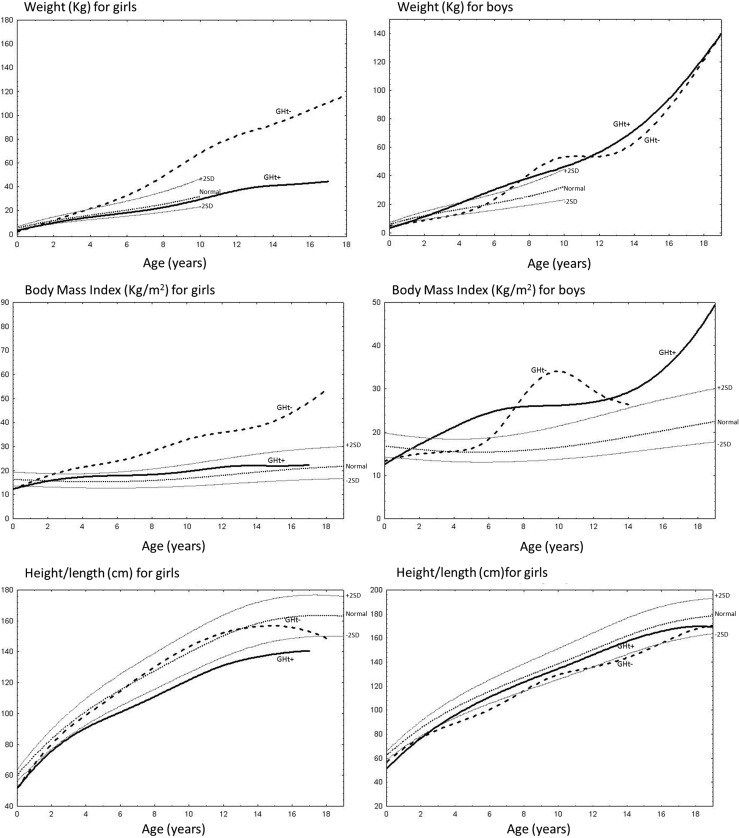
A retrospective study was performed based on the medical records of a cohort of 35 patients diagnosed with Prader-Willi syndrome. The main clinical characteristics were compared between the group of patients presenting with microdeletions and the group presenting with maternal uniparental disomy of chromosome 15. Curves for height/length, weight and body mass index were constructed and compared between Prader-Willi syndrome patients treated with and without growth hormone to determine how growth hormone treatment affected body composition. The curves for these patient groups were also compared with curves for the normal population.
No significant differences were identified between patients with microdeletions and patients with maternal uniparental disomy for any of the clinical parameters measured. Growth hormone treatment considerably improved the control of weight gain and body mass index for female patients but had no effect on either parameter in male patients. Growth hormone treatment did not affect height/length in either gender.
The prevalence rates of several clinical features in this study are in agreement with the rates reported in the literature. Additionally, we found modest benefits of growth hormone treatment but failed to demonstrate differences between patients with microdeletions and those with maternal uniparental disomy. The control of weight gain in patients with Prader-Willi syndrome is complex and does not depend exclusively on growth hormone treatment.
普拉德-威利综合征是一种常见的综合征性肥胖病因,通常由 15 号染色体上的父源微缺失(微缺失)或母源单亲二体性(uniparental disomy)引起。本研究的目的是描述 35 例经分子证实的普拉德-威利综合征患者的主要临床特征,并确定生长激素治疗对临床结局的影响。
基于 35 例确诊为普拉德-威利综合征患者的病历进行回顾性研究。比较了微缺失组和 15 号染色体母源单亲二体组患者的主要临床特征。构建了身高/长度、体重和体重指数的曲线,并比较了生长激素治疗和未治疗的普拉德-威利综合征患者的曲线,以确定生长激素治疗如何影响身体成分。还将这些患者组的曲线与正常人群的曲线进行了比较。
在测量的任何临床参数方面,微缺失患者与母源单亲二体患者之间均无显著差异。生长激素治疗显著改善了女性患者体重增加和体重指数的控制,但对男性患者的这两个参数均无影响。生长激素治疗对男女患者的身高/长度均无影响。
本研究中几项临床特征的患病率与文献报道的患病率一致。此外,我们发现生长激素治疗有一定的益处,但未能证明微缺失患者与母源单亲二体患者之间存在差异。普拉德-威利综合征患者的体重控制较为复杂,不仅取决于生长激素治疗。