Department of Psychiatry and Clinical Psychobiology, University of Barcelona, Spain.
Health Qual Life Outcomes. 2012 Sep 5;10:106. doi: 10.1186/1477-7525-10-106.
Although the studies published so far have found an affectation in the Health Related Quality of Life (HRQOL) in both psychiatric and substance use dependence disorders, very few studies have applied HRQOL as an assessment measure in patients suffering both comorbid conditions, or Dual Diagnosis. The aim of the current study was to assess HRQOL in a group of patients with Dual Diagnosis compared to two other non-comorbid groups and to determine what clinical factors are related to HRQOL.
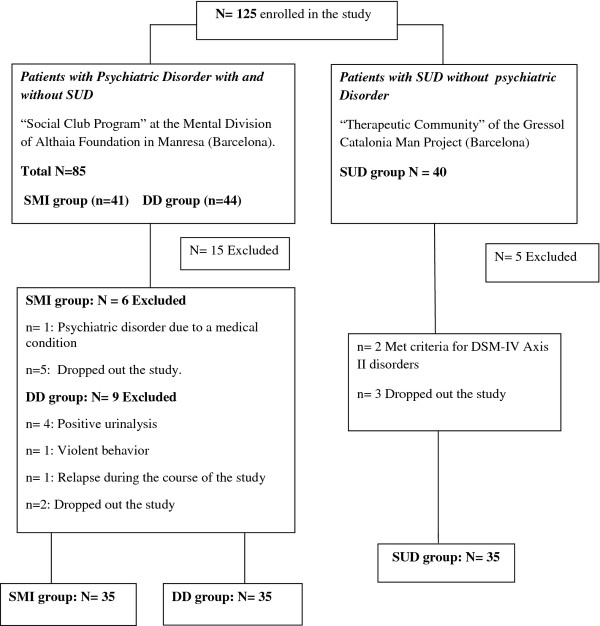
Cross-sectional assessment of three experimental groups was made through the Short Form - 36 Item Health Survey (SF-36). The sample consisted of a group with Dual Diagnosis (DD; N = 35), one with Severe Mental Illness alone (SMI; N = 35) and another one with Substance Use Dependence alone (SUD; N = 35). The sample was composed only by males. To assess the clinical correlates of SF-36 HRQOL, lineal regression analyses were carried out.
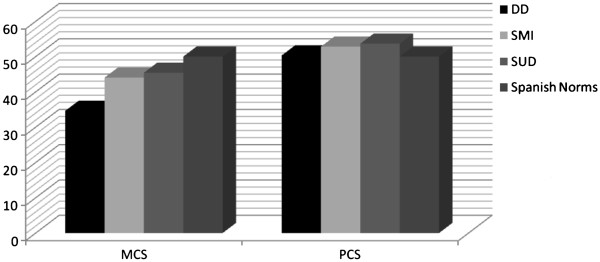
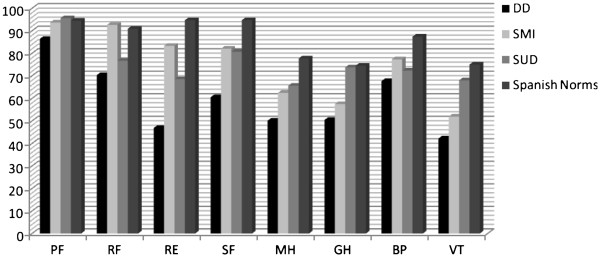
The DD group showed lower scores in most of the subscales, and in the mental health domain. The group with SUD showed in general a better state in the HRQOL while the group with SMI held an intermediate position with respect to the other two groups. Daily medication, suicidal attempts and daily number of coffees were significantly associated to HRQOL, especially in the DD group.
The DD group showed lower self-reported mental health quality of life. Assessment of HRQOL in dual patients allows to identify specific needs in this population, and may help to establish therapeutic goals to improve interventions.
尽管迄今为止发表的研究发现,在精神疾病和物质使用依赖障碍中,健康相关生活质量(HRQOL)都受到了影响,但很少有研究将 HRQOL 作为患有两种共病或双重诊断的患者的评估措施。本研究旨在评估患有双重诊断的患者与其他两种非共病组之间的 HRQOL,并确定哪些临床因素与 HRQOL 相关。
通过 36 项简短健康调查(SF-36)对三组实验组进行了横断面评估。样本包括一组双重诊断患者(DD;N=35)、一组仅患有严重精神疾病患者(SMI;N=35)和一组仅患有物质使用依赖患者(SUD;N=35)。样本仅由男性组成。为了评估 SF-36 HRQOL 的临床相关性,进行了线性回归分析。
DD 组在大多数子量表和心理健康领域的得分较低。SUD 组总体上在 HRQOL 方面表现较好,而 SMI 组与其他两组相比处于中间位置。每日用药、自杀企图和每天喝咖啡的次数与 HRQOL 显著相关,尤其是在 DD 组。
DD 组的自我报告心理健康质量较低。对双重患者的 HRQOL 进行评估可以确定该人群的特定需求,并有助于确定治疗目标以改善干预措施。