Centre for Research in Evolutionary and Environmental Anthropology, University of Roehampton, London, United Kingdom.
PLoS One. 2012;7(8):e44387. doi: 10.1371/journal.pone.0044387. Epub 2012 Aug 30.
Recent work on non-human primates indicates that the allocation of social attention is mediated by characteristics of the attending animal, such as social status and genotype, as well as by the value of the target to which attention is directed. Studies of humans indicate that an individual's emotion state also plays a crucial role in mediating their social attention; for example, individuals look for longer towards aggressive faces when they are feeling more anxious, and this bias leads to increased negative arousal and distraction from other ongoing tasks. To our knowledge, no studies have tested for an effect of emotion state on allocation of social attention in any non-human species.
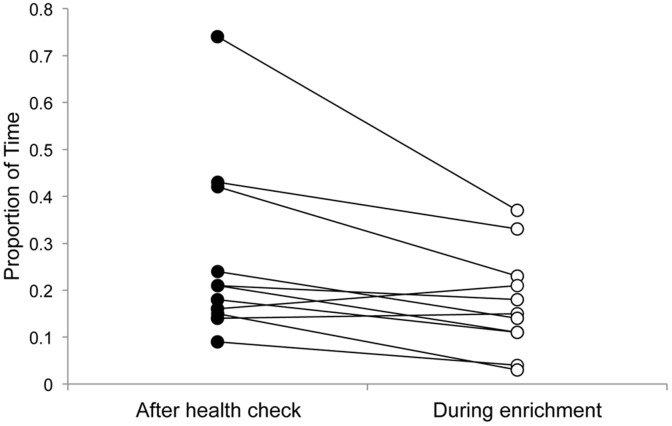
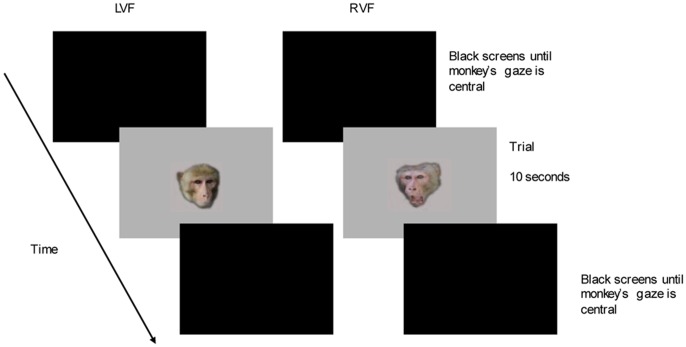
We presented captive adult male rhesus macaques with pairs of adult male conspecific face images - one with an aggressive expression, one with a neutral expression - and recorded gaze towards these images. Each animal was tested twice, once during a putatively stressful condition (i.e. following a veterinary health check), and once during a neutral (or potentially positive) condition (i.e. a period of environmental enrichment). Initial analyses revealed that behavioural indicators of anxiety and stress were significantly higher after the health check than during enrichment, indicating that the former caused a negative shift in emotional state.
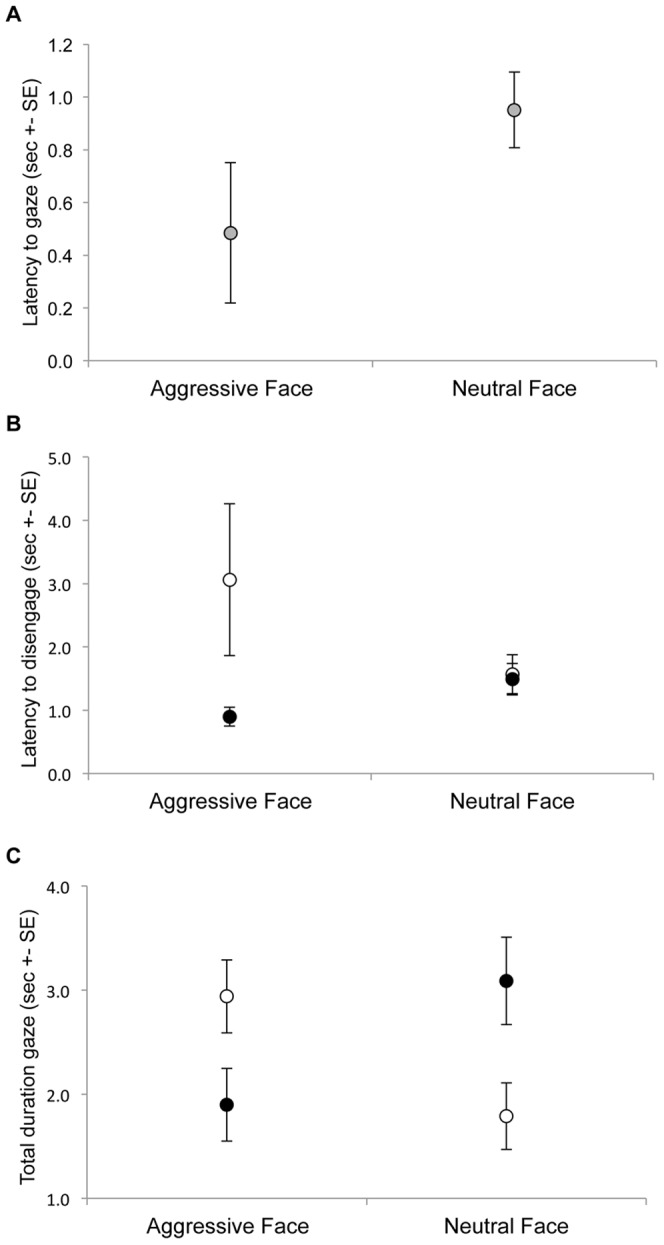
The macaques showed initial vigilance for aggressive faces across both conditions, but subsequent responses differed between conditions. Following the health check, initial vigilance was followed by rapid and sustained avoidance of aggressive faces. By contrast, during the period of enrichment, the macaques showed sustained attention towards the same aggressive faces.
CONCLUSIONS/SIGNIFICANCE: These data provide, to our knowledge, the first evidence that shifts in emotion state mediate social attention towards and away from facial cues of emotion in a non-human animal. This work provides novel insights into the evolution of emotion-attention interactions in humans, and mechanisms of social behaviour in non-human primates, and may have important implications for understanding animal psychological wellbeing.
最近对非人类灵长类动物的研究表明,社交注意力的分配受到动物自身特征的影响,例如社会地位和基因型,以及注意力指向目标的价值。人类研究表明,个体的情绪状态在调节其社交注意力方面也起着至关重要的作用;例如,当个体感到更焦虑时,他们会更长时间地注视攻击面孔,这种偏见会导致更多的负面唤醒和对其他正在进行的任务的分心。据我们所知,尚无研究测试情绪状态对任何非人类物种的社交注意力分配的影响。
我们向圈养的成年雄性恒河猴呈现成对的成年雄性同种面孔图像-一个带有攻击性表情,一个带有中性表情-并记录它们对这些图像的注视。每只动物接受两次测试,一次在假定的应激条件下(即兽医健康检查后),一次在中性(或潜在积极)条件下(即环境丰富期)。初步分析表明,健康检查后焦虑和应激的行为指标明显高于环境丰富期,这表明前者导致情绪状态的负面转变。
在两种情况下,猕猴最初对攻击面孔表现出警惕,但随后的反应在两种情况下有所不同。在健康检查后,最初的警惕之后是对攻击面孔的快速和持续回避。相比之下,在环境丰富期,猕猴对相同的攻击面孔表现出持续的关注。
结论/意义:这些数据提供了,据我们所知,第一个证据表明,情绪状态的转变调节了非人类动物对情绪面部线索的注意力的转移和保持。这项工作为人类情绪-注意力相互作用的进化以及非人类灵长类动物的社会行为机制提供了新的见解,并可能对理解动物心理福利具有重要意义。