Institut National de la Recherche Agronomique, UMR 0042, Carrtel, Thonon, France.
PLoS One. 2012;7(8):e44458. doi: 10.1371/journal.pone.0044458. Epub 2012 Aug 30.
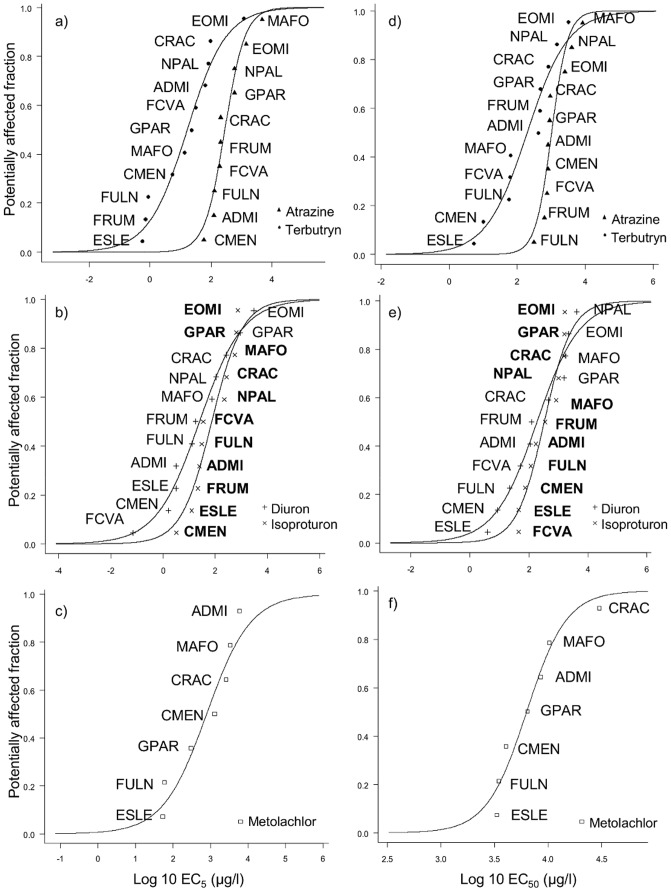
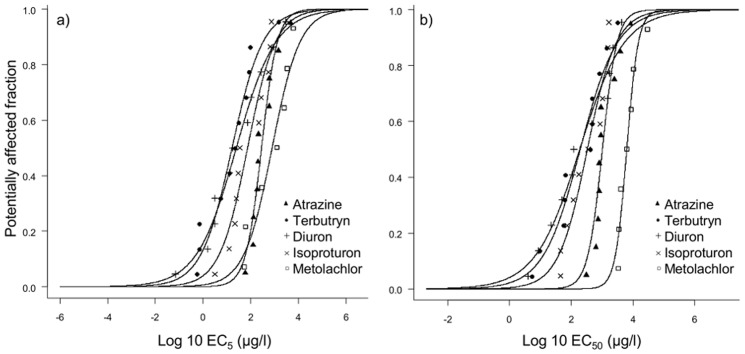
Although benthic diatoms are widely used in ecological studies of aquatic systems, there is still a dearth of data concerning species sensitivities towards several contaminants. Within the same community, different species may respond differently depending on their physiological and ecological characteristics. This lack of knowledge makes specific appropriate risk assessment impossible. To find out whether species sensitivity distribution (SSD) could be used to estimate the risk of herbicide toxicity for diatoms, we need to know whether their sensitivity depends on their physiological and ecological characteristics. We carried out single-species bioassays on 11 diatom species exposed to 8 herbicides. Dose-responses relationships were used to extrapolate the Effective Concentration 5 (EC(5)) and the Effective Concentration 50 (EC(50)) for each exposure. These data were used to fit a SSD curve for each herbicide, and to determine the Hazardous concentration 5 (HC(5)) and 50 (HC(50)). Our results revealed a high level of variability of the sensitivity in the set of species tested. For photosystem-II inhibitor (PSII) herbicides, diatoms species displayed a typical grouping of sensitivity levels consistent with their trophic mode and their ecological guild. N-heterotroph and "motile" guild species were more tolerant of PSII inhibitors, while N-autotroph and "low profile" guild species were more sensitive. Comprehensive SSD curves were obtained for 5 herbicides, but not for sulfonylurea herbicides or for dimetachlor, which had toxicity levels that were below the range of concentration tested. The SSD curves provided the following ranking of toxicity: diuron> terbutryn> isoproturon> atrazine> metolachlor. The HC that affected 5% of the species revealed that, even at the usual environmental concentrations of herbicides, diatom assemblages could be affected, especially by isoproturon, terbutryn, and diuron.
尽管底栖硅藻被广泛用于水生系统的生态研究,但关于几种污染物对物种敏感性的数据仍然缺乏。在同一群落中,不同的物种可能会因其生理和生态特征而产生不同的反应。这种知识的缺乏使得特定的适当风险评估成为不可能。为了了解物种敏感性分布(SSD)是否可用于估计除草剂对硅藻的毒性风险,我们需要知道它们的敏感性是否取决于其生理和生态特征。我们对 11 种硅藻物种进行了单一物种生物测定,这些物种暴露于 8 种除草剂中。使用剂量-反应关系来推断每种暴露的有效浓度 5(EC5)和有效浓度 50(EC50)。这些数据用于为每种除草剂拟合 SSD 曲线,并确定危险浓度 5(HC5)和 50(HC50)。我们的结果表明,在测试的物种中,敏感性存在很高的变异性。对于光合作用系统 II 抑制剂(PSII)除草剂,硅藻物种表现出与其营养模式和生态类群一致的典型敏感性水平分组。N-异养和“运动”类群的物种对 PSII 抑制剂更具耐受性,而 N-自养和“低调”类群的物种则更敏感。获得了 5 种除草剂的综合 SSD 曲线,但未获得磺酰脲类除草剂或二甲戊灵的曲线,因为它们的毒性水平低于测试的浓度范围。SSD 曲线提供了以下毒性排序:敌草隆>特丁津>异丙隆>莠去津>甲草胺。影响 5%物种的 HC 表明,即使在除草剂的通常环境浓度下,硅藻组合也可能受到影响,尤其是异噁草松、特丁津和敌草隆。