Department of Orthopaedics, Tampere University Hospital, Teiskontie 35, PL2000, Tampere 33521, Finland.
BMC Musculoskelet Disord. 2012 Sep 7;13:167. doi: 10.1186/1471-2474-13-167.
Proximal humerus fracture is the third most common fracture type after hip and distal radius fracture in elderly patients. A comprehensive study by Palvanen et al. demonstrated an increase in the annual fracture rate of 13.7% per year over the past 33 years. Should this trend continue, the fracture rate would triple over the next three decades. The increasing incidence of low-energy fractures raises questions about the optimal treatment in terms of functional outcome, pain, and rehabilitation time, as well as the economical impact. Despite the high incidence and costs of proximal humerus fractures, there is currently no valid scientific evidence for the best treatment method. Several publications, including a Cochrane review outline the need for high-quality, well-designed randomized controlled trials.
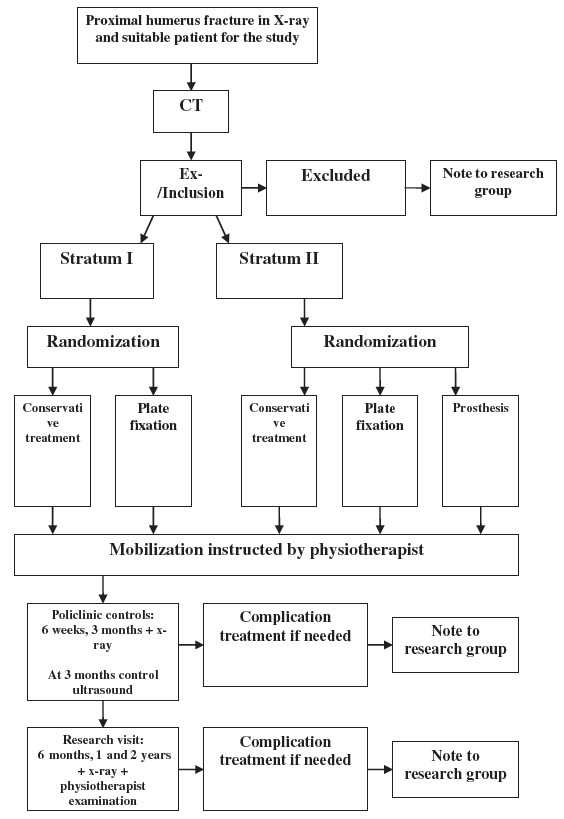
METHODS/DESIGN: The study is a prospective, randomized, national multi-center trial. The hypothesis of the trial is that surgical treatment of displaced proximal humerus fractures achieves better functional outcome, pain relief, and patient satisfaction compared to conservative treatment. The trial is designed to compare conservative and surgical treatment of proximal humerus fractures in patients 60 years and older. The trial includes two strata. Stratum I compares surgical treatment with locking plates to conservative treatment for two-part fractures. Stratum II compares multi-fragmented fractures, including three- and four-part fractures. The aim of Stratum II is to compare conservative treatment, surgical treatment with the Philos locking plate, and hemiarthroplasty with an Epoca prosthesis. The primary outcome measure will be the Disabilities of the Arm, Shoulder and Hand (DASH) score and the secondary outcome measures will be the EuroQol-5D (EQ-5D) value, OSS, Constant-Murley Score, VAS, and 15D.Recruiting time will be 3 years. The results will be analyzed after the 2-year follow-up period.
This publication presents a prospective, randomized, national multi-center trial. It gives details of patient flow, randomization, aftercare and also ways of analysis of the material and ways to present and publish the results.
ClinicalTrials.gov identifier: NCT01246167.
肱骨近端骨折是老年人中仅次于髋部和桡骨远端骨折的第三大常见骨折类型。Palvanen 等人的一项综合研究表明,在过去的 33 年中,每年骨折发生率以 13.7%的速度递增。如果这种趋势持续下去,未来 30 年内骨折发生率将增加两倍。低能量骨折的发生率不断上升,引发了人们对功能结果、疼痛和康复时间以及经济影响方面的最佳治疗方法的质疑。尽管肱骨近端骨折的发病率和治疗费用很高,但目前还没有关于最佳治疗方法的有效科学证据。一些出版物,包括一项 Cochrane 综述,都强调需要进行高质量、精心设计的随机对照试验。
方法/设计:本研究为前瞻性、随机、全国多中心试验。试验的假设是,与保守治疗相比,手术治疗移位的肱骨近端骨折在功能结果、疼痛缓解和患者满意度方面更优。该试验旨在比较 60 岁及以上患者的保守治疗和手术治疗肱骨近端骨折。该试验包括两个分层。第 I 层比较锁定钢板手术治疗与保守治疗二部分骨折。第 II 层比较多部分骨折,包括三部分和四部分骨折。第 II 层的目的是比较保守治疗、使用 Philos 锁定钢板的手术治疗以及使用 Epoca 假体的半髋关节置换术。主要结局测量指标为上肢功能障碍问卷(DASH)评分,次要结局测量指标为欧洲五维健康量表(EQ-5D)值、OSSW、Constant-Murley 评分、VAS 和 15D。招募时间为 3 年。结果将在 2 年随访期后进行分析。
本出版物介绍了一项前瞻性、随机、全国多中心试验。它详细说明了患者流程、随机分组、随访以及对材料的分析方法,以及呈现和发表结果的方式。
ClinicalTrials.gov 标识符:NCT01246167。