Department of Engineering Design, Indian Institute of Technology Madras, Tamil Nadu, India.
J Appl Clin Med Phys. 2012 Sep 6;13(5):3845. doi: 10.1120/jacmp.v13i5.3845.
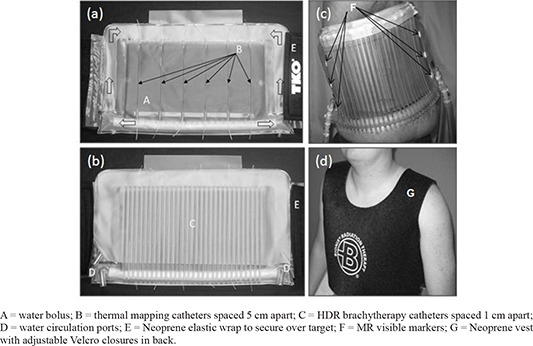
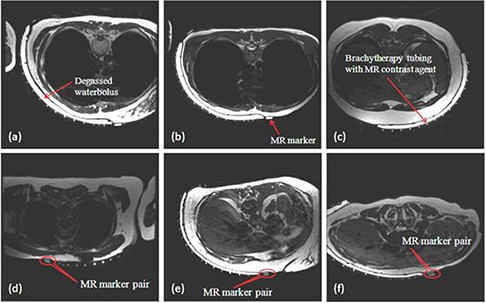
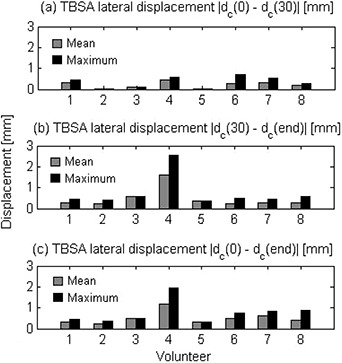
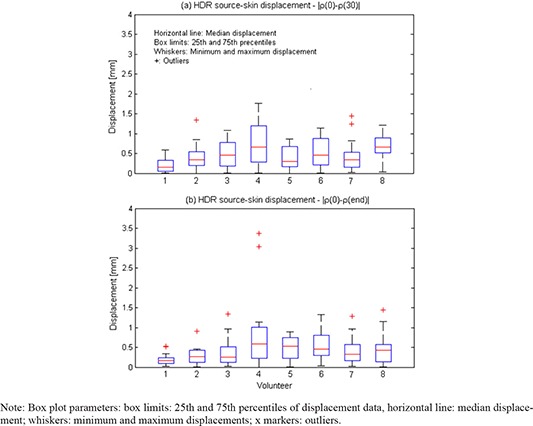
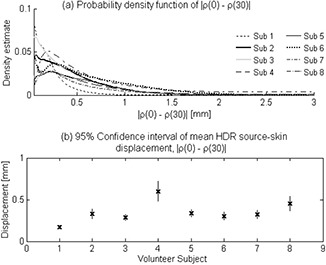
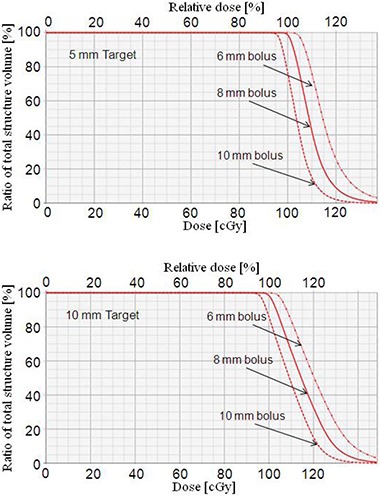
A thermobrachytherapy surface applicator (TBSA) was developed for simultaneous heat and brachytherapy treatment of chest wall (CW) recurrence of breast cancer. The ability to comfortably secure the applicator over the upper torso relative to the CW target throughout treatment is assessed on volunteers. Male and postmastectomy female volunteers were enrolled to evaluate applicator secure fit to CW. Female subjects with intact breast were also enrolled to assess the ability to treat challenging cases. Magnetic resonance (MR) images of volunteers wearing a TBSA over the upper torso were acquired once every 15 minutes for 90 minutes. Applicator displacement over this time period required for treatment preplanning and delivery was assessed using MR visible markers. Applicator comfort and tolerability were assessed using a questionnaire. Probability estimates of applicator displacements were used to investigate dosimetric impact for the worst-case variation in radiation source-to-skin distance for 5 and 10 mm deep targets spread 17 × 13 cm on a torso phantom. Average and median displacements along lateral and radial directions were less than 1.2 mm over 90 minutes for all volunteers. Maximum lateral and radial displacements were measured to be less than 1 and 1.5 mm, respectively, for all CW volunteers and less than 2 mm for intact breast volunteers, excluding outliers. No complaint of pain or discomfort was reported. Phantom treatment planning for the maximum displacement of 2 mm indicated < 10% increase in skin dose with < 5% loss of homogeneity index (HI) for -2 mm uniform HDR source displacement. For +2 mm uniform displacement, skin dose decreased and HI increased by 20%. The volunteer study demonstrated that such large and uniform displacements should be rare for CW subjects, and the measured variation is expected to be low for multifraction conformal brachytherapy treatment.
一种热近距放疗表面敷贴器(TBSA)被开发出来,用于同时进行胸部(CW)乳腺癌复发的热疗和近距离放疗。评估志愿者在治疗过程中相对于 CW 靶区舒适地固定敷贴器的能力。招募男性和乳房切除术后的女性志愿者来评估敷贴器对 CW 的固定贴合。还招募了具有完整乳房的女性受试者来评估治疗挑战性病例的能力。志愿者佩戴 TBSA 覆盖上半身的磁共振(MR)图像每 15 分钟采集一次,共采集 90 分钟。使用 MR 可见标记评估在此期间治疗前规划和输送所需的敷贴器位移。使用问卷评估敷贴器的舒适性和耐受性。应用器位移的概率估计用于研究最差情况下辐射源到皮肤距离变化对 5 和 10 毫米深目标的影响,这些目标在躯干体模上的分布为 17×13 厘米。所有志愿者在 90 分钟内,侧向和径向的平均和中位数位移均小于 1.2 毫米。最大侧向和径向位移分别测量为所有 CW 志愿者小于 1 毫米和 1.5 毫米,不包括异常值,而完整乳房志愿者小于 2 毫米。没有报告疼痛或不适的投诉。最大位移为 2 毫米的体模治疗计划表明,皮肤剂量增加小于 10%,均匀 HDR 源位移为-2 毫米时均匀指数(HI)损失小于 5%。对于+2 毫米的均匀位移,皮肤剂量减少,HI 增加 20%。志愿者研究表明,这种大而均匀的位移对于 CW 患者应该很少见,并且预计对于多分次适形近距离放疗,测量的变化应该很低。