Hematology Oncology Research Area, Amgen Inc., Seattle, WA, USA.
Br J Cancer. 2012 Oct 23;107(9):1498-505. doi: 10.1038/bjc.2012.392. Epub 2012 Sep 6.
Macrophage migration inhibitory factor (MIF) has been proposed as a link between inflammation and tumorigenesis. Despite its potentially broad influence in tumour biology and prevalent expression, the value of MIF as a therapeutic target in cancer remains unclear. We sought to validate MIF in tumour models by achieving a complete inhibition of its expression in tumour cells and in the tumour stroma.
We used MIF shRNA-transduced B16-F10 melanoma cells implanted in wild-type and MIF-/- C57Bl6 mice to investigate the effect of loss of MIF on tumour growth. Cytokine detection and immunohistochemistry (IHC) were used to evaluate tumours ex vivo.
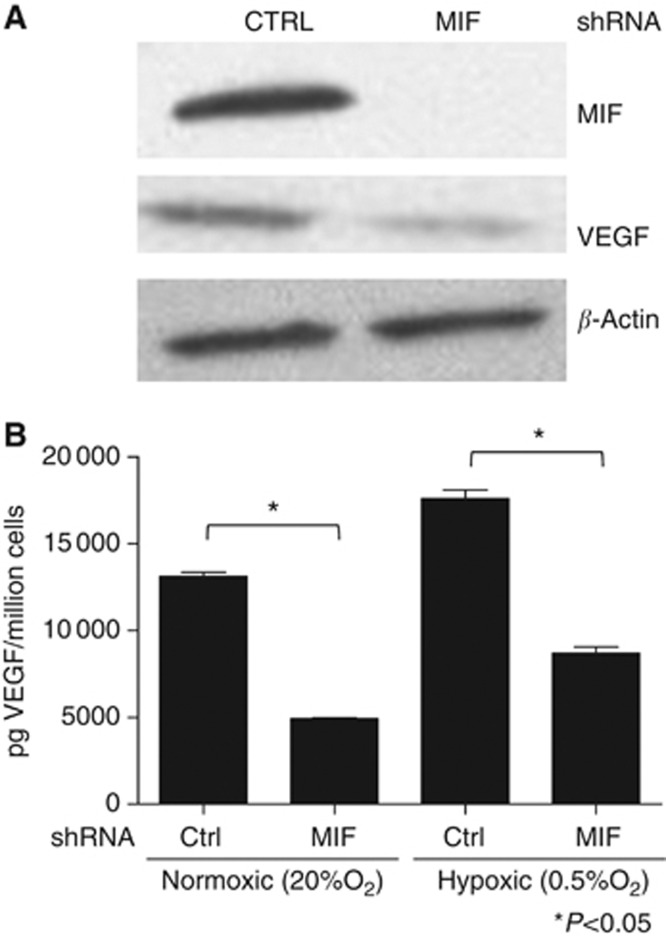
Macrophage migration inhibitory factor shRNA inhibited expression of MIF protein by B16-F10 melanoma cells in vitro and in vivo. In vitro, the loss of MIF in this cell line resulted in a decreased response to hypoxia as indicated by reduced expression of VEGF. In vivo the growth of B16-F10 tumours was inhibited by an average of 47% in the MIF-/- mice compared with wild-type but was unaffected by loss of MIF expression by the tumour cells. Immunohistochemistry analysis revealed that microvessel density was decreased in tumours implanted in the MIF-/- mice. Profiling of serum cytokines showed a decrease in pro-angiogenic cytokines in MIF-/- mice.
We report that the absence of MIF in the host resulted in slower tumour growth, which was associated with reduced vascularity. While the major contribution of MIF appeared to be in the regulation of angiogenesis, tumour cell-derived MIF played a negligible role in this process.
巨噬细胞移动抑制因子(MIF)被认为是炎症和肿瘤发生之间的联系。尽管它在肿瘤生物学中具有潜在的广泛影响和普遍表达,但 MIF 作为癌症治疗靶点的价值仍不清楚。我们试图通过在肿瘤细胞和肿瘤基质中实现 MIF 的完全抑制来验证 MIF 在肿瘤模型中的作用。
我们使用 MIF shRNA 转导的 B16-F10 黑色素瘤细胞植入野生型和 MIF-/- C57Bl6 小鼠中,研究 MIF 缺失对肿瘤生长的影响。细胞因子检测和免疫组织化学(IHC)用于评估体外肿瘤。
MIF shRNA 抑制了 B16-F10 黑色素瘤细胞在体外和体内的 MIF 蛋白表达。在体外,该细胞系中 MIF 的缺失导致对缺氧的反应降低,表现为 VEGF 表达减少。在体内,与野生型相比,MIF-/- 小鼠中 B16-F10 肿瘤的生长平均受到 47%的抑制,但肿瘤细胞中 MIF 表达的缺失不受影响。免疫组织化学分析显示,植入 MIF-/- 小鼠的肿瘤中微血管密度降低。血清细胞因子分析显示 MIF-/- 小鼠中促血管生成细胞因子减少。
我们报告说,宿主中缺乏 MIF 导致肿瘤生长缓慢,这与血管生成减少有关。虽然 MIF 的主要作用似乎是调节血管生成,但肿瘤细胞来源的 MIF 在这个过程中作用微不足道。