Svensson Asa, Waling Maria, Bäcklund Catharina, Larsson Christel
Department of Food and Nutrition, Umeå University, 901 87 Umeå, Sweden.
J Nutr Metab. 2012;2012:247389. doi: 10.1155/2012/247389. Epub 2012 Aug 16.
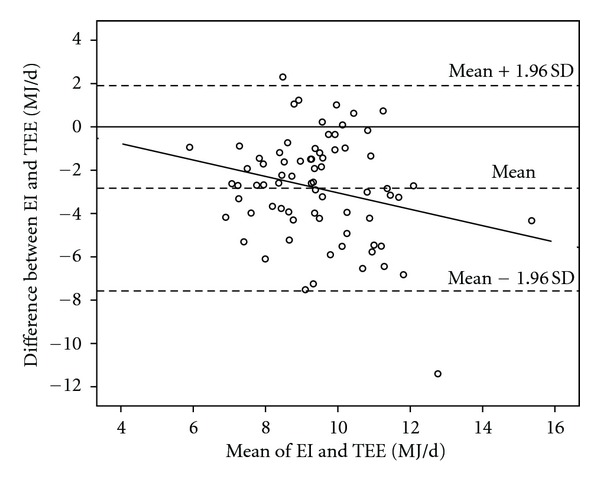
The objective was to evaluate overweight and obese children's ability to report reproducible and valid estimates of energy intake (EI) by using digital camera food records (FR) during a 2-year study, compared with objectively measured total energy expenditure (TEE). Seventy-three overweight/obese children, aged 8-12 years at inclusion, kept FR with the help of digital cameras for 16 days in total, on 7 occasions during a 2-year period. On the same days, their TEE was registered with SenseWear Armband (SWA). The children underestimated their EI by -2.8 (2.4) MJ/d on the first assessment occasion (95% CI: -3.3, -2.3). Reporting accuracy did not differ between the 7 assessment occasions (P = 0.15). Variables negatively associated with reporting accuracy relative to TEE were increased age (95% CI: -0.07, -0.01) and BMI z-score (95% CI: -0.18, -0.06). Further, reporting accuracy relative to TEE was lower for girls than boys (95% CI: -0.14, -0.01) and on weekdays compared with weekend days (95% CI: -0.08, -0.001). In conclusion, overweight and obese children were able to report their EI using a digital camera FR with good reproducibility over a 2-year period, even though their EI was underestimated compared with objectively measured TEE.
目的是在一项为期2年的研究中,评估超重和肥胖儿童通过使用数码相机食物记录(FR)报告能量摄入(EI)的可重复性和有效估计值的能力,并与客观测量的总能量消耗(TEE)进行比较。73名超重/肥胖儿童,纳入研究时年龄为8至12岁,在2年期间共7次借助数码相机进行了16天的食物记录。在同一天,使用体动监测臂带(SWA)记录他们的总能量消耗。在第一次评估时,儿童低估其能量摄入2.8(2.4)兆焦/天(95%可信区间:-3.3,-2.3)。7次评估之间报告准确性无差异(P = 0.15)。与相对于总能量消耗的报告准确性呈负相关的变量为年龄增加(95%可信区间:-0.07,-0.01)和BMI z评分(95%可信区间:-0.18,-0.06)。此外,相对于总能量消耗,女孩的报告准确性低于男孩(95%可信区间:-0.14,-0.01),工作日的报告准确性低于周末(95%可信区间:-0.08,-0.001)。总之,超重和肥胖儿童能够在2年期间使用数码相机食物记录报告其能量摄入,且具有良好的可重复性,尽管与客观测量的总能量消耗相比,他们的能量摄入被低估了。