Bayer HealthCare, LLC, Animal Health, Shawnee, KS 66201, USA.
Parasit Vectors. 2012 Sep 7;5:192. doi: 10.1186/1756-3305-5-192.
Cat fleas, Ctenocephalides felis, are one of the most common ectoparasites infesting dogs and their environments. This study evaluated the efficacy of imidacloprid + pyriproxyfen (PPF) (Advantage® II for Dogs) and spinosad (Comfortis®) against established C. felis populations in dogs' simulated home environments.
Thirty Beagle dogs were randomly assigned to three groups of 10 dogs each and treated twice (Study Days 0 and 28) with imidacloprid + PPF, spinosad tablets, or a negative control (untreated). Dogs were housed individually in controlled simulated home environments capable of supporting the flea life cycle. Flea infestations were established in these environments by infesting each dog with 100 adult cat fleas on Study Days -21, -16 and 1. The impact of the treatments on fleas in the dogs' environments were assessed by collecting floor mat samples from each simulated home environment, incubating them for 32 days, and counting the number of emerging adult fleas. On Study Days 7, 14, 21, 28, 35, 42, 49 and 56, after collection of the cocoa matting samples, each dog was infested with an additional 5 ± 1 fleas to maintain the environmental infestations. Flea comb counts on dogs were conducted on Study Days 0 (pretreatment) and 63.
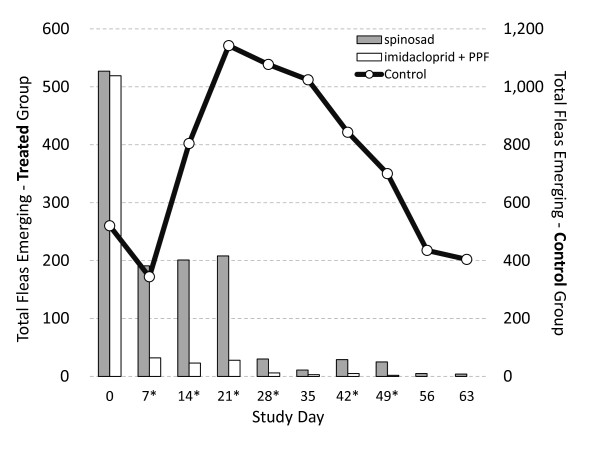
From Study Days 7-28, flea infestations in the imidacloprid + PPF environments were significantly lower (p < 0.03) than those in the spinosad environments. Following the second treatment, flea infestations in all the imidacloprid + PPF environments fell to zero for the remainder of the study. In contrast, flea infestations persisted in some of the spinosad environments through the study's end.On Study Day 63 all 10 dogs treated with imidacloprid + PPF were flea free, while only one of the 10 spinosad treated dogs was flea free. Flea counts on the other 9 spinosad treated dogs ranged from 3 to 46 fleas/dog (geometric mean = 8.6). A mean of 405 adult fleas/animal were recovered from the control dogs on Study Day 63.
Flea infestations in environments of dogs treated with imidacloprid + PPF declined more rapidly than in those containing dogs treated with spinosad. Flea infestations were completely eliminated by Study Day 56 in environments of dogs treated with imidacloprid + PPF, but persisted through the study's end in some of environments of dogs treated with spinosad.
猫跳蚤,Ctenocephalides felis,是最常见的寄生在狗及其环境中的外寄生虫之一。本研究评估了吡虫啉+吡丙醚(PPF)(Advantage® II for Dogs)和螺旋霉素(Comfortis®)对狗模拟家庭环境中已建立的 C. felis 种群的功效。
30 只比格犬随机分为三组,每组 10 只,分别于第 0 天和第 28 天接受两次吡虫啉+PPF、螺旋霉素片或阴性对照(未处理)治疗。狗被单独安置在能够支持跳蚤生命周期的受控模拟家庭环境中。通过在第-21、-16 和 1 天给每只狗感染 100 只成年猫跳蚤,在这些环境中建立跳蚤感染。通过从每个模拟家庭环境中收集地板垫样本进行评估,孵育 32 天,并计算出现的成年跳蚤数量,评估处理对狗环境中跳蚤的影响。在收集可可垫样本后的第 7、14、21、28、35、42、49 和 56 天,每只狗又被感染了额外的 5±1 只跳蚤,以维持环境中的感染。在第 0 天(预处理)和第 63 天对狗进行了跳蚤梳计数。
从第 7 天到第 28 天,吡虫啉+PPF 环境中的跳蚤感染明显低于(p<0.03)螺旋霉素环境。第二次治疗后,所有吡虫啉+PPF 环境中的跳蚤感染在研究结束前均降至零。相比之下,一些螺旋霉素环境中的跳蚤感染持续到研究结束。在第 63 天,所有接受吡虫啉+PPF 治疗的 10 只狗均无跳蚤,而接受螺旋霉素治疗的 10 只狗中只有 1 只无跳蚤。其他 9 只接受螺旋霉素治疗的狗的跳蚤计数范围为 3 至 46 只/只(几何平均值=8.6)。在第 63 天,从对照狗身上共回收了 405 只成年跳蚤。
用吡虫啉+PPF 治疗的狗的环境中的跳蚤感染比用螺旋霉素治疗的狗的环境中的跳蚤感染下降得更快。在接受吡虫啉+PPF 治疗的狗的环境中,跳蚤感染在第 56 天完全消除,但在一些接受螺旋霉素治疗的狗的环境中,感染持续到研究结束。