Department of Psychology, University of California, Los Angeles, CA, 90095, USA.
Children's National Medical Center, Washington, DC, 20010, USA.
J Neurodev Disord. 2012 Jun 7;4(1):17. doi: 10.1186/1866-1955-4-17.
Individuals with Autism Spectrum Disorders (ASD) typically show impaired eye contact during social interactions. From a young age, they look less at faces than typically developing (TD) children and tend to avoid direct gaze. However, the reason for this behavior remains controversial; ASD children might avoid eye contact because they perceive the eyes as aversive or because they do not find social engagement through mutual gaze rewarding.
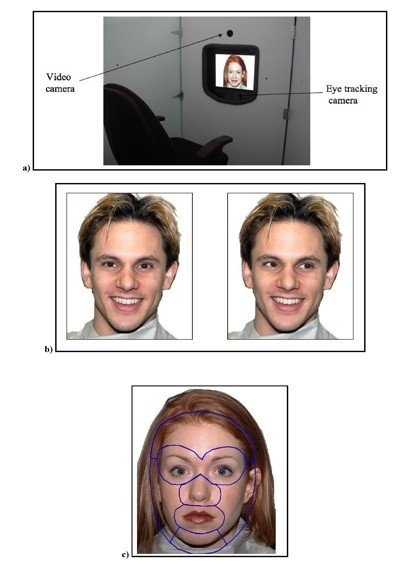
We monitored pupillary diameter as a measure of autonomic response in children with ASD (n = 20, mean age = 12.4) and TD controls (n = 18, mean age = 13.7) while they looked at faces displaying different emotions. Each face displayed happy, fearful, angry or neutral emotions with the gaze either directed to or averted from the subjects.
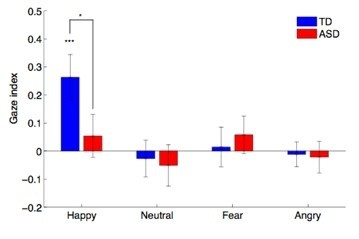
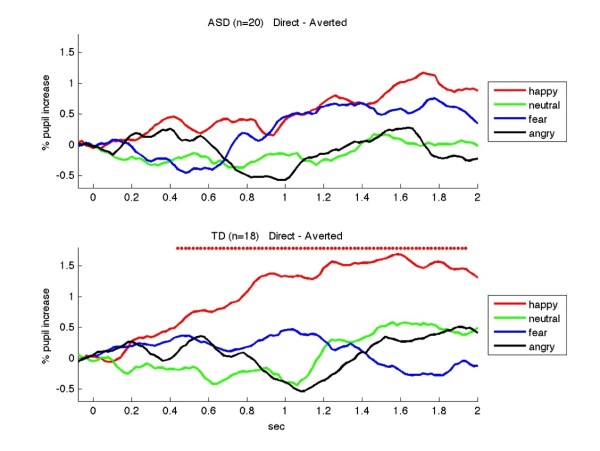
Overall, children with ASD and TD controls showed similar pupillary responses; however, they differed significantly in their sensitivity to gaze direction for happy faces. Specifically, pupillary diameter increased among TD children when viewing happy faces with direct gaze as compared to those with averted gaze, whereas children with ASD did not show such sensitivity to gaze direction. We found no group differences in fixation that could explain the differential pupillary responses. There was no effect of gaze direction on pupil diameter for negative affect or neutral faces among either the TD or ASD group.
We interpret the increased pupillary diameter to happy faces with direct gaze in TD children to reflect the intrinsic reward value of a smiling face looking directly at an individual. The lack of this effect in children with ASD is consistent with the hypothesis that individuals with ASD may have reduced sensitivity to the reward value of social stimuli.
自闭症谱系障碍(ASD)个体在社交互动中通常表现出目光接触障碍。从很小的时候起,他们看人脸的时间就比正常发育的儿童少,并且往往避免直视。然而,这种行为的原因仍存在争议;ASD 儿童可能避免目光接触,是因为他们觉得眼睛是令人厌恶的,或者因为他们没有通过相互注视来获得社交互动的回报。
我们监测了 ASD 儿童(n=20,平均年龄=12.4 岁)和 TD 对照组儿童(n=18,平均年龄=13.7 岁)的瞳孔直径,作为自主反应的测量指标,当他们看显示不同情绪的人脸时。每张脸都显示了快乐、恐惧、愤怒或中性的情绪,目光要么直接指向受试者,要么避开。
总体而言,ASD 儿童和 TD 对照组儿童的瞳孔反应相似;然而,他们在对快乐面孔的注视方向的敏感性上存在显著差异。具体来说,与注视方向偏离的快乐面孔相比,TD 儿童在观看注视方向的快乐面孔时瞳孔直径会增大,而 ASD 儿童则没有表现出这种对注视方向的敏感性。我们发现,注视方向对 TD 或 ASD 组的消极或中性面孔的瞳孔直径没有影响。
我们将 TD 儿童观看直接注视的快乐面孔时瞳孔直径的增加解释为直接注视的笑脸的内在奖励价值。ASD 儿童缺乏这种影响,这与 ASD 个体可能对社交刺激的奖励价值敏感性降低的假设是一致的。