Brain Behav. 2011 Sep;1(1):1-11. doi: 10.1002/brb3.6.
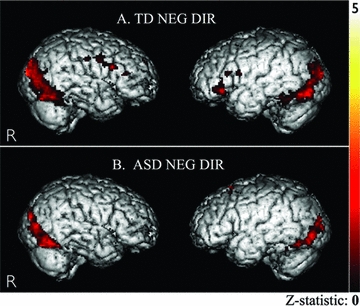
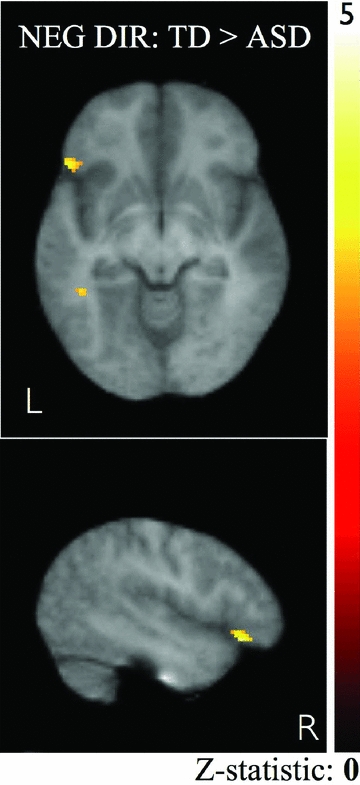
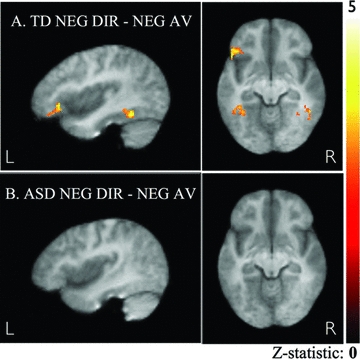
Abnormal eye contact is a core symptom of autism spectrum disorders (ASD), though little is understood of the neural bases of gaze processing in ASD. Competing hypotheses suggest that individuals with ASD avoid eye contact due to the anxiety-provoking nature of direct eye gaze or that eye-gaze cues hold less interest or significance to children with ASD. The current study examined the effects of gaze direction on neural processing of emotional faces in typically developing (TD) children and those with ASD. While undergoing functional magnetic resonance imaging (fMRI), 16 high-functioning children and adolescents with ASD and 16 TD controls viewed a series of faces depicting emotional expressions with either direct or averted gaze. Children in both groups showed significant activity in visual-processing regions for both direct and averted gaze trials. However, there was a significant group by gaze interaction such that only TD children showed reliably greater activity in ventrolateral prefrontal cortex for direct versus averted gaze. The ASD group showed no difference between direct and averted gaze in response to faces conveying negative emotions. These results highlight the key role of eye gaze in signaling communicative intent and suggest altered processing of the emotional significance of direct gaze in children with ASD.
异常的眼神接触是自闭症谱系障碍(ASD)的核心症状,尽管对于 ASD 中的注视处理的神经基础知之甚少。竞争假说表明,ASD 个体避免眼神接触是因为直接眼神注视具有令人焦虑的性质,或者对于 ASD 儿童来说,眼神注视线索的兴趣或重要性较低。本研究考察了注视方向对发育正常(TD)儿童和 ASD 儿童情绪面孔神经加工的影响。在进行功能磁共振成像(fMRI)时,16 名高功能 ASD 儿童和青少年以及 16 名 TD 对照组观看了一系列带有直接或回避注视的表情面孔。两组儿童在直接和回避注视试验中均在视觉处理区域表现出显著的活动。然而,存在注视的显著组间交互作用,即只有 TD 儿童在对传达负面情绪的面孔时,在腹外侧前额叶皮层中表现出直接注视与回避注视之间可靠的更大活动。在 ASD 组中,对传达负面情绪的面孔,直接注视和回避注视之间没有差异。这些结果突出了眼神注视在传达交流意图方面的关键作用,并表明 ASD 儿童对直接注视的情绪意义的处理发生改变。